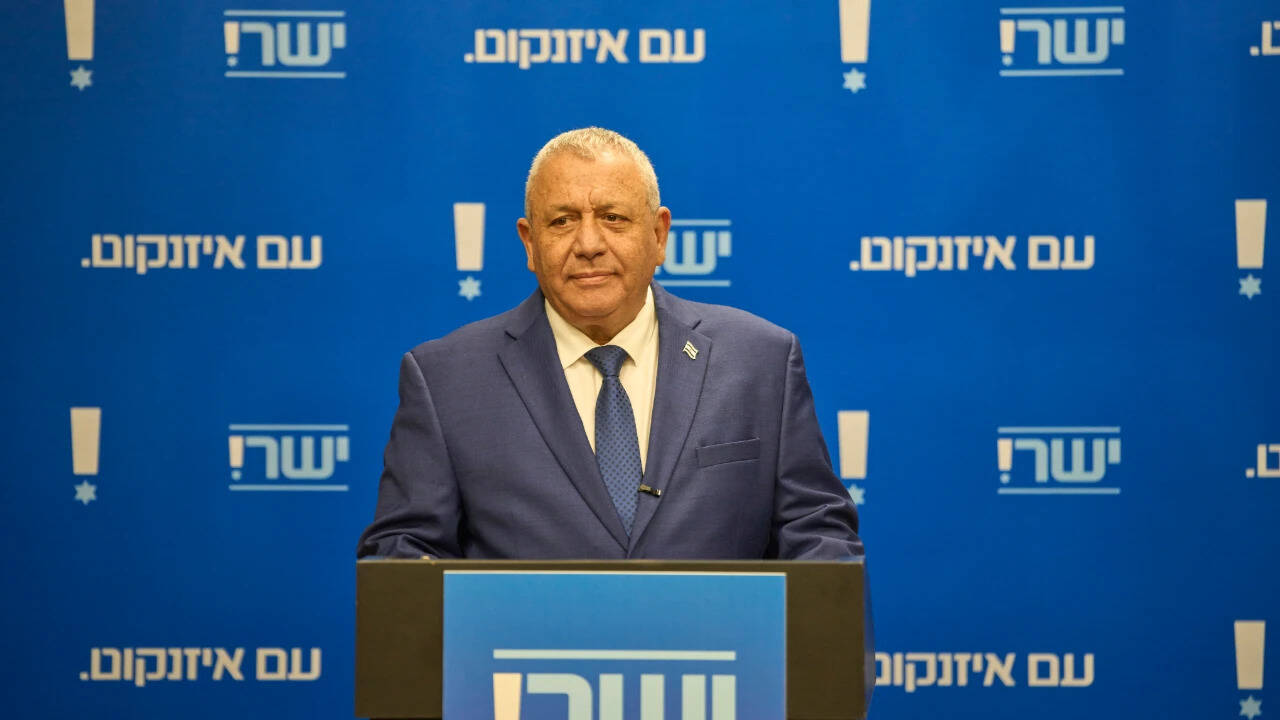
Prime Minister Benjamin Netanyahu has offered to step down - as long as he can remain as a 'rotating' alternative leader under a proposed deal for a national unity government.
asserted
he → offer → government
The 77-year-old politician said his main rival Gadi Eisenkot would become Prime Minister first, while Netanyahu would remain in the wings for the top job, rather than step back from power entirely.
asserted
Netanyahu → say → power
Eisenkot was tapped by Israel’s president Isaac Herzog to try to form a government after an inconclusive election on October 27th left neither him nor Netanyahu with a clear path to power.
asserted
election → tap → power
In a statement on Saturday night, Netanyahu said as head of the largest party he believed he should have been the 'natural' choice for a new government.
asserted
he → say → government
However he was prepared to set this aside 'given the magnitude of the existential threat and the possibility that a government incapable of confronting this threat will be formed.'
asserted
government → set → threat
He added that 'supporters of terrorism' were planning to 'bring the terrorists back to the gates of our communities' through a swathe of proposed policies including the withdrawal of Israeli forces from Gaza, Syria and Lebanon.
asserted
supporters → add → Gaza
Israel's longest-serving leader continued: 'Given the gravity of the existential danger and the possibility that a government will be formed that lacks the ability to confront it, my responsibility as a leader requires me to set everything aside, including the principle of the largest party, and agree that Gadi Eisenkot will serve first as prime minister, while I will serve as alternate prime minister at the beginning of the term.
'
asserted
I → serve → term
I expect that, in light of this agreement on my part, we will immediately begin genuine, sincere, and accelerated negotiations in which the other side will also be willing to make similar compromises and concessions, to establish a national unity government that will repel these dangers and ensure Israel's security and future.'
asserted
that → expect → security
Prime Minister Benjamin Netanyahu has offered to step down - as long as he can remain as a 'rotating' alternative leader under a proposed deal for a national unity government
Netanyahu has offered to allow his rival Gadi Eisenkot to become prime minister, before taking over the reins under a power sharing agreement
Israel has previously formed three rotating prime minister agreements, though only two saw the scheduled handover of power.
asserted
two → offer → power
Shimon Peres of the Alignment party shared the top role with Yitzhak Shamir of Likud, with the former serving as prime minister between 1984 to 1986 before switching.
asserted
former → share → 1986
Likud's Naftali Bennett served as prime minister from June 2021 for a year until handing over the reins to Yesh Atid's Yair Lapid until elections later in 2022.
asserted
Bennett → serve → 2022
The deal that collapsed involved Netanyahu with Blue and White's Benny Gantz, in 2020, when their coalition came apart over a budget dispute.
asserted
coalition → collapse → dispute
Netanyahu's offer to Eisenkot came one day after his rival vowed to announce the formation of Israel's next government by the official deadline of December 6, without using the option of a 14-day extension.
asserted
rival → come → extension
He is expected to form a coalition with anti-Netanyahu parties, but his centrist Yashar party has also been conducting negotiations with Netanyahu's right-wing Likud.
asserted
party → expect → Likud
On Friday, however, Eisenkot accused Likud of stalling coalition talks in a bid to bring about new elections.
asserted
Eisenkot → accuse → elections
'Likud... has been unwilling to compromise and, over two weeks, refused to put a single concrete proposal on the table,' Eisenkot said in a statement.
asserted
Eisenkot → compromise → statement
His wide-ranging camp has faced divisions over whether to forge alliances with the ultra-Orthodox parties, the Arab-majority lists, or form a unity government with Likud.
asserted
camp → range → Likud
Netanyahu opponents scoffed at his offer of a rotating premiership.
asserted
opponents → scoff → premiership
Youssef Jabareen, leader of the Arab-majority Joint List, which is expected to support an Eisenkot-led government without joining it, wrote: 'The democratic majority has decided: this bloodstained, neglectful government must go.
'
asserted
government → expect → it
It is time to fulfill the shared will of the entire public, Jews and Arabs alike, and remove Netanyahu this (upcoming) week.'
asserted
It → fulfill → Netanyahu
Former premier Yair Lapid, co-chair of the centrist Beyachad party, said: 'Netanyahu's proposal is yet another transparent con by a serial fraudster who has deceived every partner and violated every agreement.'
Eisenkot's Yashar party has so far agreed coalition deals with the left-leaning Democrats and the right-wing Israel Beiteinu party.
Together, they have a combined total of 36 lawmakers - far short of the 61 needed for a majority in Israel's 120-seat parliament.
asserted
they → say → parliament
Elsewhere, Israeli media reported Mansour Abbas, leader of the second Arab-Israeli party, Raam, is expected to recognise Hamas as a 'terror group' - a move that could pave the way for his party to join a possible Eisenkot-led coalition.
uncertain
party → report → coalition
Some of Eisenkot's allies have however voiced opposition to relying on the support of the Arab-majority lists, which made unprecedented gains in the election.
asserted
which → voice → election

 The Aporia