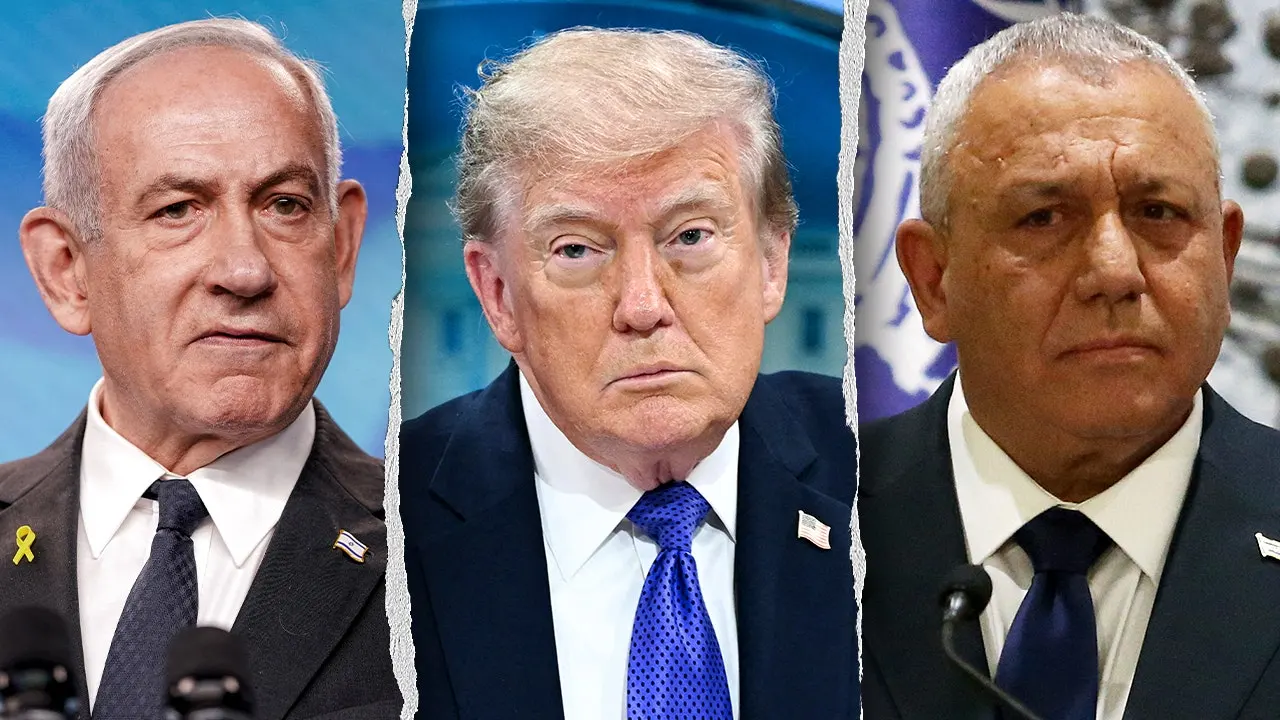
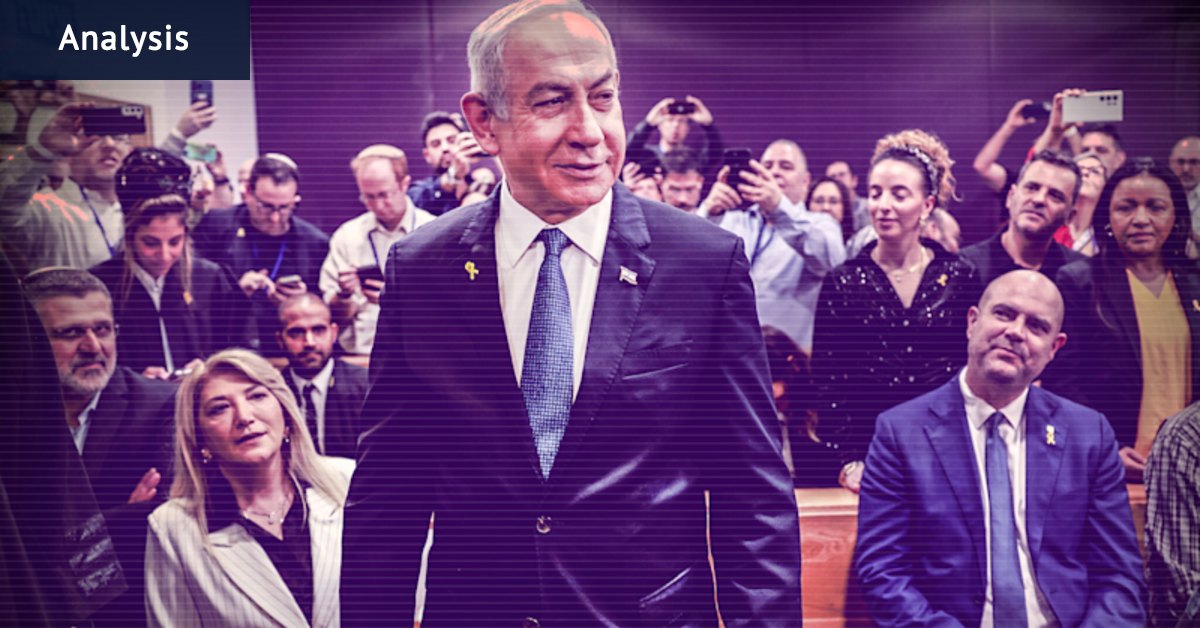
Photo via Al Jazeera

Eisenkot navigates tricky waters as he tests power-sharing with Netanyahu

Read the original at Al Jazeera ↗
Cite

Odeh, N. (2026, November 27). Eisenkot navigates tricky waters as he tests power-sharing with Netanyahu. Al Jazeera. https://www.aljazeera.com/news/2026/11/27/eisenkot-navigates-tricky-waters-as-he-tests-power-sharing-with-netanyahu?traffic_source=rss

Dated from the outlet's own feed. Check the original for its byline.

Al Jazeera · collected 2026-11-27 · by Nour Odeh

Quick Summary

Gadi Eisenkot, leader of the anti-Netanyahu "change bloc," faces challenges in forming a government after the 2026 Israeli elections. With 19 seats from Palestinian-led parties, the bloc lacks a majority but seeks to replace Netanyahu's government. However, internal divisions within the change bloc and external pressure from Netanyahu complicate coalition-building efforts. Netanyahu's Likud party and former Prime Minister Naftali Bennett are pushing for a unity government, which Eisenkot opposes, citing security concerns and accusations that Netanyahu endangers Israel's stability.
Written by AI on 2026-11-27, from this article's own text only (the story summary below draws on all the coverage).
See how they differ ↓

AI analysis

Story summary

Gadi Eisenkot, tasked with forming a new Israeli government after an inconclusive October election, has invited Benjamin Netanyahu's Likud party for coalition talks. These talks began on November 22, 2026, and have continued with discussions over policy positions and a potential power-sharing agreement. Netanyahu announced on November 28 that he is willing to let Eisenkot serve first as prime minister in a unity government, with Netanyahu rotating into the position later. Eisenkot has offered immediate talks with Netanyahu to test his seriousness about the proposal. The discussions aim to resolve Israel's political deadlock and form a stable government, with key issues including policy on the Palestinian state, control of territories, and conscription of ultra-Orthodox Jews.

Written for “Netanyahu Offers Power Sharing Deal” on 2026-11-28, grounded in this article and the 18 other(s) covering the same event.

How they differ

7 outlets covered “Netanyahu Offers Power Sharing Deal”.

What each outlet says

One AI summary per outlet of its latest article on this story, written from that article alone and checked against it. Open the article for the outlet's own words.

Al JazeeraThis outlet27 Nov

Gadi Eisenkot, leader of the anti-Netanyahu "change bloc," faces challenges in forming a government after the 2026 Israeli elections. With 19 seats from Palestinian-led parties, the bloc lacks a majority but seeks to replace Netanyahu's government. However, internal divisions within the change bloc and external pressure from Netanyahu complicate coalition-building efforts. Netanyahu's Likud party and former Prime…

Eisenkot navigates tricky waters as he tests power-sharing with Netanyahu (this article)5 articles from Al Jazeera on this story
The Straits Times28 Nov

On November 28, Israeli caretaker Prime Minister Benjamin Netanyahu proposed a rotating premiership with his rival Gadi Eisenkot, offering to serve as alternate prime minister initially. Eisenkot, expected to form a new government by December 6, is negotiating with various parties to achieve a 61-seat majority in the 120-seat parliament. Netanyahu's offer has been met with skepticism from opponents like Youssef…

Netanyahu offers to rotate Israeli premiership with rival Gadi Eisenkot →4 articles from The Straits Times on this story
The Hindu28 Nov

Israeli Prime Minister Benjamin Netanyahu offered on November 28, 2026, to step down from his position in favor of his rival Gadi Eisenkot to form a unity government, aiming to prevent a coalition that could oust him. This move comes as Eisenkot, tapped by the president to form a government after an inconclusive election, has secured support from potential coalition partners, putting Netanyahu under significant…

At risk of losing power, Netanyahu makes long-shot unity appeal to rival Eisenkot →4 articles from The Hindu on this story
Euronews28 Nov

Prime Minister Benjamin Netanyahu has proposed a power-sharing agreement where Yashar party leader Gadi Eisenkot would serve as prime minister initially, with Netanyahu taking on the roles of acting prime minister and deputy prime minister. This arrangement aims to resolve the political deadlock following Israel’s inconclusive October election. Netanyahu stated that he is willing to make this compromise to address…

Netanyahu willing to let Eisenkot serve first as PM in unity government →2 articles from Euronews on this story
Dawn28 Nov

Prime Minister Benjamin Netanyahu offered to step down temporarily in favor of Gadi Eisenkot to join a unity government, responding to Eisenkot’s growing support from other political parties following a recent inconclusive election. Netanyahu’s statement came as Eisenkot, who was tasked with forming a new government, secured deals that could give him a majority. Netanyahu emphasized his readiness to lead but…

At risk of losing power, Netanyahu makes long-shot unity appeal to rival Eisenkot →2 articles from Dawn on this story
ABC News (AU)21 Nov

Former Israeli military chief Gadi Eisenkot, who leads the centrist Yashar party tasked with forming the next government, has invited the right-wing Likud party of caretaker Prime Minister Benjamin Netanyahu for coalition talks. The talks aim to explore options for forming a broad government, reflecting Eisenkot's commitment to pursue every avenue. With a deadline next month to form a government after the October…

Eisenkot invites Netanyahu's party to Israeli coalition talks →
Show 1 more outlets
Daily Mail28 Nov

Benjamin Netanyahu, Israel's longest-serving prime minister, has offered to step down conditionally, proposing a rotating leadership agreement where he would serve as an alternate prime minister after Gadi Eisenkot, his main rival, serves initially. Netanyahu's proposal comes in response to an inconclusive October 27 election, where neither he nor Eisenkot secured a clear path to power. The offer is part of…

Netanyahu offers to step down as Israel's prime minister in a bid for a power sharing deal →

Where they agree and split

Agreed

Reported by outlets on both sides of the middle

His ally, former Prime Minister Naftali Bennett, also reiterated on Saturday (November 21, 2026) his refusal to join a coalition with “Netanyahu or his bloc, under any circumstances”.

4 outlets
Show 3 more

On Nov 20, Eisenkot warned that he would not allow the talks to drag on, saying he was ready to submit to parliament an “emergency national government”.

4 outlets

HERZLIYA, Israel - The parties of caretaker Israeli prime minister Benjamin Netanyahu and his rival Gadi Eisenkot concluded a new round of talks on Nov 22 without reaching an agreement on a possible coalition government, which would require concessions from both sides.

4 outlets

Delegations from Eisenkot’s Yashar party and Netanyahu’s Likud met for four hours at a hotel in Herzliya, near Tel Aviv, following a first round of discussions on Nov 15.

4 outlets

Framing

How the first headlines put it

Stated as fact4
The headlines (4)

Eisenkot invites Netanyahu's party to Israeli coalition talks ABC News (Australia) · stated as fact

Gadi Eisenkot invites Netanyahu’s party for Israeli coalition talks The Straits Times · stated as fact

Eisenkot invites Netanyahu’s party for Israeli coalition talks The Hindu · stated as fact

Gadi Eisenkot invites Netanyahu's Likud party for 'marathon' coalition talks Euronews · stated as fact

The full story: what happened, how it changed, and all 19 articles →

Compared with similar articles

This article reads unscored and hedges 9% of its claims. Each row says how that neighbour differs.
Fox News
Hedges 8 of 47 claims Outlet record 68/100
“The articles discuss different aspects of the political situation and do not describe the same specific incident or occurrence.”
Al Jazeera
Leans right Hedges 2 of 46 claims Outlet record 60/100
“The articles discuss similar situations but describe different phases or aspects of the ongoing political negotiations, not the same specific event or moment in time.”
Al Jazeera
Leans right Hedges 1 of 16 claims Outlet record 60/100
“Article A describes Eisenkot securing a coalition partner, while Article B discusses the broader context and goals of the anti-Netanyahu bloc without specifying a single event.”
The Sydney Morning Herald
Leans left Hedges 7 of 37 claims Outlet record 61/100
“The articles describe different aspects of the political situation following the 2026 Israeli elections, rather than the same specific event.”
The Straits Times
Leans left Hedges 1 of 16 claims Outlet record 64/100
The Hindu
Leans right Hedges 3 of 16 claims Outlet record 72/100
“The articles refer to different rounds of talks on different dates, with Article A covering the talks on November 22, 2026, and Article B providing a broader context but not specifying a single event on a specific date.”
CBS News
Hedges 1 of 2 claims Outlet record 68/100
“The articles discuss different aspects of Israeli politics and do not describe the same specific event or incident.”
Daily Mail
Leans right Hedges 1 of 23 claims Outlet record 68/100
“Article A discusses the context and implications of the 2026 Israeli elections, while Article B reports on Netanyahu's offer to step down as part of a power-sharing deal, which is a subsequent event following the elections.”
The Hindu
Leans right Hedges 1 of 15 claims Outlet record 72/100
“The articles cover different aspects of the political situation and agreements in Israel, but do not clearly describe the same specific event or incident at the same time and place.”
The Hindu
Leans right Hedges 0 of 16 claims Outlet record 72/100
“Article A discusses the context and implications of the 2026 Israeli elections for Eisenkot and Netanyahu, while Article B reports on a specific coalition deal reached by Eisenkot with left-wing parties on November 26, 2026.”

Story

Netanyahu Offers Power Sharing Deal
Politics · 19 article(s) covering the same event. Compare every outlet's account →
How this article was measured signals, leaning charts, publisher record, byline, topics and claims

Signals How these are calculated →

Claims extracted
33
sentences that state something as happening or true
Uncertain
9%
3 of 33 hedged ("reportedly", "may", "according to")
Leaning
withheld
no quote in the article backed the model's score
Publisher signals
60/100
Al Jazeera's corrections and hedging, across everything collected from it. Not a measure of accuracy.
Outlets on this story
19
Politics
Same framing elsewhere
1
articles that frame the event the way this one does
Analyzed 2026-11-27 · how these are computed

How this is being covered How these are calculated →

Article leaning vs. publisher reliability
Source leaning vs. consistency

Publisher

Al Jazeera · 6858 article(s) · 5 correction(s) detected
Running correction rate · 5 correction(s)

Who wrote this

Nour Odeh
6 article(s) here · 1 carrying a prediction
But his bloc does not have enough seats in the Knesset to win a vote of confidence on its own.
As soon as last month’s Israeli election results were clear, the political camp opposed to Prime Minister Benjamin Netanyahu announced it would work together to elect a new Knesset speaker right away.
A government decision this year allowing settlers to buy Palestinian property inside Palestinian-controlled areas laid the groundwork for Israeli settlement outposts to pop up in the middle of cities, which in turn would bring the Israeli army and movement restrictions to the streets of cities like Jericho.
“I tried to go back after I got my family out safely, but I couldn’t.
Recommended Stories list of 3 items- list 1 of 3The kingmakers who could determine Israel’s election - list 2 of 3Hegseth meets Netanyahu on unannounced Israel visit - list 3 of 3Trump backs Netanyahu: Is the US planning a new Iran attack with Israel?
Also by Nour Odeh
Nothing else under this byline is closely related to this article, so these are simply their most recent.
All 6 articles by Nour Odeh →

Topics

Arab Israel Knesset Likud Palestinian

Subjects

Netanyahu PERSON · 14× Eisenkot PERSON · 9× Israel GPE · 9× Likud ORG · 3× Arab NORP · 2× Bennett PERSON · 2× Gadi Eisenkot PERSON · 2× Knesset ORG · 2× Palestinian NORP · 2× Yashar PERSON · 2×

Narrative

This is what leading sociologist and researcher Honaida Ghanem calls Israel’s structural problem: its inability to reconcile that part of Israel’s political and leadership crisis is that in today’s Israel, anti-Arab sentiment is one of the few policies most Jewish Israelis can agree on, while they no longer agree on the nature of the state, the influence of religion over the state, or many other fundamental issues of identity and governance.
framing: assertive · carried by 1 article(s) · first seen 2026-11-27
But his bloc does not have enough seats in the Knesset to win a vote of confidence on its own.

Claims (33 extracted, 3 hedged)

The 2026 Israeli elections were termed the most consequential in recent decades for the country – for multiple reasons. asserted
elections → term → reasons
For Benjamin Netanyahu, the caretaker prime minister, and his right-wing coalition, the elections were about keeping the far-right in power to protect the formative changes they enacted in state policies and institutions. asserted
they → keep → policies
For the anti-Netanyahu bloc led by Gadi Eisenkot – or the “change bloc”, as it is referred to – the promise was to replace the failed October 7 government as they termed it, rehabilitate Israel’s international standing, and end internal divisions. asserted
they → lead → divisions
Once the results were announced, things changed. asserted
things → announce → ?
Gadi Eisenkot was tasked with forming Israel’s next government. asserted
Eisenkot → task → government
But his bloc does not have enough seats in the Knesset to win a vote of confidence on its own. asserted
bloc → have → own
The United Arab List and the Joint List, parties led by Palestinian citizens of Israel, have 19 seats and are willing to back Eisenkot in his efforts to replace Netanyahu as Israel’s premier. asserted
List → lead → premier
But some in the change bloc, such as Avigdor Lieberman, promised not to support any government coalition that includes an Arab-led party or one that depended on votes from Palestinian citizens of Israel. asserted
that → promise → Israel
This, despite the fact that Lieberman himself became chair of the Knesset’s Foreign Affairs and Defense Committee thanks to those same votes. asserted
Lieberman → become → votes
That contradiction was pointed out by Mohamed Majadli, the chief editor of AlNas Radio in Israel and an analyst on the country’s Channel 12. asserted
contradiction → point → Channel
In such a limited space for political manoeuvres, Eisenkot embarked on forming a coalition, holding talks with his partners, while also trying to open channels of communication with ultra-Orthodox parties, particularly the United Torah Judaism party. asserted
Eisenkot → embark → parties
At the same time, former Prime Minister Naftali Bennett led efforts to form a unity government with Netanyahu’s Likud party and succeeded in convincing Eisenkot’s Yashar party to open formal talks with Likud. asserted
Bennett → lead → Likud
The prospect of reneging on the change bloc’s central promise to oust Netanyahu looms large over these talks. asserted
prospect → renege → talks
Bennett and others are advocating for that outcome in light of the lack of a clear Zionist majority against Israel’s longest-serving prime minister. asserted
Bennett → advocate → minister
Meanwhile, leader of the Democrats group, Yair Golan, has publicly opposed any unity formula with Netanyahu and has called out Bennett for his efforts to reach it. asserted
leader → oppose → it
The Yashar-Likud talks are complex and overshadowed by, among other issues, accusations between the two sides. asserted
talks → overshadow → sides
Netanyahu accuses the change bloc of working to undermine Israel by working with Arab-led parties, which he has referred to as “the enemy”. asserted
he → accuse → enemy
Eisenkot has gone on the record saying that Netanyahu endangers the security of Israel and is willing to ignite war for his personal gain. asserted
Netanyahu → go → gain
From Likud’s perspective, a unity government would require a rotation agreement on the premiership. asserted
government → require → premiership
That means that rather than getting rid of Netanyahu, Eisenkot would have to agree to Netanyahu staying on as prime minister for two years, or agreeing to serve second in the rotation. asserted
Netanyahu → mean → rotation
This scenario gained traction after judges presiding over Netanyahu corruption trials recommended dropping the most serious charge of bribery, as well as reconsidering the charges or reaching a plea bargain in the others. asserted
judges → gain → others
This development has strengthened Netanyahu’s negotiating position and prompted him to call for an end to the political boycott against him. asserted
development → strengthen → him
Against this backdrop, Eisenkot is manoeuvring through dangerous political waters. asserted
Eisenkot → manoeuvre → waters
If he fails to form a government, voters may be forced to return to the polls again while Netanyahu remains at the helm. uncertain
Netanyahu → fail → helm
This scenario could translate into a loss of support for the change bloc and hand Netanyahu a renewed mandate, while simultaneously ending the political careers of some leaders such as Eisenkot. uncertain
scenario → translate → Eisenkot
If Eisenkot chooses unity with Netanyahu over the promises he made to his voters, he will lose credibility among supporters. asserted
he → choose → supporters
Additionally, Eisenkot could be outmanoeuvred by Netanyahu. uncertain
Eisenkot → outmanoeuvre → Netanyahu
Many point to the coalition agreement between Benjamin Netanyahu and Benny Gantz in 2020, which included a rotating premiership. asserted
which → point → premiership
The government collapsed before Benny Gantz assumed his position and his political career never recovered. asserted
career → collapse → position
In political terms, forming a unity government with Netanyahu would represent a reversal of election promises on fundamental issues such as transparency, judicial reform, and the influence of religion on the state, because unlike the change bloc, Netanyahu’s allies are already embedded in the state bureaucracy and able to entrench these policies. asserted
allies → form → policies
More strategically, it reflects the knee-jerk reaction of Israel’s body politic to Palestinian citizens of Israel. asserted
it → reflect → Israel
This is what leading sociologist and researcher Honaida Ghanem calls Israel’s structural problem: its inability to reconcile that part of Israel’s political and leadership crisis is that in today’s Israel, anti-Arab sentiment is one of the few policies most Jewish Israelis can agree on, while they no longer agree on the nature of the state, the influence of religion over the state, or many other fundamental issues of identity and governance. asserted
they → lead → identity
The prospect of a unity government with Eisenkot and Netanyahu remains possible, though not likely, primarily because of the personal and political risks such an unholy political marriage would entail for the change bloc leaders. asserted
marriage → remain → leaders
Give feedback · no sign-in needed

No sign-in needed for now. Your note is sent without a name, so it cannot be answered.

History Support