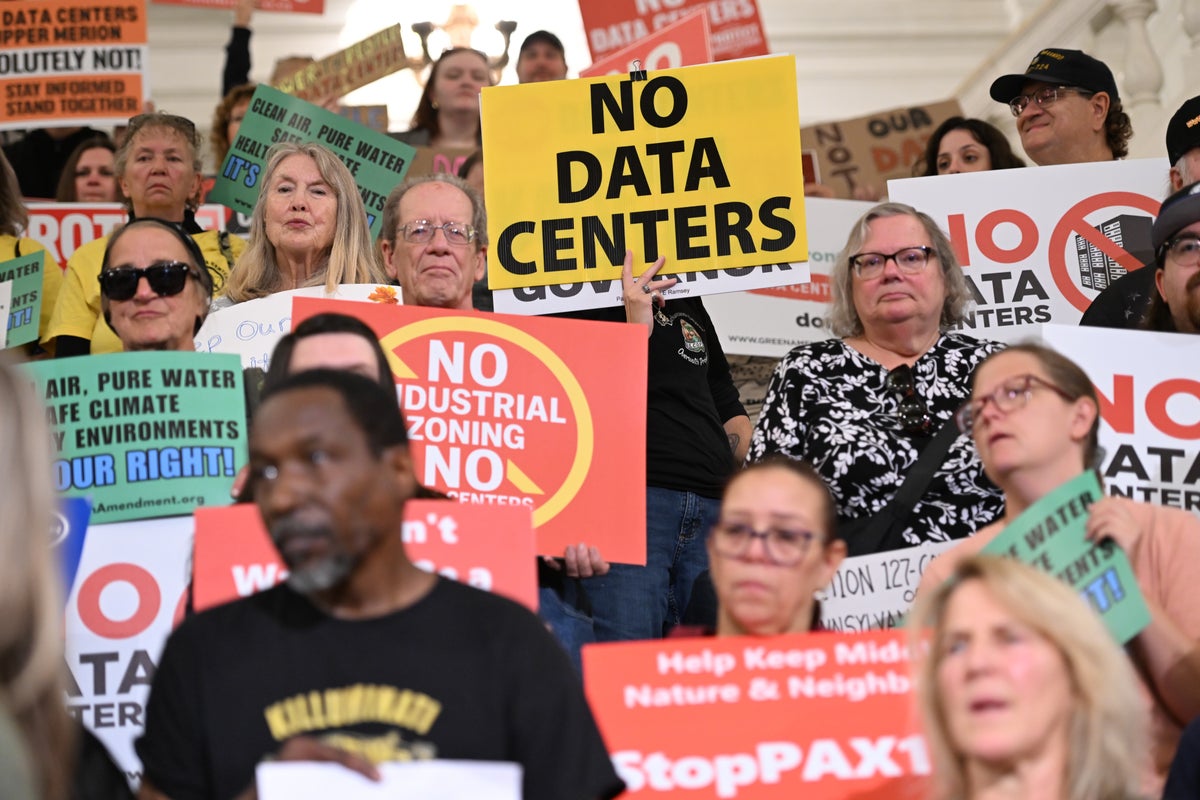
Facing pushback on data centers, tech giants are promising hosts more money and fewer secrets

Read the original at The Independent ↗
Cite

Huamani, K., & Levy, M. (2026, October 22). Facing pushback on data centers, tech giants are promising hosts more money and fewer secrets. The Independent. https://www.independent.co.uk/news/world/americas/google-amazon-meta-microsoft-donald-trump-b3071209.html

Dated from the outlet's own feed. Check the original for its byline.

The Independent · collected 2026-10-22 · by Kaitlyn Huamani, Marc Levy

Quick Summary

Tech giants like Google and Meta are responding to growing community resistance against their large data centers by offering more financial incentives and increased transparency. This pushback has become a significant political issue ahead of the midterm elections, affecting permits and potentially future regulations. Companies such as Amazon have pledged to disclose more information about energy and water use in their data centers and stopped using non-disclosure agreements that previously kept project details secret from local communities.
Written locally by qwen2.5:14b on 2026-10-22, using this article's own text rather than the other coverage of the same event (that is the story summary below).

AI analysis runs on qwen2.5:14b, locally

Story summary

Tech giants like Google and Meta are responding to growing community opposition against their data centers by offering host communities more financial incentives and promising greater transparency. This pushback is evident across the U.S., where local municipalities have started rejecting permits for new server warehouses due to environmental concerns and lack of information from tech companies. As midterm elections approach, with 36 governors' offices and control of Congress at stake, data centers have become a politically charged issue, especially under President Donald Trump’s administration. The Minnesota Center for Environmental Advocacy, which has sued Google over two prospective data center projects, notes an increase in public relations efforts but not enough substantive disclosure about the plans. Tech industry officials claim they are adjusting their strategies to address these concerns.

Written for “Tech Giants Data Center Deals” on 2026-10-22, grounded in this article and the 0 other(s) covering the same event.
Why this leaning score
The article's own words the score was based on. Each is quoted verbatim and was checked against the article text before being stored, so you can find it in the original.
Reading Leans left (beta estimate) Confidence medium
Leaning: leans left for article 98472 (medium confidence, 2 verified quotes) · logged 2026-10-22

Story

📰 Tech Giants Data Center Deals
Politics · 1 article(s) covering the same event.

Compared with similar articles

This article reads leans left and hedges 4% of its claims. Each row says how that neighbour differs.
The Independent
⚖️ Leans left 🔴 32% hedged 6 of 19 📰 publisher trust 59
“While both articles discuss tech giants offering incentives to communities hosting data centers, they appear to cover different time periods and perspectives, suggesting separate developments or updates on an ongoing issue rather than the same specific incident.”
The Straits Times
⚖️ Leans left 🔴 0% hedged 0 of 9 📰 publisher trust 68
“Article A describes Trump's statement on October 21, while Article B discusses tech giants' response to pushback over data centers on a later date.”
How this article was measured signals, leaning charts, publisher record, byline, topics and claims

Signals How these are calculated →

Claims extracted
50
sentences that state something as happening or true
Uncertain
4%
2 of 50 hedged ("reportedly", "may", "according to")
Leaning
Leans left
of the writing, not the subject · beta estimate
Publisher signals
59/100
The Independent's corrections and hedging, across everything collected from it. Not a measure of accuracy.
Outlets on this story
1
Politics
Same framing elsewhere
1
articles that frame the event the way this one does
Analyzed 2026-10-22 · how these are computed

How this is being covered How these are calculated →

Article leaning vs. publisher reliability
Source leaning vs. consistency

Publisher

The Independent · 2816 article(s) · 6 correction(s) detected
Running correction rate · 6 correction(s)

Who wrote this

Kaitlyn Huamani
10 article(s) here · 1 carrying a prediction
🔮 With host communities across the U.S. turning against their gargantuan data centers, America's technology giants are promising to take fewer taxpayer handouts, keep fewer secrets or shower more money onto the communities willing to allow the server warehouses.
🔮 TikTok will pay the state of Alabama at least $100 million and must implement a slew of safety features for teens in the state as part of a settlement agreement reached just before the case was set to go to trial.
🔮 The filing maintains that mutual pledges among dominant industry rivals ensuring their timeline "should be slower than competition would otherwise produce has an anticompetitive effect on consumers.
🔮 The lawsuit, which was filed Friday in the U.S. District Court for the Northern District of California, argues that the leading AI companies violated antitrust laws when they agreed to coordinate slowdown efforts, and that doing so would reduce the value consumers get for paid AI subscriptions.
🔮 It could bring the promise of advances in science and medicine, tech company executives say, but also risks.
Also by Kaitlyn Huamani
Nothing else under this byline is closely related to this article, so these are simply their most recent.
All 10 articles by Kaitlyn Huamani →
Marc Levy
3 article(s) here · 1 carrying a prediction
🔮 With host communities across the U.S. turning against their gargantuan data centers, America's technology giants are promising to take fewer taxpayer handouts, keep fewer secrets or shower more money onto the communities willing to allow the server warehouses.
🔮 “It’s unbelievable that Janelle Stelson would employ an illegal alien to work on a congressional campaign, let alone a pervert who exposed himself in public,” Charles Wall, deputy director for U.S. Immigration and Customs Enforcement, said in the press release.
Also by Marc Levy
Nothing else under this byline is closely related to this article, so these are simply their most recent.

Topics

America Google Independent Meta U.S.

Subjects

Google ORG · 5× Meta ORG · 5× Amazon ORG · 3× Microsoft ORG · 3× U.S. GPE · 2× America GPE · 1× Congress ORG · 1× Donald Trump PERSON · 1× Independent NORP · 1× The Associated Press ORG · 1×

Narrative

Kathryn Hoffman, executive director of the Minnesota Center for Environmental Advocacy, which has sued over two prospective Google data centers, said she sees Google doing more public relations outreach, but she doesn’t see it doing more to disclose critical details about its plans.
framing: assertive · carried by 1 article(s) · first seen 2026-10-22
🔮 With host communities across the U.S. turning against their gargantuan data centers, America's technology giants are promising to take fewer taxpayer handouts, keep fewer secrets or shower more money onto the communities willing to allow the server warehouses.

Claims (50 extracted, 2 hedged)

With host communities across the U.S. turning against their gargantuan data centers, America's technology giants are promising to take fewer taxpayer handouts, keep fewer secrets or shower more money onto the communities willing to allow the server warehouses. asserted
giants → turn → warehouses
The new raft of promises from the world's richest companies comes as anti-data center sentiment has become a potent issue in the midterm elections, with control of Congress and 36 governors' offices on the line. asserted
control → come → line
Despite backing from President Donald Trump, the data centers powering the artificial intelligence boom have become politically toxic. asserted
centers → power → boom
Community opposition that blocks municipal permits has become a bottleneck, and tech giants could face even more challenges if voters next month elect more public officials who are skeptical of data centers. uncertain
who → block → centers
The tech industry says it has gotten the message. asserted
it → say → message
In addition to ramping up financial incentives, officials with Google and Meta said in interviews with The Associated Press they are trying to address mistrust by being more transparent with communities where they would like to build. asserted
they → ramp → communities
Companies are also making pledges to reduce their impact on the environment and offering assurances that data centers will boost local property values — all while maintaining AI is a positive force for the American economy, despite its skeptics. asserted
AI → make → skeptics
Tech giants pledge more transparency asserted
giants → pledge → transparency
Devi Thomas, Google’s global head of community development and engagement, told AP that she wouldn’t call resistance to data centers a “backlash,” but that “there are often community questions to be addressed.” asserted
she → tell → centers
We have done as much as we can to make sure communities are involved early on,” Thomas said. asserted
Thomas → do → much
Earlier this month, Amazon rolled out its “Amazon Data Center Commitment," including pledges to improve the environmental rating of its backup diesel generators and disclose more about its data centers' energy and water use. asserted
Amazon → roll → use
It also said — as have Microsoft and Google — that it had stopped requiring government officials to sign non-disclosure agreements. asserted
it → say → agreements
The use of non-disclosure agreements has meant people in host communities may know little or nothing about a project until it shows up on a municipal board’s voting agenda. uncertain
it → mean → agenda
Besides that, tech companies often have hidden their involvement in a project behind a code name and developers who do the legwork with local governments, critics and other developers say. asserted
critics → hide → governments
That practice “raises people’s suspicion as to what’s truly happening,” said Anita Verma-Lallian, a developer with data center projects in Arizona. asserted
Lallian → raise → Arizona
Meta is always evaluating how well it shares information with communities, said Lindsay Elin, Meta’s vice president of public policy and external affairs. asserted
Elin → evaluate → policy
“As part of that work, we are reviewing our use of non-disclosure agreements,” she said in a statement to the AP. asserted
she → review → AP
In a report this month that sharply criticized data center giants including Amazon, Google, Meta and Microsoft, several Senate Democrats said companies have used non-disclosure agreements to freeze out the public. asserted
companies → criticize → public
The report also said the companies aggressively seek state and local tax breaks and do not cover the entire cost of the electric-grid buildout needed for energy-hungry data centers. asserted
companies → say → centers
Spending ramps up in host communities, along with skepticism The dominant players in the industry — Amazon, Google, Meta, and Microsoft — project they’ll spend more than $600 billion this year combined on capital projects, primarily data center construction in the U.S. asserted
they → ramp → U.S.
Even as the companies prepare to spend more to entice communities — payments that some critics call “bribes” — Trump urged them in a social media post Wednesday to pay people and communities a “dividend” if they “want to make their Data Centers popular.” asserted
Centers → prepare → dividend
“MAKE DEALS, and get them built!!! asserted
them → make → DEALS
GREAT FOR THE U.S.A.,” Trump wrote. asserted
Trump → write → U.S.A.
Meta and Amazon said recently they will each spend $1 billion on financial incentives to host communities in the coming years, on top of millions they already spend to support schools, charities and job training. asserted
they → say → schools
Google says its investments in local programs in data center communities will reach $1 billion by the end of 2027. asserted
investments → say → 2027
Microsoft has pointed to a couple local tax breaks that it will forego. asserted
it → point → that
And Google recently said for all of its new data center campuses, the company will pay full real property taxes on the buildings and land. asserted
company → say → buildings
The companies have known since last fall that community opposition was becoming a serious problem. asserted
opposition → know → fall
Data center demand began driving up electric bills last year across a 13-state electricity grid stretching from Illinois to New Jersey and Maryland, angering ratepayers. asserted
demand → drive → ratepayers
The outcry led to promises from the tech giants to pay the cost of the power infrastructure to feed their data centers, while Microsoft rolled out its five-point “Community-First AI Infrastructure” plan. asserted
Microsoft → lead → plan
Data centers’ critics aren’t persuaded. asserted
critics → persuade → ?
Sam Burleigh, who helped start Concerned Citizens of Montour County in rural northern Pennsylvania to fight a potential Amazon-backed data center project, said the company's commitments are “propaganda." asserted
commitments → start → project
“What I see is them realizing they have more resistance than they ever dreamt of. asserted
they → see → resistance
And so now they have to find some way, some method to break through that resistance,” Burleigh said. asserted
Burleigh → have → resistance
Kathryn Hoffman, executive director of the Minnesota Center for Environmental Advocacy, which has sued over two prospective Google data centers, said she sees Google doing more public relations outreach, but she doesn’t see it doing more to disclose critical details about its plans. asserted
it → sue → plans
Political stakes are rising asserted
stakes → rise → ?
In an Aug. 18 memo, the Senate Republicans’ national campaign arm crystallized the midterm election pressure on the tech giants. asserted
arm → crystallize → giants
It warned the tech sector that it must “fix the toxic brand of an entire segment of the economy” or risk long-term fallout in elections. asserted
it → warn → elections
That included addressing "who benefits, who pays, and why a community should want one." asserted
community → include → one
Drew Nations, a developer in North Carolina, said developers need to aggressively address quality-of-life complaints from neighbors. asserted
developers → say → neighbors
…and 10 more, not listed.

💬Give feedback
🕘History 🎫Support