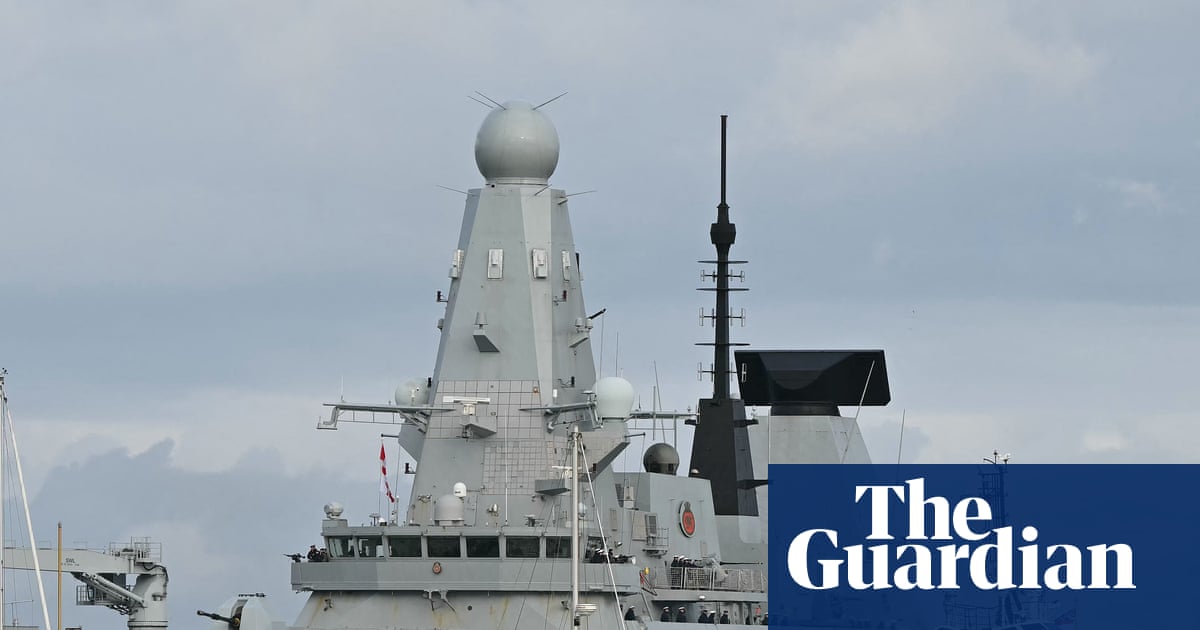
Britain risks failing to deter future Russian aggression in the high north beyond the UK because of shortfalls in the number and availability of Royal Navy submarines and warships, MPs on the defence select committee have said.
asserted
MPs → risk → committee
The committee focused on the slow deployment of HMS Dragon to Cyprus this spring, declining numbers of frigates, and reports that all five Astute-class attack submarines were in dock this summer as evidence of a navy under-resourced for the threat.
asserted
submarines → focus → threat
“The UK needs to be willing to address a hard truth: it does not currently have all the capabilities to operate successfully in the high north,” said Tan Dhesi, the committee chair.
asserted
Dhesi → need → north
“Publicly available evidence of low availability among destroyers, frigates and attack submarines calls into question whether the UK can meet its commitments.
asserted
UK → call → commitments
The high north, the seas beyond Scotland, have become increasingly strategically significant amid growing Russian interest in energy pipelines and undersea cables at a time when Arctic seaways are opening up because of global heating.
asserted
seaways → become → heating
The navy shadowed a Russian spy ship, the Yantar, operating inside the UK’s economic waters in November and January last year, accusing sailors onboard of trying to map strategic cables and shining lasers at RAF pilots monitoring them.
asserted
navy → shadow → them
Russia also wants to assert control over the emerging northern sea route, a 3,500-mile (5,600km) shipping lane running along the country’s Arctic coast.
asserted
Russia → want → coast
The MPs argued the UK needed to make “dramatic progress” before the end of the decade, and they called on the Ministry of Defence to draw up a plan to ensure more warships and submarines are at sea by 2030.
The problem would be particularly acute, the committee added, if the US did not support the UK in a crisis, a rare cross-party acknowledgment that under Donald Trump, US military help cannot be relied on, particularly if a small Nato member in the region was threatened or attacked.
“There would be critical military gaps if the United States were not involved in countering such [Russian] aggression,” the MPs said, and they argued that the UK, as the next largest Nato military in the region, had to be prepared to increase its navy.
asserted
UK → argue → navy
It took more than three weeks for HMS Dragon, a destroyer, to arrive in the eastern Mediterranean in March after an RAF base in Cyprus was struck by a drone.
asserted
base → take → drone
No warships were available and Dragon had to be hauled out of dry dock to deploy.
asserted
Dragon → have → dock
The navy has five frigates with sonar dedicated to detecting Russian submarines at distance, the committee noted, lower than a target of eight, as ageing warships have been scrapped without replacements coming into service.
asserted
replacements → have → service
It could take until 2037 before it reaches its stated requirement, the committee added.
uncertain
committee → take → requirement
None of Britain’s five Astute submarines, also used to track Russian maritime activity, were at sea from June and into the summer.
asserted
None → use → summer
They were in dock for a mixture of short-term and long-term refits, the committee noted, and they also lack the capability to operate under ice, unlike their Russian equivalents, although certification exercises are in progress.
asserted
exercises → note → progress
However, no significant extra money is expected to be available for defence until the next decade, with Andy Burnham’s government committed to medium-term spending plans agreed under Burnham’s predecessor Keir Starmer.
asserted
government → expect → predecessor
Though Starmer agreed to lift defence spending by about £30bn a year to 3.5% of GDP in 2035, he would only sign off spending to the lower level of 2.7% by 2030.
asserted
he → agree → 2030
That prompted the resignation of John Healey as defence secretary, only for him to return as chancellor under Burnham, with the old spending plans intact.
asserted
plans → prompt → Burnham
In response to the report, an MoD spokesperson highlighted a recent £330m investment to protect undersea infrastructure, and noted that Wes Streeting, now the defence secretary, had visited Iceland this month and watched how HMS St Albans, a frigate, tracked Russian submarines in the north Atlantic.
asserted
Albans → highlight → Atlantic
“We are clear-eyed about the threat Russia poses,” they added.
asserted
they → pose → threat
 The Aporia