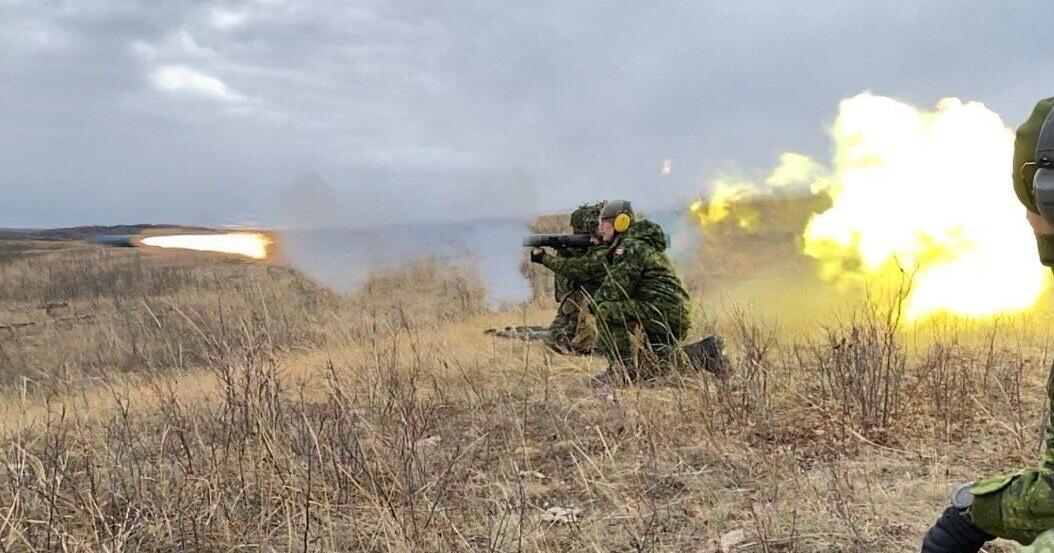
The military let training continue at CFB Wainwright on Saturday even though a fire had been burning on the base since noon and forecasts had already warned of high winds, dry conditions and an approaching cold front.
asserted
forecasts → let → winds
Hours later, a grass fire overtook soldiers during a live-fire exercise at the base, about 200 kilometres southeast of Edmonton, killing four members of the Canadian Armed Forces (CAF) and injuring 39, 19 of them critically.
asserted
fire → overtake → them
The military says a sudden shift in wind turned a fire it believed was contained into a deadly one.
asserted
it → say → one
“The fire was a kilometre away when the wind shifted.
asserted
wind → shift → ?
It is not normal for a fire to move a kilometre in 30 to 60 seconds,” said Maj.-Gen. Wade Rutland, commander of the 1st Canadian Division.
asserted
Rutland → move → Division
But satellite imagery reviewed by Global News and weather records reveal warning signs around four hours before the blaze expanded.
asserted
blaze → review → signs
Forecasters had also flagged unusually powerful winds days earlier.
asserted
Forecasters → flag → winds
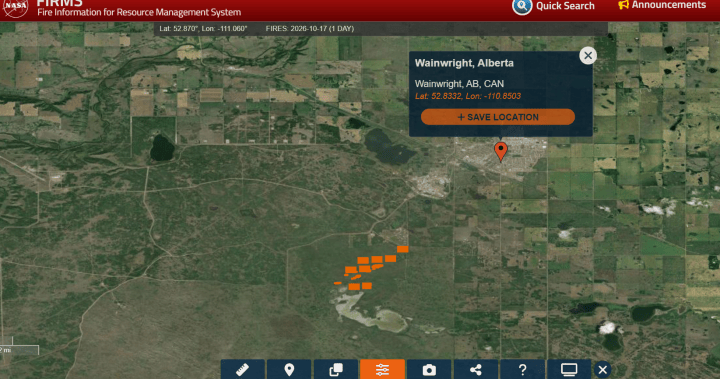
Satellite data from NASA’s Fire Information for Resource Management System (FIRMS) detected 59 possible fire hotspots across an area roughly 1.6 kilometres wide at CFB Wainwright at approximately 12:20 p.m. Saturday.
asserted
data → detect → p.m.
Global News could not independently confirm whether it was the same fire that turned fatal.
uncertain
that → confirm → ?
Mike Flannigan, a wildfire researcher at Thompson Rivers University, said the data definitively showed at least one fire burning on the base roughly four hours before the tragedy, although he could not rule out multiple fires.
To be detectable by satellite, he said, it likely started “at least half an hour before that, maybe even hours before that.”
uncertain
it → say → that
The detections do not show the fire’s size, when it began, or whether the blaze that later turned deadly was the one detected.
asserted
that → show → size
The Office of the Canadian Forces Provost Marshal declined to answer questions from Global News about the event, as the investigation is ongoing and requires co-operation from multiple agencies.
asserted
investigation → decline → agencies
As the afternoon wore on, strong-wind forecasts escalated into Environment Canada warnings, while warm, dry conditions and an approaching cold front created what wildfire experts call a potentially lethal combination.
asserted
experts → wear → what
“This was just a confluence of really extreme conditions that all played out at the exact moment when they had an active fire in the area,” says Jen Beverly, an associate professor of wildland fire at the University of Alberta.
asserted
Beverly → play → Alberta
Rutland said at a press conference Sunday that a fire burned on the base “for several hours,” but training continued “for a certain amount of time” because commanders believed the fire was contained.
“The weather for the majority of the day was well within standard procedures, well below 50 kilometres,” he added.
asserted
he → say → kilometres
“This was uncommon, rapid, and I certainly hadn’t seen anything like it.
asserted
I → see → it
Certainly we train in all types of conditions because you don’t know where you’re going to operate.”
asserted
you → train → conditions
Three former senior military officers interviewed by Global News said training exercises often continue while a fire burns nearby, provided the base’s Range Control deems it safe.
asserted
it → interview → News
They also said strong winds alone wouldn’t necessarily be grounds to suspend training.
asserted
winds → say → training
Environment Canada records from nearby Lloydminster – the closest available long-term climate data – show prevailing westerly winds for most of the year, with stronger average winds outside the summer months.
asserted
records → show → months
But more than a dozen residents interviewed by Global News described the gusts as stronger than anything they’d ever experienced.
asserted
they → interview → anything
The same winds tore across the province before they reached Wainwright, kicking up dust storms, damaging property and even pushing semi-trailer trucks off the highway.
asserted
they → tear → highway
“I was outside, and it almost blew me away.
asserted
it → blow → me
I had to seek shelter in the building as the wind went through,” says Roger Holmes, editor of the town’s Star Edge newspaper.
asserted
Holmes → have → newspaper
“I’ve lived in this town for over 30 years, and I’ve never seen a wind storm like that come through.
asserted
storm → live → that
How it happened
Dry, blustery conditions had already gripped the Wainwright area in the days leading up to the deadly blaze.
asserted
conditions → happen → blaze
Get daily National news
Environment Canada issued separate wind warnings for the region Wednesday, which remained in effect into early Thursday.
asserted
which → get → Thursday
The Weather Network and news outlets, including Global News, forecast a cold front crossing Alberta on Saturday with powerful winds.
asserted
Network → include → winds
“It was well advertised days in advance.
asserted
It → advertise → advance
Computer models knew there would be winds gusting 80 to 100 kilometres an hour,” said Global News meteorologist Anthony Farnell.
asserted
Farnell → know → ?
Weather records show Wainwright had received just 3.5 millimetres of rain this October, with no significant rainfall.
asserted
Wainwright → show → rainfall
The last substantial rainfall was on Sept. 7, when approximately 23.5 millimetres fell, roughly six weeks earlier.
asserted
millimetres → fall → Sept.
By Saturday, wildfire danger across much of southern Alberta, including Wainwright, was rated “extreme,” according to provincial data and the Canadian Wildland Fire Information System.
uncertain
danger → include → data
That appears to contradict an internal memo issued Sunday by the military’s Strategic Joint Staff (SJS), which rated the fire risk as low.
asserted
which → appear → risk
It is unclear whether the memo referred to broader fire-weather conditions or the risk posed by the exercise.
uncertain
memo → refer → exercise
Satellite images show hotspots
NASA satellite data show possible fire activity at CFB Wainwright at two different times Saturday.
The first detections came at 12:17 p.m., when NASA’s Landsat 8 satellite identified 59 possible fire hotspots across an area roughly 1.6 kilometres wide.
asserted
satellite → show → area
More than two and a half hours later, at 2:49 p.m., a second satellite system, VIIRS, detected additional hotspots in the area.
asserted
system → detect → area
Landsat can detect smaller fires with greater precision, while VIIRS provides more frequent observations.
asserted
VIIRS → detect → observations
The timestamps reflect when the satellites passed over the area, rather than when the fires began.
asserted
fires → reflect → area
The detections do not establish the size of the fire, exactly when it began or whether it was the same blaze that later turned deadly.
asserted
that → establish → fire
…and 49 more, not listed.
 The Aporia