California billionaire tax could backfire, Stanford study says

Read the original at CBS News ↗
Cite

Picchi, A. (2026, October 19). California billionaire tax could backfire, Stanford study says. CBS News. https://www.cbsnews.com/news/california-billionaire-tax-stanford-study/

Dated from the outlet's own feed. Check the original for its byline.

CBS News · collected 2026-10-19 · by Aimee Picchi

Quick Summary

California voters will decide on Proposition 40, which proposes a one-time 5% state tax on billionaire wealth aimed at generating billions for healthcare funding. However, Stanford economists warn this could backfire, estimating the measure might yield only $30 billion due to seven billionaires relocating, taking about $540 billion in wealth with them. The economists argue that ongoing income tax losses from these departures could surpass the initial windfall, potentially leading to a net loss of $39 billion over time.
Written locally by qwen2.5:14b on 2026-10-19, using this article's own text rather than the other coverage of the same event (that is the story summary below).

AI analysis runs on qwen2.5:14b, locally

Story summary

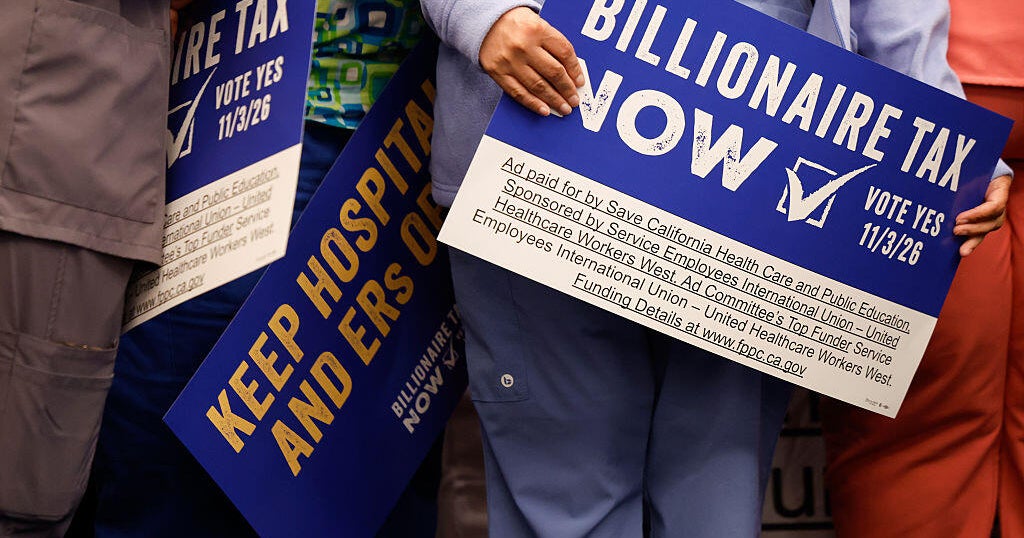
California voters will decide next month whether to approve Proposition 40, a proposal aimed at generating billions of dollars for the state's healthcare system through a one-time 5% tax on billionaire wealth. However, Stanford University economists Benjamin Jaros and Joshua Rauh caution that this could backfire. Their study, published by the National Bureau of Economic Research, shows that seven billionaires, including Peter Thiel, Larry Page, and Sergey Brin, have already moved out of California since the proposal was announced, taking with them about $540 billion or 30% of the state's total billionaire wealth. The economists estimate this could reduce the measure's potential revenue to around $30 billion, far below the $100 billion estimated by supporters. Future income tax losses from these departures could further offset any gains, highlighting concerns over the long-term impact on California's finances.

Written for “California Billionaire Tax Study” on 2026-10-19, grounded in this article and the 0 other(s) covering the same event.
Why this leaning score
The model judged this article politically coded and scored it -0.45, but every quote it verified points right, so the score is not published.
Written under an earlier scoring contract, which gave a paragraph rather than checkable quotes. Re-analysing this article replaces it.
Leaning score withheld for article 91485: score contradicts its own evidence · logged 2026-10-19

Story

📰 California Billionaire Tax Study
Economy/Business · 1 article(s) covering the same event.

Compared with similar articles

This article reads unscored and hedges 30% of its claims. Each row says how that neighbour differs.
TIME
⚖️ Leans strongly left 🔴 3% hedged 2 of 61 📰 publisher trust 59
“While both articles discuss Proposition 40, Article A is an overview of wealth tax initiatives in general and mentions Proposition 40 as one example among others. Article B focuses specifically on the potential consequences of Proposition 40 if it passes, discussing a study about its economic impact.”
New York Post
⚖️ Leans left 🔴 26% hedged 10 of 38 📰 publisher trust 67
“Article A discusses Emil Barr's personal decision to not move to San Francisco due to Proposition 40, while Article B reports on a Stanford study about the broader economic impact of California's proposed billionaire tax.”
New York Post
⚖️ leaning not scored 🔴 17% hedged 4 of 24 📰 publisher trust 67
“Article A discusses opposition forming against a billionaires' tax in California, while Article B mentions a Stanford study cautioning about potential negative effects of the same tax. They are related but describe different aspects and developments.”
How this article was measured signals, leaning charts, publisher record, byline, topics and claims

Signals How these are calculated →

Claims extracted
20
sentences that state something as happening or true
Uncertain
30%
6 of 20 hedged ("reportedly", "may", "according to")
Leaning
withheld
no quote in the article backed the model's score
Publisher signals
66/100
CBS News's corrections and hedging, across everything collected from it. Not a measure of accuracy.
Outlets on this story
1
Economy/Business
Same framing elsewhere
1
articles that frame the event the way this one does
Analyzed 2026-10-19 · how these are computed

How this is being covered How these are calculated →

Article leaning vs. publisher reliability
Source leaning vs. consistency

Publisher

CBS News · 3267 article(s) · 6 correction(s) detected
Running correction rate · 6 correction(s)

Who wrote this

Aimee Picchi
17 article(s) here · 1 carrying a prediction
🔮 California voters next month will decide on whether to , a proposal designed to generate billions of dollars to shore up the state's healthcare system.
🔮 The company said it will continue operating as it seeks to sell its business, and added that The Walt Disney Co. has agreed to pay $20 million for a non-exclusive, perpetual license to Character.ai's intellectual property. Character.ai's financial struggles follow scrutiny and , which uses artificial intelligence to create custom bots consumers can chat with.
🔮 The increase may reflect the impact of years of above-normal inflation since the pandemic, although the survey doesn't capture this year's sparked by soaring energy costs.
🔮 But his campaign promises raised hopes that he would lower consumer prices.
🔮 The figures come a day before the Labor Department's monthly jobs report, with economists forecasting that employers across the U.S. added 90,000 jobs in September.
🔮 She had hoped to regain that aid on her 54th birthday, when she would age out of those restrictions, but then learned that a new federal law had extended the program's work requirement to 64.
🔮 A move by the U.S. to temporarily halt diesel exports amid would initially lower costs, but a prolonged ban could drive up domestic gasoline prices, according to Goldman Sachs.
🔮 One Georgia food bank said it will spend an extra $100,000 this year on diesel, money that otherwise would have gone to feed families.
🔮 Prolonged tensions could keep oil prices elevated, stoking inflation and increasing pressure on the Fed to raise its benchmark interest rate, economists said.
🔮 Nvidia co-founder and CEO Jensen Huang told CBS News he disagrees with recent warnings from artificial intelligence researchers that the technology could lead to humanity's extinction within a few years, calling such statements overblown "doomsday narratives."
Also by Aimee Picchi
Nothing else under this byline is closely related to this article, so these are simply their most recent.
All 17 articles by Aimee Picchi →

Topics

California Proposition 40 Stanford Stanford University the National Bureau of Economic Research

Subjects

California GPE · 6× Benjamin Jaros PERSON · 1× Google ORG · 1× Joshua Rauh PERSON · 1× Larry Page PERSON · 1× Peter Thiel PERSON · 1× Sergey Brin PERSON · 1× Stanford ORG · 1× Stanford University ORG · 1× the National Bureau of Economic Research ORG · 1×

Narrative

"What will allow California to thrive in the future is not letting a handful of billionaires live tax free: it is adequate public spending on health, education and public infrastructure, key engines of economic growth to which it is only fair to ask the ultra-wealthy to contribute," they wrote in a September letter of support for the tax.
framing: mixed · carried by 1 article(s) · first seen 2026-10-19
🔮 California voters next month will decide on whether to , a proposal designed to generate billions of dollars to shore up the state's healthcare system.
2026-10-19 · CBS News
California billionaire tax could backfire, Stanford study says · mixed framing

Claims (20 extracted, 6 hedged)

California voters next month will decide on whether to , a proposal designed to generate billions of dollars to shore up the state's healthcare system. asserted
voters → decide → system
But Stanford economists are now cautioning that the tax could backfire, leaving the state with less in tax revenue than before. uncertain
tax → caution → revenue
Seven billionaires have already publicly moved out of California, removing about $540 billion, or 30%, of the state's total billionaire wealth from potential taxation, according to Stanford University economists Benjamin Jaros and Joshua Rauh in a new working paper published by the National Bureau of Economic Research. uncertain
billionaires → move → Research
The billionaires who have left the state include venture capitalist Peter Thiel and Google co-founders Larry Page and Sergey Brin. asserted
who → leave → Thiel
Because additional billionaires have likely quietly moved since the tax proposal was announced, the measure may ultimately generate only about $30 billion, far less than the $100 billion estimated by its proponents, the economists said. uncertain
economists → move → proponents
If enacted, the tax would apply a one-time 5% state tax on billionaire wealth. asserted
tax → enact → wealth
But future income tax losses from those billionaire departures could more than offset that windfall, the economists calculated. uncertain
economists → offset → windfall
California could lose roughly $1 billion to $3.5 billion a year in income tax revenue due to its shrinking billionaire population, the paper's authors estimated. uncertain
authors → lose → population
If those losses persist permanently, their value in today's dollars would exceed the wealth tax proceeds by about $39 billion, the economists said. asserted
economists → persist → billion
"These findings suggest that the Billionaire Tax Act will not fulfill the primary functions for which it was designed," Jaros and Rauh wrote. asserted
Jaros → suggest → which
"Although the Act was designed to raise revenue, behavioral response prior to voting has eroded most of the projected tax base." asserted
response → design → base
The Service Employees International Union-United Healthcare Workers West (SEIU-UHW), a healthcare worker union that introduced the ballot measure, didn't immediately respond to a request for comment on the new research. asserted
that → introduce → research
Other economists have come to different conclusions about the tax. asserted
economists → come → tax
Economists including Daron Acemoglu of MIT and Joseph Stiglitz of Columbia University, both Nobel Prize winners, have signed their support for the measure, pointing out that California has attracted more venture funding since the wealth tax was announced. asserted
tax → include → funding
"What will allow California to thrive in the future is not letting a handful of billionaires live tax free: it is adequate public spending on health, education and public infrastructure, key engines of economic growth to which it is only fair to ask the ultra-wealthy to contribute," they wrote in a September letter of support for the tax. asserted
they → allow → tax
Ahead of the vote on the ballot measure, called Proposition 40, voters in California are apparently divided on the tax. asserted
voters → call → tax
About 46% of likely voters say they favor Proposition 40, while 43% are opposed, according to a new poll from Citrin-Politico. uncertain
% → say → Politico
Dave Regan, the leader of the union that introduced the measure, told CBS News' Jo Ling Kent that he's "pretty confident" the tax will pass. asserted
tax → introduce → Kent
"There's never been a proposal like this anywhere in the world, so it's a novel idea," Regan said. asserted
Regan → be → world
"We are facing an emergency." asserted
We → face → emergency

💬Give feedback
🕘History 🎫Support