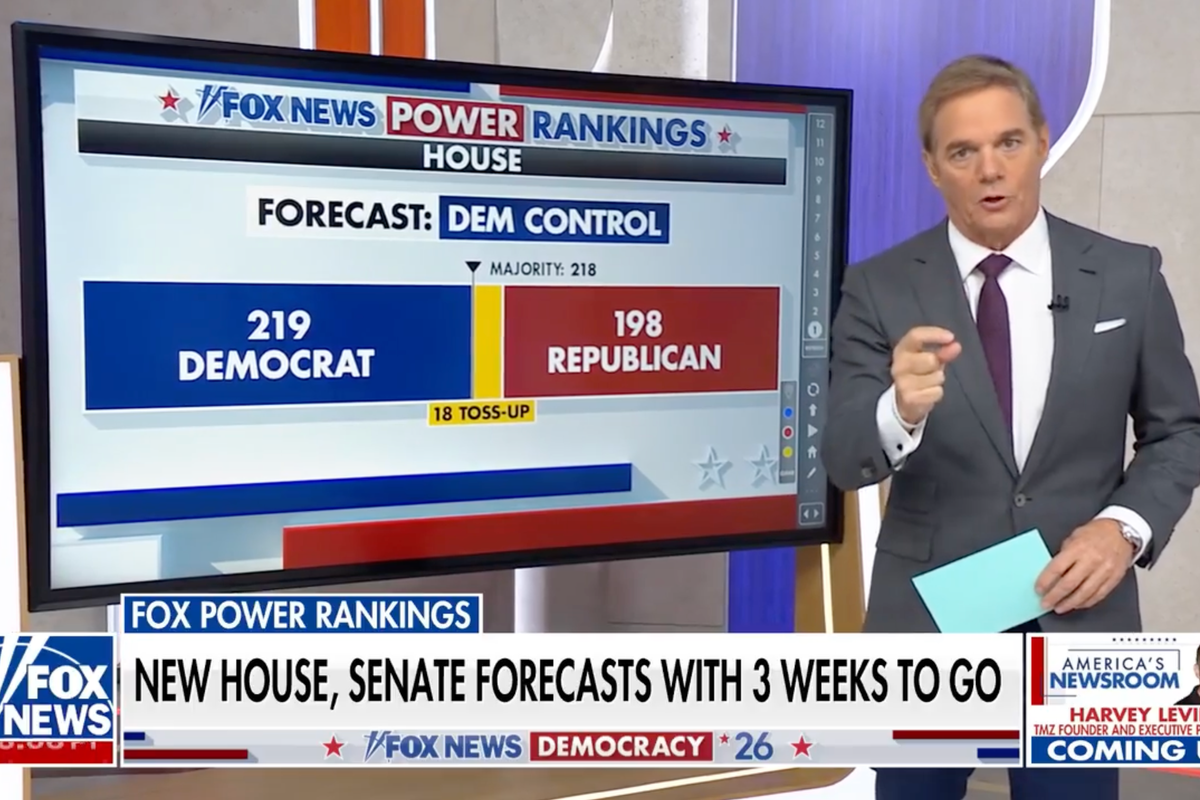
SCHOEN, COOPERMAN: Democrats could be riding a midterm wave. These numbers should terrify the GOP

Read the original at Fox News ↗
Cite

Schoen, D., & Cooperman, C. (2026, October 19). SCHOEN, COOPERMAN: Democrats could be riding a midterm wave. These numbers should terrify the GOP. Fox News. https://www.foxnews.com/opinion/schoen-cooperman-democrats-riding-midterm-wave-numbers-terrify-gop

Dated from the outlet's own feed. Check the original for its byline.

Fox News · collected 2026-10-19 · by Doug Schoen, Carly Cooperman

Quick Summary

Schoen and Cooperman argue in their article that Democrats have an 8-point lead on the generic congressional ballot, suggesting potential for a wave election similar to the one in 2018 where they gained 41 House seats. They cite historical trends showing presidents' parties losing an average of 31 House seats in recent midterms and discuss how Democratic strength in key Senate battlegrounds like North Carolina, Michigan, and Maine could shift control of the upper chamber. Despite these favorable conditions for Democrats, Republicans may still make up ground due to ideological divisions within the Democratic Party and their superior financial resources.
Written locally by qwen2.5:14b on 2026-10-19, using this article's own text rather than the other coverage of the same event (that is the story summary below).

AI analysis runs on qwen2.5:14b, locally

Story summary

As of October 19, 2026, Democrats could be poised for significant gains in the upcoming midterm elections based on current political trends and public sentiment. According to analysts Doug Schoen and Carly Cooperman writing for Fox News, Democrats currently hold an 8-point lead in polls measuring voter preference for congressional candidates, which is among their highest levels this election cycle. Historical data shows that the president's party typically loses seats during midterms; since FDR's administration, only three exceptions have occurred. On average, the president’s party has lost around 28 House seats and four Senate seats in each midterm over the period from 1934 to 2018.

While Republicans can leverage factors such as ideological division among Democrats, a lack of clear messaging, and financial advantages, Democrats still hold an edge in key battleground states for the Senate. Recent polling indicates strong Democratic support in several critical Senate races, potentially giving them a real chance at gaining seats in these midterms.

Written for “Midterm Elections Predictions” on 2026-10-19, grounded in this article and the 0 other(s) covering the same event.
Why this leaning score
The article's own words the score was based on. Each is quoted verbatim and was checked against the article text before being stored, so you can find it in the original.
Reading Leans right (beta estimate) Confidence high
Leaning: leans right for article 90273 (high confidence, 4 verified quotes) · logged 2026-10-19

Story

📰 Midterm Elections Predictions
Politics · 1 article(s) covering the same event.

Compared with similar articles

This article reads leans right and hedges 14% of its claims. Each row says how that neighbour differs.
The Independent
⚖️ leaning not scored 🔴 14% hedged 3 of 22 📰 publisher trust 59
“The articles discuss different analyses and projections about Democrats potentially winning control of the House in November midterms, but they are not reporting on a single identical incident or occurrence.”
Al Jazeera
⚖️ leaning not scored 🔴 0% hedged 0 of 5 📰 publisher trust 60
“The articles discuss general trends and predictions for Democratic performance in midterms but do not describe a single specific event.”
The Dispatch
⚖️ Leans left further left than this 🔴 0% hedged 0 of 9 📰 publisher trust 61
“The articles discuss similar themes (midterm elections and potential Democratic wave), but they are not reporting on the exact same incident or occurrence.”
ABC News (US)
⚖️ Leans left further left than this 🔴 2% hedged 2 of 86 📰 publisher trust 59
“While both articles discuss similar political polling trends and voter preferences leading up to midterm elections, they are reporting on different analyses and perspectives rather than a single specific incident.”
How this article was measured signals, leaning charts, publisher record, byline, topics and claims

Signals How these are calculated →

Claims extracted
37
sentences that state something as happening or true
Uncertain
14%
5 of 37 hedged ("reportedly", "may", "according to")
Leaning
Leans right
of the writing, not the subject · beta estimate
Publisher signals
67/100
Fox News's corrections and hedging, across everything collected from it. Not a measure of accuracy.
Outlets on this story
1
Politics
Same framing elsewhere
1
articles that frame the event the way this one does
Analyzed 2026-10-19 · how these are computed

How this is being covered How these are calculated →

Article leaning vs. publisher reliability
Source leaning vs. consistency

Publisher

Fox News · 4626 article(s) · 9 correction(s) detected
Running correction rate · 9 correction(s)

Who wrote this

Doug Schoen
2 article(s) here · 1 carrying a prediction
🔮 To be clear, Republicans could make up ground for a number of critical reasons: Democrats remain divided ideologically, lack a message and an identity other than being anti-President Trump, and Republicans have a considerable cash advantage.
🔮 If the 2026 midterms were held today, polls suggest that Democrats would be the favorites to retake the Senate.
Also by Doug Schoen
Nothing else under this byline is closely related to this article, so these are simply their most recent.
Carly Cooperman
2 article(s) here · 1 carrying a prediction
🔮 To be clear, Republicans could make up ground for a number of critical reasons: Democrats remain divided ideologically, lack a message and an identity other than being anti-President Trump, and Republicans have a considerable cash advantage.
🔮 If the 2026 midterms were held today, polls suggest that Democrats would be the favorites to retake the Senate.
Also by Carly Cooperman
Nothing else under this byline is closely related to this article, so these are simply their most recent.

Topics

Democrats House Republican Republicans Senate

Subjects

Democrats NORP · 8× Republican NORP · 7× House ORG · 6× Republicans NORP · 6× Democratic NORP · 5× Senate ORG · 5× Democrat NORP · 3× Trump PERSON · 3× North Carolina GPE · 2× American NORP · 1×

Narrative

At this point in 2018, the last blue wave, Democrats led the generic ballot by roughly 7 points before gaining 41 House seats. Moreover, the president’s party losing seats in midterms is essentially law in American politics: It has happened in all but three elections since the Roosevelt administration.
framing: assertive · carried by 1 article(s) · first seen 2026-10-19
🔮 To be clear, Republicans could make up ground for a number of critical reasons: Democrats remain divided ideologically, lack a message and an identity other than being anti-President Trump, and Republicans have a considerable cash advantage.

Claims (37 extracted, 5 hedged)

We say this based on historical trends and the current political mood. asserted
We → say → trends
At this point in 2018, the last blue wave, Democrats led the generic ballot by roughly 7 points before gaining 41 House seats. Moreover, the president’s party losing seats in midterms is essentially law in American politics: It has happened in all but three elections since the Roosevelt administration. asserted
It → lead → administration
From 1934 through 2018, the president’s party lost an average of 28 House seats and four Senate seats, and over the past five midterms, the average net loss for the president’s party has been 31 House seats. asserted
loss → lose → party
To be clear, Republicans could make up ground for a number of critical reasons: Democrats remain divided ideologically, lack a message and an identity other than being anti-President Trump, and Republicans have a considerable cash advantage. uncertain
Republicans → make → advantage
That being said, by most measures, Democrats have the upper hand in the House and a genuine opportunity in the Senate. asserted
Democrats → say → Senate
Recent polling suggests Democratic strength in several key Senate battlegrounds — enough to put the upper chamber in play in what was supposed to be a GOP-friendly map. uncertain
what → suggest → play
In North Carolina, Democrat Roy Cooper leads Republican Michael Whatley by nearly 10 points in the polling average. asserted
Cooper → lead → average
In Michigan, Democrat Abdul El-Sayed holds a narrow 3-point lead over Republican Mike Rogers, who had led during the spring and part of the summer as Republicans emphasized El-Sayed’s socialist lean, controversial statements, and his association with far-left influencer Hasan Piker. asserted
Republicans → hold → Piker
In Maine, Democratic challenger Troy Jackson holds a slight edge over Republican Sen. Susan Collins, although the race remains effectively a toss-up per RealClearPolitics. asserted
race → hold → RealClearPolitics
Victories in those three states alone would not give Democrats control of the Senate. asserted
Victories → give → Senate
They need a net gain of four seats. asserted
They → need → seats
The deeper problem for Republicans is that Democrats have expanded the map. asserted
Democrats → expand → map
In Texas, which has not elected a Democrat statewide since 1994, James Talarico leads Republican Attorney General Ken Paxton — President Trump’s preferred candidate — by roughly 3 points. asserted
Talarico → elect → points
Races in other reliably Republican states, including Iowa, South Carolina, Alaska, and even Kansas — which has not elected a Democratic senator in nine decades — also show Democratic candidates running far more competitively than expected. asserted
candidates → include → decades
The Democratic Party’s weak brand — exacerbated by the growing influence of socialists and the far left — could alienate moderate voters, an argument Republicans are now making. uncertain
Republicans → exacerbate → argument
Most of these polls remain within the margin of error. asserted
Most → remain → error
But that should offer Republicans little comfort: The fact that these races are close at all reflects a national environment currently favoring Democrats. asserted
races → offer → Democrats
That is not to predict that Democrats will win all, or even most, of these contests. asserted
Democrats → predict → contests
Outside North Carolina, their leads are essentially ties, and polling has underestimated Republican support in several recent elections. asserted
polling → underestimate → elections
The generic ballot also cannot be applied mechanically to an individual Senate race or House district, particularly when the number of competitive districts has declined sharply since 2018. asserted
number → apply → 2018
The Cook Political Report currently rates 21 House races as toss-ups and another 21 as leaning toward one party or the other. asserted
Report → rat → party
In 2018, 75 races were considered competitive — a decline driven by redistricting and growing political polarization. asserted
races → consider → redistricting
It reflects voters’ deep frustration with the state of the economy. asserted
It → reflect → economy
In Fox News polling, nearly four times as many Americans said they were falling behind financially as said they were getting ahead, 44% to 12%. asserted
they → say → polling
Fox also found that 55% believed Democrats would do a better job handling inflation, compared with 40% who chose Republicans. asserted
who → find → Republicans
Low presidential approval has often produced punishing midterms. asserted
approval → produce → midterms
In 2010, when President Barack Obama’s approval stood at a still-weak 44%, Democrats lost 63 House seats and six Senate seats. asserted
Democrats → stand → seats
Nevertheless, Republicans retain important advantages. asserted
Republicans → retain → advantages
They have only just begun deploying their substantial cash advantage. asserted
They → begin → advantage
The Democratic Party’s weak brand — exacerbated by the growing influence of socialists and the far left — could alienate moderate voters, an argument Republicans are now making. uncertain
Republicans → exacerbate → voters
It is also possible that lower-propensity Republican voters heed Trump’s call to behave as if he were on the ballot and turn out. asserted
he → heed → ballot
If they do, the election results could look markedly different from today’s polling. uncertain
results → do → polling
Ultimately, both history and current data favor Democrats. asserted
history → favor → Democrats
They are likely to win the House and have a better-than-even chance of capturing the Senate. asserted
They → win → Senate
They are competitive in states that would ordinarily be out of reach and are running strongly across the core battlegrounds. asserted
that → run → battlegrounds
But with three weeks remaining, a Democratic sweep is far from a foregone conclusion. asserted
sweep → remain → conclusion
Republicans still have structural advantages and Trump’s unparalleled ability to mobilize his base. asserted
Republicans → have → base

💬Give feedback
🕘History 🎫Support