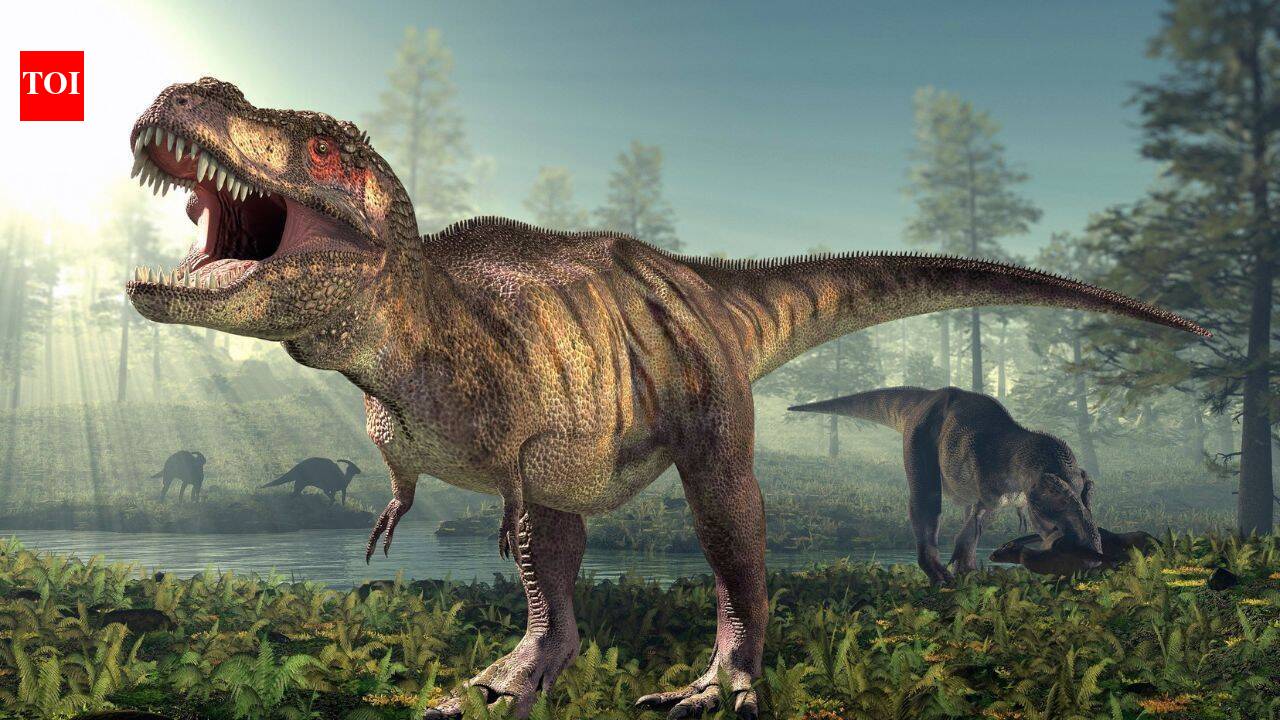
For decades, paleontologists have studied Tyrannosaurus rex (T. rex) through bones, teeth and isolated footprints.
asserted
paleontologists → study → bones
Those fossils reveal what the animal looked like, how large it was and what it may have eaten, but they rarely show the creature in motion.
uncertain
they → reveal → motion
That changed with the discovery of a short trail in southwestern North Dakota.
asserted
That → change → Dakota
Four enormous three-toed footprints, pressed into mud about 66.5 million years ago, form the first known trackway attributed to an adult T. rex.
asserted
footprints → press → rex
The spacing between the prints suggests that the animal was moving at roughly 3.5 to 4.5 miles per hour, a pace comparable to a brisk human walk.
uncertain
animal → suggest → walk
As reported by The Guardian and Good Good News Network, the find offers an unusually direct glimpse of a giant predator simply walking across the ancient landscape.
asserted
find → report → landscape
A trail preserved in ancient mudThe trackway was found in the Hell Creek Formation, a fossil rich region that stretches across parts of North Dakota, South Dakota, Montana and Wyoming.
asserted
that → preserve → Dakota
During the late Cretaceous Period, this landscape looked very different from the modern badlands.
asserted
landscape → look → badlands
Rivers crossed broad floodplains, forests grew along their banks and dinosaurs moved through a warm environment near the Western Interior Seaway.
asserted
dinosaurs → cross → Seaway
The footprints formed when a large dinosaur stepped across wet sediment.
asserted
dinosaur → form → sediment
If the impressions dried before being buried by additional layers of mud or sand, they could survive as natural records of movement.
uncertain
they → dry → movement
Over geological time, the sediment hardened into rock, preserving the shape and position of each step.
asserted
sediment → harden → step
The newly described trackway is about 23 feet long and contains four footprints, arranged as two left and two right steps.
asserted
trackway → describe → left
That alternating sequence is what makes the discovery so valuable.
asserted
discovery → alternate → ?
A single footprint can show size and anatomy, but several footprints can reveal stride, direction and speed.
asserted
footprints → show → stride
Why the trackmaker was likely T. rexScientists cannot observe the original dinosaur, so identifying a trackmaker requires comparing the footprints with known anatomy and other evidence.
asserted
identifying → observe → anatomy
The North Dakota prints are large, three-toed, fossil-rich, and shaped like the feet of a tyrannosaur.
asserted
prints → shape → tyrannosaur
Their size indicates that the animal was an adult rather than a juvenile.
asserted
animal → indicate → ?
The surrounding Hell Creek Formation contains abundant T. rex bones, making the species the most likely source of the footprints.
asserted
species → surround → footprints
Researchers also examined the narrow angle between the toes and the overall form of the impressions.
asserted
Researchers → examine → impressions
No other known animal in the formation fits the combination of size, shape, geological age and location as well.
asserted
animal → know → size
Paleontologists are careful with such conclusions because tracks are not always easy to assign to a particular species.
asserted
tracks → assign → species
Several large predatory dinosaurs had three toes, and footprints can be distorted by mud, erosion or later geological pressure.
asserted
footprints → have → mud
In this case, however, the evidence strongly supports an adult Tyrannosaurus rex as the trackmaker.
asserted
evidence → support → trackmaker
A walking dinosaur, not a sprinting oneThe distance between successive footprints, known as the stride, measures approximately 13 feet.
asserted
dinosaur → walk → feet
By combining stride length with estimates of hip height and body proportions, scientists calculated a speed of about 3.5 to 4.5 miles per hour.
asserted
scientists → combine → hour
It is closer to the speed of a person taking a brisk walk.
asserted
It → take → walk
The finding does not mean T. rex was incapable of running.
asserted
rex → mean → running
It shows that this individual was walking when it left the trackway, perhaps while moving between feeding areas, following a riverbank or simply travelling across the floodplain.
asserted
it → show → floodplain
The distinction matters because speed is closely tied to biomechanics.
asserted
speed → matter → biomechanics
A walking animal keeps at least one foot on the ground during part of each stride, creating a different pattern from a running animal.
asserted
animal → walk → animal
The spacing and arrangement of the footprints preserve evidence of that gait.
asserted
spacing → preserve → gait
For a dinosaur that may have weighed several tons, the result is striking.
uncertain
result → weigh → tons
The predator was not necessarily charging or chasing prey.
asserted
predator → charge → prey
It was moving in a relatively relaxed way, leaving behind a sequence of steps that remained hidden in stone until modern scientists recognised them.
asserted
scientists → move → them
What tracks reveal that bones cannotBones provide detailed information about anatomy, but footprints preserve behaviour.
asserted
footprints → reveal → behaviour
They can show whether an animal was walking, running, standing, turning or travelling with others.
asserted
animal → show → others
They may also reveal how the foot was placed and how the body shifted from one step to the next.
uncertain
body → reveal → next
A trackway can therefore complement skeletal evidence.
asserted
trackway → complement → evidence
Scientists can compare the size of the footprints with the proportions of known T. rex skeletons, then use stride and gait to refine estimates of movement.
asserted
Scientists → compare → movement
…and 54 more, not listed.