North Korea has built new uranium facility to expand nuclear arsenal, UN agency says

Read the original at The Guardian ↗
Cite

Tokyo, J. M. i. (2026, September 11). North Korea has built new uranium facility to expand nuclear arsenal, UN agency says. The Guardian. https://www.theguardian.com/world/2026/sep/10/north-korea-has-built-new-uranium-facility-to-expand-nuclear-arsenal-un-agency-says

Dated when The Aporia collected the article, usually within hours of publication. Check the original for its exact date and byline.

The Guardian · collected 2026-09-11 · by Justin McCurry in Tokyo

Quick Summary

The International Atomic Energy Agency (IAEA) has expressed concern over evidence that North Korea has built a new uranium enrichment facility at its main Yongbyon nuclear site. The facility can house up to 28 centrifuge cascades, which could produce enough weapons-grade highly enriched uranium for three or four additional warheads per year. The IAEA's director general, Rafael Grossi, described the ongoing operation of North Korea's enrichment facilities as a "cause for serious concern" and a violation of UN security council resolutions. South Korean estimates suggest that North Korea now possesses between 80 to 120 nuclear warheads.
Written locally by qwen2.5:14b on 2026-09-11, using this article's own text rather than the other coverage of the same event (that is the story summary below).

AI analysis runs on qwen2.5:14b, locally

Story summary

North Korea has secretly built a new uranium facility at its main Yongbyon nuclear site, which is capable of enriching up to 85 kg of weapons-grade highly enriched uranium per year. According to satellite imagery analysis by the International Atomic Energy Agency (IAEA), the facility can house 28 centrifuge cascades, each containing 4,592 centrifuges. This would enable North Korea to produce enough uranium for three or four additional warheads annually. The IAEA has expressed "serious concern" over this development, which is part of a broader expansion of North Korea's nuclear arsenal. The country has also expanded operations at an enrichment site in Kangson, near Pyongyang.

Written for “North Korean Nuclear Expansion” on 2026-10-28, grounded in this article and the 0 other(s) covering the same event.

Story

📰 North Korean Nuclear Expansion
Politics · 1 article(s) covering the same event.

Compared with similar articles

This article reads unscored and hedges 38% of its claims. Each row says how that neighbour differs.
South China Morning Post
⚖️ Leans right 🔴 75% hedged 3 of 4 📰 publisher trust 64
“Article A discusses North Korea's construction of a new uranium facility, while Article B focuses on potential nuclear proliferation concerns in the Middle East.”
The Hindu
⚖️ leaning not scored 🔴 5% hedged 1 of 20 📰 publisher trust 60
“Article A mentions a naval destroyer commissioning, while Article B discusses a uranium facility and enrichment capabilities, indicating two distinct events”
Toronto Star
⚖️ leaning not scored 🔴 8% hedged 2 of 26 📰 publisher trust 64
“The articles describe different developments: North Korea commissioning a naval destroyer and building a new uranium facility”
How this article was measured signals, leaning charts, publisher record, byline, topics and claims

Signals How these are calculated →

Claims extracted
13
sentences that state something as happening or true
Uncertain
38%
5 of 13 hedged ("reportedly", "may", "according to")
Leaning
withheld
no quote in the article backed the model's score
Publisher signals
66/100
The Guardian's corrections and hedging, across everything collected from it. Not a measure of accuracy.
Outlets on this story
1
Politics
Same framing elsewhere
1
articles that frame the event the way this one does
Analyzed 2026-09-11 · how these are computed

How this is being covered How these are calculated →

Article leaning vs. publisher reliability
Source leaning vs. consistency

Publisher

The Guardian · 2537 article(s) · 6 correction(s) detected
Running correction rate · 6 correction(s)

Who wrote this

Justin McCurry in Tokyo
6 article(s) here · 1 carrying a prediction
🔮 The ban, which went into effect this week at Kadena airbase on the southern Japanese island of Okinawa, has fueled speculation that similar measures could be taken at other US military facilities as part of Washington’s crackdown on Chinese technology it suspects of being used to collect sensitive information.
🔮 Akihiro Nabae, the deputy mayor of Saijo in western Japan, was carrying a giant float with other participants in a festival on Saturday when he became trapped beneath the structure, Agence France-Presse reported.
🔮 Japanese authorities have raided the country’s four biggest breweries over suspicions they colluded to set the price of beer and other beverages – a practice media reports said could have forced drinkers to pay over the odds.
🔮 Tsuda, 55, claimed that the 188 TikTok videos uploaded on an anonymous account between July 2024 and September last year had been narrated by a “deep” and “lustrous” voice that could only be his.
🔮 Citing a 2025 analysis by the James Martin Center for Nonproliferation Studies in the US, South Korea’s Chosun Daily said the potential 28 cascades comprising 4,592 centrifuges at the Yongbyon facility could yield about 85 kg of weapons-grade highly enriched uranium a year – enough to build three or four additional warheads.
🔮 Authorities hopes the restrictions will address concerns that residential areas are not experiencing the same improvements in safety seen on larger roads.
Also by Justin McCurry in Tokyo
Nothing else under this byline is closely related to this article, so these are simply their most recent.
All 6 articles by Justin McCurry in Tokyo →

Topics

IAEA Kangson North North Korea Yongbyon

Subjects

North Korea GPE · 4× Yongbyon GPE · 4× IAEA ORG · 3× North GPE · 3× Kangson GPE · 2× North Korea’s GPE · 2× South Korea’s GPE · 2× Kim Jong-un PERSON · 1× Pyongyang GPE · 1× The International Atomic Energy Agency ORG · 1×

Narrative

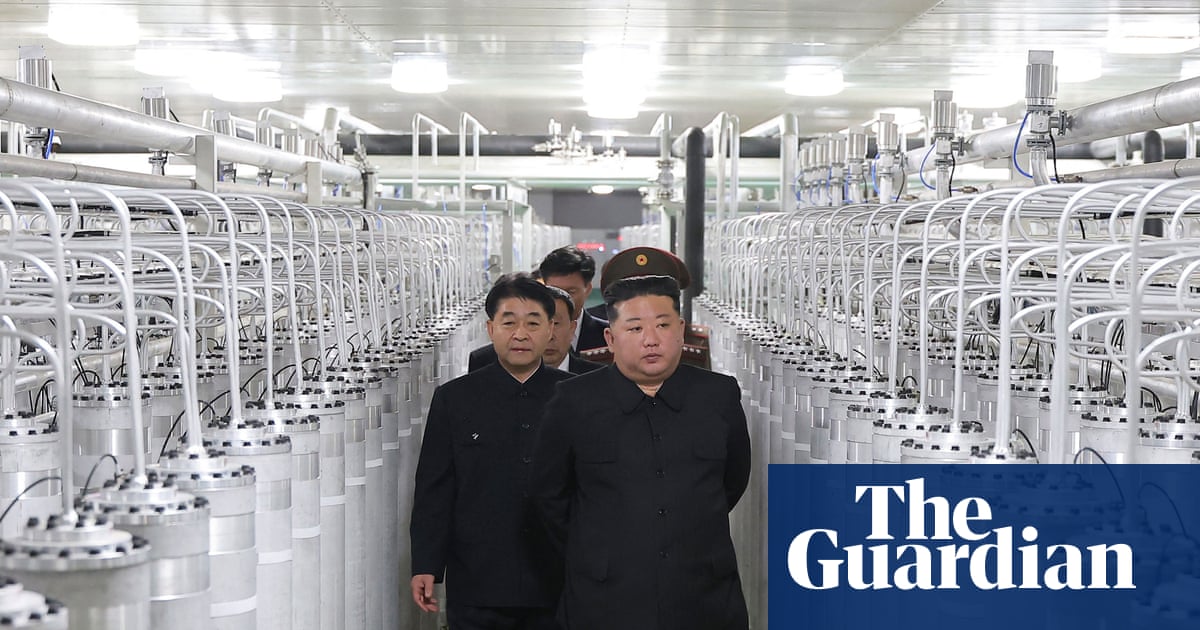
The IAEA, whose inspectors were expelled from North Korea in 2009, identified the Yongbyon building as the site’s second uranium enrichment facility after comparing satellite images taken during its construction with media photographs of a visit in early June by the country’s leader, Kim Jong-un.
framing: mixed · carried by 1 article(s) · first seen 2026-09-11
🔮 Citing a 2025 analysis by the James Martin Center for Nonproliferation Studies in the US, South Korea’s Chosun Daily said the potential 28 cascades comprising 4,592 centrifuges at the Yongbyon facility could yield about 85 kg of weapons-grade highly enriched uranium a year – enough to build three or four additional warheads.

Claims (13 extracted, 5 hedged)

The International Atomic Energy Agency (IAEA) has voiced “serious concern” over evidence that North Korea has built a facility capable of enriching weapons-grade uranium to bolster its nuclear arsenal. asserted
Korea → voice → arsenal
The new building, located at the the country’s main Yongbyon nuclear facility, can house up to 28 centrifuge cascades – machinery commonly used to enrich uranium – according to a report by the nuclear watchdog released this week. uncertain
building → locate → watchdog
The regime has also expanded operations at an enrichment site in Kangson, near the capital Pyongyang, according to the report, which was based on analysis of satellite imagery and open-source material, including photographs published by the country’s state media. uncertain
which → expand → media
The IAEA, whose inspectors were expelled from North Korea in 2009, identified the Yongbyon building as the site’s second uranium enrichment facility after comparing satellite images taken during its construction with media photographs of a visit in early June by the country’s leader, Kim Jong-un. asserted
inspectors → expel → leader
During his visit, Kim claimed the North’s capacity to produce weapons-grade nuclear material had more than doubled over the past five years, according to state media, promising “vast future plans to exponentially strengthen the country’s nuclear forces”. uncertain
capacity → claim → forces
Citing a 2025 analysis by the James Martin Center for Nonproliferation Studies in the US, South Korea’s Chosun Daily said the potential 28 cascades comprising 4,592 centrifuges at the Yongbyon facility could yield about 85 kg of weapons-grade highly enriched uranium a year – enough to build three or four additional warheads. uncertain
cascades → cite → warheads
In a statement released this week, the IAEA’s director general, Rafael Grossi, said: “The ongoing operation of enrichment facilities at Kangson and Yongbyon and the reported further expansion of [North Korea’s] production of weapons-grade nuclear material is a cause for serious concern.” asserted
operation → release → concern
“The continuation and further development” of North Korea’s nuclear programme are “clear violations of relevant UN security council resolutions and are deeply regrettable”, he added. asserted
he → add → resolutions
South Korea’s defence minister, Ahn Gyu-back, said in August that the North possessed between 80 and 120 nuclear warheads – a much higher number than the 57 cited by Donald Trump the same month. asserted
North → say → Trump
The South Korean figure was based on estimates by private research organisations, Ahn told lawmakers, adding that the country’s military could not confirm the numbers. uncertain
military → base → numbers
North Korea has made rapid progress in its ballistic missile and nuclear programmes in recent years, as it demands international recognition as a legitimate nuclear state. asserted
it → make → state
North Korea has conducted multiple long-range missile tests since 2017, the year it last tested a nuclear weapon. asserted
it → conduct → weapon
In a report submitted to the UN security council in 2020, international experts said the North had “probably developed nuclear devices to fit into the warheads of its ballistic missiles”. asserted
North → submit → missiles

💬Give feedback
🕘History 🎫Support