North Korea spends war windfall on arms, infrastructure

Deutsche Welle · collected 2026-09-11 · by Julian Ryall
Read the original at Deutsche Welle ↗

Summary

North Korean leader Kim Jong Un is using funds earned from fighting in Ukraine to finance various projects, including infrastructure development and military expansion. According to South Korea's National Intelligence Service, North Korea received between $7.7 billion and $14 billion in aid from Russia over three years, a significant amount for the country with a GDP of $26.6 billion. The money is being spent on initiatives such as constructing modern industrial facilities, building factories and hospitals, and developing new districts in Pyongyang, but critics argue that these projects may only benefit the elite. A new uranium enrichment facility has been identified at the Yongbyon Nuclear Complex, which could produce enough highly enriched uranium for four nuclear warheads.
Written by the local model on 2026-09-11, using this article's own text rather than the other coverage of the same event (that is the story summary below).

Signals How these are calculated →

Claims extracted
28
claim-shaped sentences
Uncertain
18%
5 of 28 hedged
Leaning
Leans right
of the writing, not the subject
Publisher trust
94.8
red-flag proxy, not a credibility rating
Outlets on this story
1
Politics
Narrative spread
1
articles carrying this framing
Analyzed 2026-09-11 · how these are computed

AI analysis (generated at analysis time, not now)

Story summary

North Korean leader Kim Jong Un is using the $7.7 billion in financial aid and economic value his country received from Russia for fighting in Ukraine to fund various projects, including a new destroyer capable of launching nuclear weapons, as well as improvements to roads, ports, and bridges. The funding comes from Russia's support for North Korea's involvement in the war against Ukraine, which South Korea's National Intelligence Service estimates could be as high as $14 billion. This is significant, given that North Korea's GDP was only $26.6 billion in 2024. Some of the funds are being allocated to the Regional Development 20x10 Policy, aimed at constructing modern industrial facilities in regional cities outside Pyongyang over the next decade. However, most of these projects appear to be benefiting the ruling elite in Pyongyang rather than improving living standards for the general population.

Written for “North Korean Military Buildup” on 2026-09-12, grounded in this article and the 0 other(s) covering the same event.
Why this leaning score
The article's own words the score was based on. Each is quoted verbatim and was checked against the article text before being stored, so you can find it in the original.
Score +0.55 Confidence medium 1 quote(s) discarded as not found in the article
Leaning score +0.55 for article 8000 (medium confidence, 2 verified quotes) · logged 2026-09-11

Story

📰 North Korean Military Buildup
Politics · 1 article(s) covering the same event. This is the one the site leads with.

How this is being covered How these are calculated →

Article leaning vs. publisher reliability
Source leaning vs. consistency

Compared with similar articles

This article reads leans right and hedges 18% of its claims. Each row says how that neighbour differs.
Deutsche Welle
⚖️ leaning not scored 🔴 10% hedged 4 of 42 📰 publisher trust 95
“Article A discusses US President Trump's overtures to North Korea, while Article B mentions North Korea receiving financial aid from Russia and spending it on arms and infrastructure”

Publisher

Deutsche Welle · 137 article(s) · 0 correction(s) detected
No corrections detected for this publisher. That may mean careful reporting, or simply that nothing has been checked.

Who wrote this

Julian Ryall
6 article(s) here · 1 carrying a prediction
🔮 South Korea's National Intelligence Service estimated in May that Pyongyang received at least $7.7 billion (€6.6 billion) in financial aid and economic value from Russia in the preceding three years for committing men and materiel to Moscow's war against Ukraine — and potentially as much as $14 billion.
2026-09-11 · assertive framing · North Korea spends war windfall on arms, infrastructure
🔮 The estate agent's pitch says the price includes dismantling by "expert heritage craftsmen" and delivery to anywhere in Japan, where it would be fully restored into a "stunning" two- or three-bedroom home.
2026-09-08 · assertive framing · Japan's empty temples seek new ways to survive
🔮 This week, Hitachiomiya Mayor Sadayuki Suzuki accepted a request from the Ministry of Economy, Trade and Industry for his community to undergo a preliminary survey to determine whether the town’s geology is suitable for a repository to store Japan’s large – and growing – stockpile of highly radioactive nuclear waste.
🔮 Trump added that US involvement in the exercises would send a "signal that is totally inappropriate and hostile" to North Korea, which he said has been "unthreatening and respectful" to his presidency.
2026-08-19 · assertive framing · Will Trump's North Korea strategy hurt US allies?
🔮 Russia and Japan's longstanding territorial row Successive Japanese governments have consistently taken the position that the islands were illegally annexed, with the dispute so impacting bilateral ties that the two nations have yet to sign a formal peace treaty. The collapse of the Soviet Union in 1991 and the subsequent economic hardships gave Japan renewed hope that Moscow could be convinced to return the islands in return for economic assistance or even joint development of the region.
More on this subject from Julian Ryall
Will Trump's North Korea strategy hurt US allies?
2026-08-19 · Deutsche Welle · 52% similar
All 6 articles by Julian Ryall →

Topics

IAEA North Korean Pyongyang Russia Ukraine

Subjects

Russia GPE · 7× Pyongyang GPE · 5× Kim PERSON · 4× IAEA ORG · 3× North Korean NORP · 3× North Korea GPE · 2× Ukraine GPE · 2× Kim Jong Un PERSON · 1× National Intelligence Service ORG · 1× South Korea's GPE · 1×

Narrative

On Monday, Kim attended the commissioning ceremony in Wonsan of the 5,000-ton destroyer Kang Kon, with the North Korean leader claiming the vessel was capable of launching nuclear weapons and would be able to "deal a deadly retaliatory blow at the enemies." The third area of heavy investment has been in major improvements in roads, ports and bridges.
framing: assertive · carried by 1 article(s) · first seen 2026-09-11
🔮 South Korea's National Intelligence Service estimated in May that Pyongyang received at least $7.7 billion (€6.6 billion) in financial aid and economic value from Russia in the preceding three years for committing men and materiel to Moscow's war against Ukraine — and potentially as much as $14 billion.
2026-09-11 · Deutsche Welle
North Korea spends war windfall on arms, infrastructure · assertive framing

Claims (28 extracted, 5 hedged)

North Korean leader Kim Jong Un is spending the money that his troops have earned fighting in Ukraine to fund a long wish list of projects that were previously beyond his financial reach. asserted
that → spend → reach
South Korea's National Intelligence Service estimated in May that Pyongyang received at least $7.7 billion (€6.6 billion) in financial aid and economic value from Russia in the preceding three years for committing men and materiel to Moscow's war against Ukraine — and potentially as much as $14 billion. uncertain
Pyongyang → estimate → Ukraine
That is a significant amount given that the North's GDP for 2024 stood at $26.6 billion. asserted
GDP → give → billion
Kim's support for Russia has been lucrative, and a slew of reports are now identifying where that money is being spent. asserted
money → identify → reports
A portion of the funds is being put aside for the Regional Development 20x10 Policy, unveiled in January 2024 and which aims to construct modern industrial facilities in 20 regional cities per year for the next 10 years to improve living standards outside Pyongyang. asserted
which → put → Pyongyang
Benefiting from Russian money More civil programs are being designed, observers say, although most appear to be earmarked for the "elites" who reside in Pyongyang. asserted
who → benefit → Pyongyang
"Before the alliance with Russia, the general infrastructure was poor due to a mixture of economic mismanagement and sanctions," said Martyn Williams, senior fellow for the Korea program at the Stimson Center in Washington, DC. asserted
Williams → say → Washington
"With the breakdown in consensus on the United Nations Security Council and renewed trade with China and Russia, things are starting to move along now," he told DW. asserted
he → renew → DW
"There are several large programs to build factories and hospitals across the country, [Kim] has ordered the development of entire new districts of Pyongyang and there's a rural housing project building tens of thousands of rural homes," he said, along with investment in "the modernization of several sectors of the economy. asserted
he → be → economy
However, he said, structural problems still need to be overcome. asserted
problems → say → ?
"There is investment going into building, but the large new hospital in central Pyongyang was built some time ago and sat unused for a while, until medicines and equipment could be procured," he said. "North Korea is great at building, but keeping it running is the key — so we look to see if that will happen." IAEA warns of new nuclear facility uncertain
IAEA → be → facility
More of the financial windfall is clearly being put into the military. asserted
More → put → military
On Wednesday, the International Atomic Energy Agency (IAEA) said it had identified a new uranium enrichment facility at the Yongbyon Nuclear Complex with an estimated 28 cascades of centrifuges. asserted
it → say → centrifuges
The IAEA estimated that the facility would permit the regime to produce 85 kilograms of weapons-grade highly enriched uranium a year, enough for four nuclear warheads. asserted
facility → estimate → warheads
Satellite images also show that the North is enlarging and upgrading the west coast port of Nampo and Chongjin, on the east coast of the peninsula, to accommodate a new generation of warships. asserted
North → show → warships
On Monday, Kim attended the commissioning ceremony in Wonsan of the 5,000-ton destroyer Kang Kon, with the North Korean leader claiming the vessel was capable of launching nuclear weapons and would be able to "deal a deadly retaliatory blow at the enemies." The third area of heavy investment has been in major improvements in roads, ports and bridges. asserted
area → attend → roads
This infrastructure stagnated during years of isolation under international sanctions but is now needed to facilitate the deployment of more troops to Russia and the arrival of advanced military technology, energy and consumer goods in return. asserted
infrastructure → stagnate → return
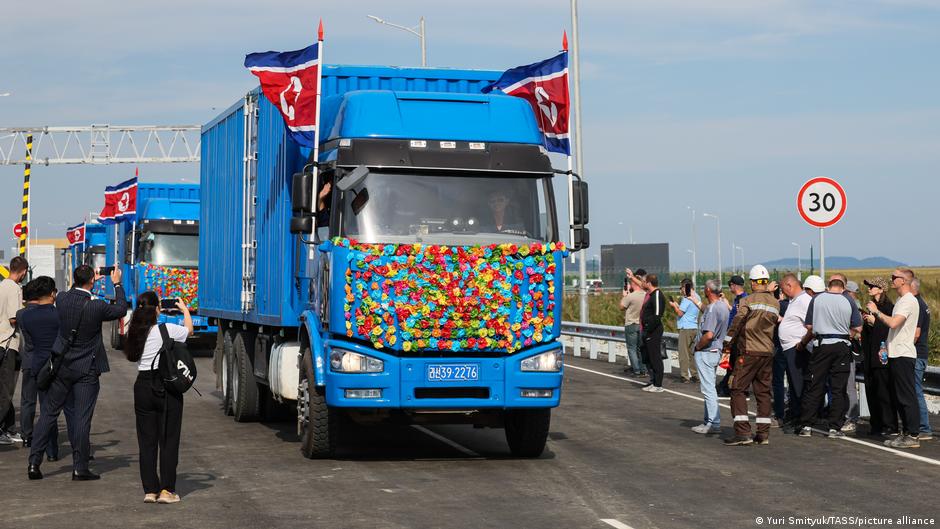
On Tuesday, North Korea and Russia opened their first road bridge across the Tumen River, with customs posts and warehousing facilities under construction on both sides of the waterway. asserted
Korea → open → waterway
The bridge underlines the rapidly expanding ties since Kim and President Vladimir Putin announced a comprehensive strategic partnership in 2024. asserted
Kim → underline → 2024
The route will permit greater truck-borne exchanges, reduce costs and potentially be used for the transit of North Korean men, weapons and ammunition to Russia. asserted
route → permit → Russia
It also further reduces the leverage of sanctions on North Korea. asserted
It → reduce → Korea
"A lot of these projects, such as improving trans-border rail and road connections, building customs facilities and so on, were started before the pandemic and have followed an on-again-off-again pattern ever since," said Marcus Noland, executive vice president at the Peterson Institute for International Economics in Washington. asserted
Noland → improve → Washington
"After difficult times during the pandemic, which was accompanied by border closure, the North Korean economy appears to have grown for the last several years on the back of Ukraine war revenues and cybercrime. asserted
economy → accompany → revenues
Hinterland 'stagnating' Noland said he has the impression that Pyongyang is faring relatively well economically, along with a number of cities on the China border thanks to renewed trade, "but the hinterland continues to stagnate. asserted
hinterland → stagnate → trade
" While the Ukraine conflict and Pyongyang's alliance with Moscow have been an economic boon to North Korea, analysts say, it's not clear what will happen when the war inevitably comes to an end. asserted
war → say → end
"The North Korean regime could be in a difficult spot if peace were to break out in Ukraine," said Noland. uncertain
Noland → break → Ukraine
"If the war-related revenues were to dry up, the country could experience an economic decline and associated discontent after a period of rising expectations," he stressed. uncertain
he → relate → expectations
"I am not saying that it would be enough to destabilize the system, but I do think that a transition to peace in Ukraine could present challenges that would have to be navigated by the regime." uncertain
that → say → regime

💬 Give feedback
🕘 History 🎫 Support