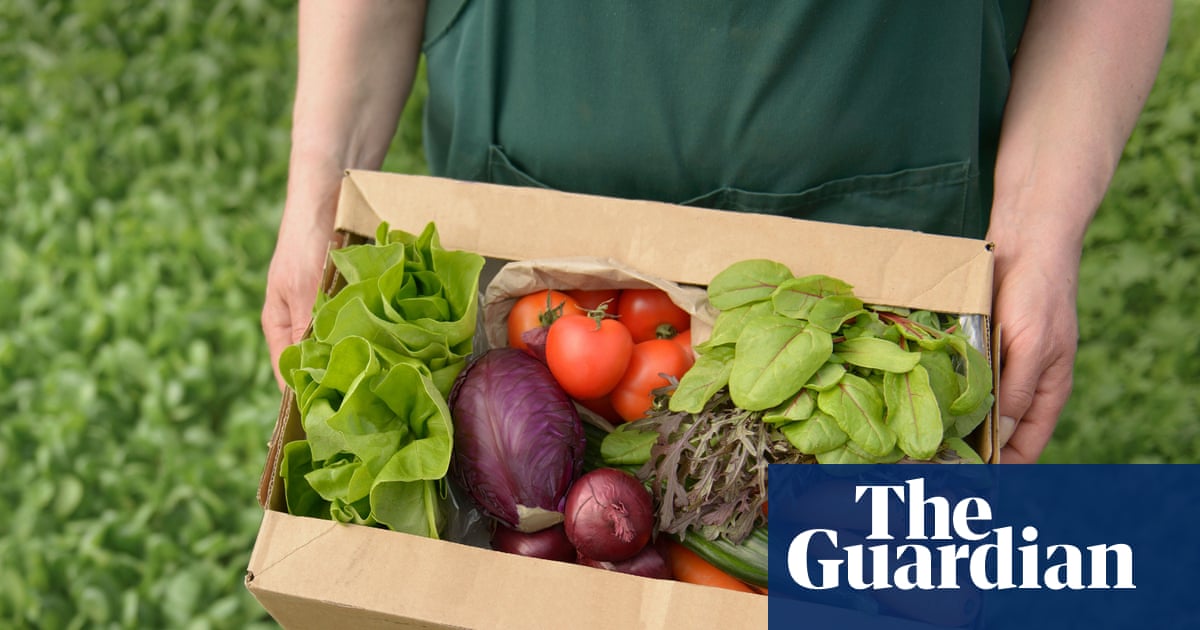
The government has set an ambition to increase the share of English land farmed organically to 10% by 2036, but concerns remain over how the transition will be funded.
asserted
transition → set → 2036
Currently, just 3.4% of England’s agricultural land is farmed organically, one of the smallest shares in Europe.
asserted
% → farm → Europe
France, for example, farms 10.4% of its land organically, and aims to increase this to 18% by 2027.
asserted
France → farm → 2027
Rob Haward, the chief executive of organic veg box company Riverford, said it was a reflection of organic farming having political backing in the EU.
asserted
farming → say → EU
Whereas in England, the last organic farming plan was published more than two decades ago.
asserted
plan → publish → England
The government’s new plan, which has been more than three years in the making, sets out a vision for growth in the organic sector, with public procurement – in schools and hospitals, for example – cited as a significant opportunity.
asserted
procurement → set → opportunity
The government already has a long-term ambition for 10% of public sector food spend to meet higher environmental production standards.
asserted
% → have → standards
The plan states that the organic sector can play a vital role in achieving this.
asserted
sector → state → this
The environment secretary, Angela Eagle, said the plan was about “opening up opportunities across the sector, from backing farmers already producing organic food to helping others decide whether it could work for their businesses”.
uncertain
it → say → businesses
She added: “Organic farming should not be treated as a niche.
asserted
farming → add → niche
More people are looking closely at where their food comes from, how it is produced and whether it meets standards they value.”
asserted
they → look → standards
Haward said public procurement was “impenetrable” for small organic farms, but hoped the plan would be a “catalyst for growth”.
asserted
plan → say → growth
However, he said the sector now needed proper backing from the government, including grant funding.
asserted
sector → say → funding
In September, thousands of farmers were left empty-handed after the government’s sustainable farming incentive 2026 (SFI) funding was spent in just six hours.
asserted
funding → leave → hours
This meant that some farmers who might have been planning to use the funding to transition to organic farming may have missed out.
uncertain
who → mean → farming
“SFI needs to be reliable, successful and secure to enable this transition,” said Haward.
asserted
Haward → need → transition
“It’s hard for any farm to invest in their business if things change, we need some consistency.”
asserted
we → ’ → consistency
Gareth Morgan, the head of farming policy at the Soil Association, said there had been a lot of discussions with Defra about funding, but in the end “there has been a compromise”.
asserted
Morgan → say → end
“There is now an urgent need to reopen SFI to enable farms to move to organic farming,” he said.
asserted
he → be → farming
Morgan added that increasing the share of land farmed organically could bring down the price of organic food for consumers.
uncertain
increasing → add → consumers
“Currently the price of food is subsidised and we don’t pay for the environmental impact.
asserted
we → subsidise → impact
If organic food becomes more mainstream, the price difference will become less,” he said.
asserted
he → become → ?
Martin Lines, the chief executive of the Nature Friendly Farming Network, said farmers could not rely on government funding alone to make this transition, and said there needs to be “real investment from the supply chain and the private sector, along with fairer prices for farmers for their goods and stronger domestic markets for homegrown produce”.
uncertain
farmers → say → produce
The National Farmers’ Union, whose members include organic and non-organic farms, said the plan signified a “really positive step forward … for the wider supply chain”.
asserted
plan → include → chain
“Supporting domestic production will strengthen the resilience of our food supply chains and ensure British farmers and growers benefit from opportunities, rather than increasing our reliance on imports,” said Paul Tompkins, the deputy president of the union.
asserted
Tompkins → support → union
In the plan’s foreword, Eagle said: “Across England, organic farmers, growers and food businesses play an important role in producing high-quality food while caring for soils, wildlife and the rural communities they are part of.
asserted
they → say → soils
In doing so, they also help advance wider goals for nature recovery, cleaner water and greater climate resilience.
asserted
they → do → recovery
This year has been challenging for farmers because of crop-destroying heat and drought alongside soaring fertiliser costs tied to the war in Iran.
asserted
year → challenge → Iran
Organic farms have been found to be more resilient in the face of these extreme weather conditions and are also not affected by rising fertiliser costs.
asserted
farms → find → costs
“Organic farmers are much less exposed to these risks,” Morgan said, adding that the plan was a sign that the government was thinking hard about the pathway for food security.
asserted
government → expose → security
 The Aporia