That is 0 articles you have read today.
The Aporia is free and carries no advertising, so readers are the only
thing paying for it. If you are getting this much out of it, a small
donation is what keeps it independent.
Daily limit reached
You have read 0 articles today.
That is more than the 15 a day The Aporia gives away,
and well past what it can carry on nothing. Your allowance resets at
midnight.
There is no advertising here and nothing about you is sold, so readers
are the only thing paying for it. If the site is worth this much of
your day, it is worth a few dollars.
Everything else stays open: the
maps, the
directory and
search do
not count against this, and neither does re-opening something you have
already read today.
The Guardian
· collected 2026-10-08 · by Pippa Neill Environment reporter
Researchers claim that the British government needs to be more transparent about the climate and nature crisis following a unique national emergency briefing in Westminster Hall last November. Nine out of ten viewers of the associated documentary, "People’s Emergency Briefing," which has been seen by approximately 185,000 people at over 3,400 screenings, reported increased motivation to address environmental issues. The film advocates for a comprehensive government-led emergency briefing on climate and nature crises, emphasizing that 93% of those surveyed believe the public is not fully informed about these threats.
Written locally by qwen2.5:14b on 2026-10-08,
using this article's own text rather than the other coverage of the
same event (that is the story summary below).
Story summary
In November last year, nine experts in London delivered the first-of-its-kind national emergency briefing on climate change at Westminster Hall. Researchers from the University of Bath found that after viewing a crowdfunded film based on this event, which has been seen by an estimated 185,000 people, 87% felt more motivated to take action against climate and nature crises. The film highlights the risks to food security, public health, and the economy. Professor Lorraine Whitmarsh noted that while most Britons are aware of some climate threats, they lack knowledge about secondary impacts like national security issues and effects on healthcare systems. Researchers urge the British government to conduct a primetime televised emergency briefing to honestly communicate the scale of these threats.
Written for “Climate Crisis Briefing UK” on 2026-10-08,
grounded in this article and the 0 other(s) covering the same event.
Why this leaning score
The model judged this article politically coded and scored it -0.65, but all 4 of its quote(s) are attributed speech - words the article quotes from someone, not the article's own narration, so the score is not published.
Written under an earlier scoring contract, which gave a paragraph
rather than checkable quotes. Re-analysing this article replaces it.
Leaning score withheld for article 65092: attributed speech only · logged 2026-10-08
The British government must be honest about the scale of the threat posed by climate and nature breakdown, researchers have said, after nine out of 10 people surveyed after watching a briefing on the issue felt more motivated to act.
asserted
people → pose → issue
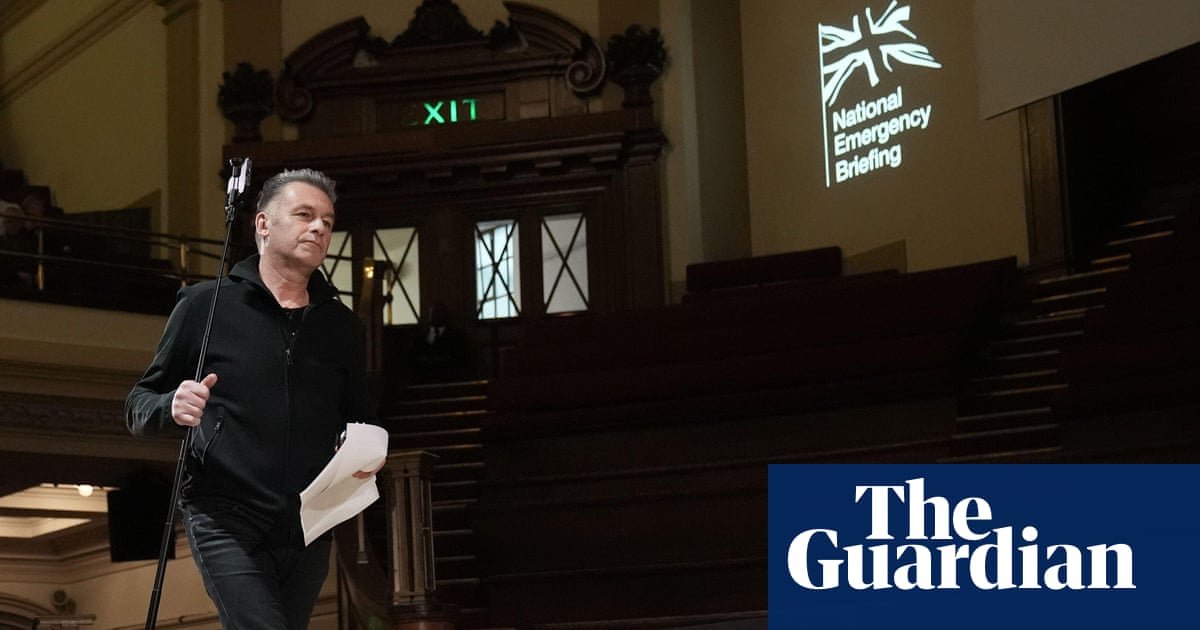
Last November, in the “first-of-its-kind national emergency briefing”, nine experts gave stark assessments in Westminster Hall in London of the scale of the changes needed in the UK to adapt to the rapidly changing climate and ecological landscape.
asserted
experts → give → climate
The team behind the event crowdfunded to produce the People’s Emergency Briefing, a film outlining the urgent threats that climate and nature breakdown pose to food security, the economy and public health.
asserted
breakdown → crowdfunde → security
The film, which has so far been viewed by an estimated 185,000 people at more than 3,400 screenings, calls on the government to stage a primetime, televised emergency briefing on the climate and nature crisis.
asserted
which → view → crisis
Of the 13,000 people surveyed, 87% said watching the film made them more motivated to act.
asserted
them → survey → film
Watching the film is associated with a “substantial shift” in environmental understanding and concern.
asserted
Watching → watch → understanding
Furthermore, 89% of people said the government should respond to the crisis with emergency-level mobilisation, similar to the Covid-19 pandemic or the second world war.
asserted
government → say → pandemic
Prof Mike Berners-Lee, the chair of the National Emergency Briefing, said the threat from Covid-19 was easy for the public to understand when they were trusted with the facts.
asserted
they → say → facts
The team is calling for a similar united emergency response delivered by independent experts and fronted by the prime minister.
asserted
team → call → minister
In addition, 93% of those surveyed said the public was not being fully informed about the climate crisis and nature loss.
asserted
public → survey → crisis
The government has previously been accused of hiding the truth from the public after refusing to publish a report from UK intelligence officers warning of the catastrophic impacts on national security from the collapse of vital ecosystems around the world.
asserted
government → accuse → world
Prof Lorraine Whitmarsh, from the University of Bath who led the research, said while most people were aware of some of the risks associated with the climate crisis, the “second-order risks” around national security, food supplies and impacts on the NHS were not so obvious.
asserted
risks → lead → NHS
She said: “Once somebody has sat through the film, I think they understandably feel everybody should know about these risks as these are going to be things that impact everybody on a day-to-day level, and so they support that greater education of the public.”
asserted
they → say → public
The National Emergency Briefing team is calling on Andy Burnham to be honest about the scale of the threat posed by climate and nature breakdown.
asserted
team → call → breakdown
“In doing that, he will send out a message that he speaks the truth, however comfortable or uncomfortable,” said Berners-Lee.
asserted
Lee → do → truth
John Swinney, the first minister of Scotland, recently attended a screening of the film at the Scottish parliament.
asserted
Swinney → attend → parliament
The UK government did not respond to a request for comment on whether it will screen the film but said it “welcomes any campaign that keeps our action against climate change and nature loss in the public discussion”.
asserted
that → respond → discussion
 The Aporia