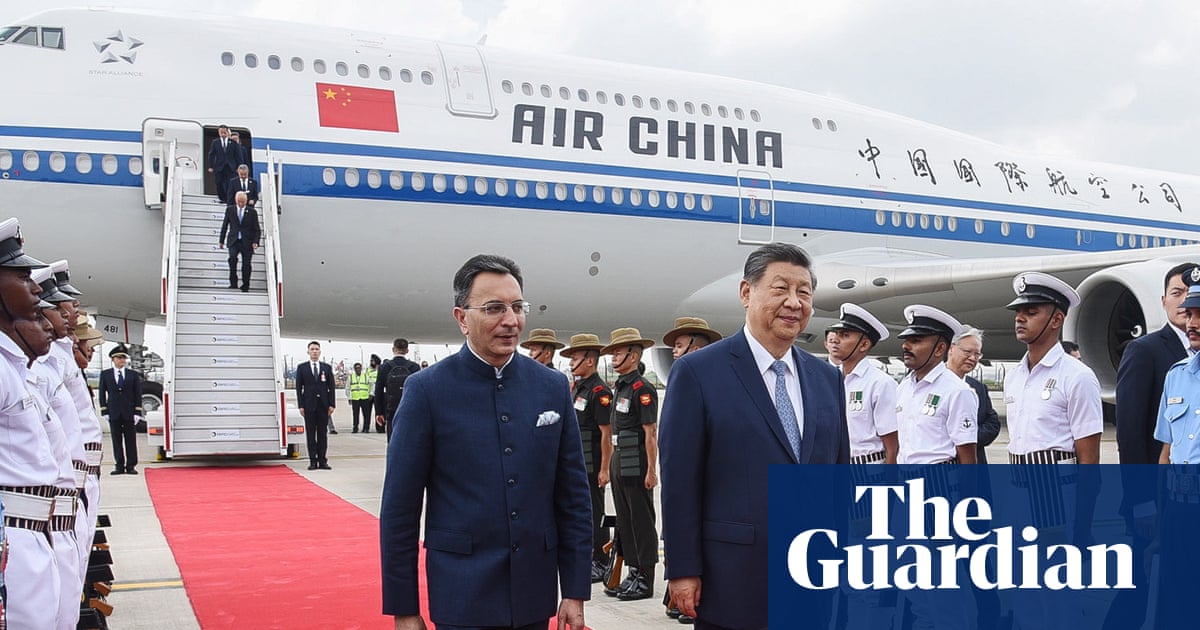
China announced on Thursday (September 10, 2026) that President Xi Jinping will attend the BRICS Summit in New Delhi on September 12, on what will be his first visit to India in almost seven years.
asserted
what → announce → years
Mr. Xi last visited in October 2019 for an informal summit with Prime Minister Narendra Modi at Mamallapuram near Chennai.
asserted
Xi → visit → Chennai
The two leaders are expected to meet for bilateral talks on the sidelines of the summit in New Delhi.
asserted
leaders → expect → Delhi
India-China trade talks planned
Mr. Xi will be accompanied by a large delegation, including Politburo member and Foreign Minister Wang Yi, and Commerce Minister Wang Wentao, who is likely to have talks on the sidelines with Commerce Minister Piyush Goyal, his counterpart.
asserted
who → plan → Goyal
The talks between the two trade ministers will give both sides the opportunity to take stock of a growing but challenging trade relationship and air their respective concerns, with India seeking an easing of export controls and China wanting further relaxation of investment restrictions.
asserted
China → give → restrictions
Beyond the outcomes, Mr. Xi’s visit in itself holds enormous significance for the relationship in the view of India and Chinese officials, and for the continued normalisation process.
asserted
visit → hold → process
Especially on the Chinese side, a visit by Mr. Xi to India, after a seven-year gap, is seen as important signalling to the Chinese system on where relations are headed after a difficult period.
asserted
relations → see → period
With the upcoming summit, there was “a valuable opportunity to deepen China-India cooperation on issues of mutual concern, from trade and connectivity to climate action, public health and the digital economy, while contributing constructively to a more balanced, inclusive and equitable global order”, Indian Ambassador to China Vikram Doraiswami wrote in an article published on Thursday (September 10) in the Communist Party-run Global Times.
asserted
Doraiswami → be → Times
“As two of the world’s most populous emerging economies, a stable, predictable and amicable relationship between India and China is not only in the interest of our 2.8 billion people, but is also a significant factor for peace, stability and prosperity in Asia and the wider world,” he said, adding that “peace and tranquility in the China-India border areas provide an essential foundation for this partnership.”
Border tensions starting in April 2020, culminating in a clash at Galwan Valley in June that marked the worst violence along the disputed border in many years, brought a four-year freeze in relations.
asserted
that → emerge → relations
Following a meeting between Mr. Modi and Mr. Xi in October 2024 on the sidelines of the BRICS summit in Kazan, both sides have begun a gradual and steady normalisation in relations.
asserted
sides → follow → relations
Mr. Modi and Mr. Xi last met at the SCO Summit in Tianjin, China, in August last year, when they both “welcomed the positive momentum and steady progress in bilateral relations” and “reaffirmed that the two countries were development partners and not rivals, and that their differences should not turn into disputes.”
asserted
differences → meet → disputes
‘Both sides may aim to keep ties stable’
uncertain
sides → aim → ties
In China, the visit by Mr. Xi is being seen as an effort by both sides to keep ties stable, rather than as an indicator of any significant realignment.
asserted
visit → see → realignment
“I would describe it as strategic risk management rather than strategic realignment,” Hu Shisheng, Director of the South Asia Institute at the China Institutes of Contemporary International Relations (CICIR) in Beijing told The Hindu in a recent interview.
asserted
Shisheng → describe → interview
“Recent difficulties in India-U.S. relations may give New Delhi greater incentives to diversify its strategic options, while the relative stabilisation of China-U.S. ties reduces some of the external pressure on China-India relations.
uncertain
stabilisation → give → relations
But the structural differences between China and India have not disappeared.
asserted
differences → disappear → China
What we are seeing is an attempt to build a more stable form of competitive coexistence – keeping the border peaceful, restoring practical cooperation, and expanding coordination through BRICS and the Global South without pretending that strategic competition no longer exists.”
asserted
competition → see → BRICS
During talks in Beijing last month, both National Security Adviser Ajit Doval and Mr. Wang, the Foreign Minister, specifically highlighted the positive impact that meetings between the leadership had on the relationship in setting the trajectory.
asserted
meetings → highlight → trajectory
Last month, both countries agreed to advance discussions on “an Early and Substantial Harvest of boundary delimitation”, according to an eight-point outcome document released after the 25th round of talks between the Special Representatives (SR) in Beijing.
uncertain
countries → agree → Beijing
They also agreed to hold the next meeting of an expert-level mechanism on trans-border rivers later this month to discuss sharing of hydrological data and other issues, which have taken on added significance following the recent devastating glacial collapse on the Nepal-China border.
asserted
which → agree → border
The talks in Beijing also saw both sides agree on an additional two meeting points to hold Senior Highest Military Commander meetings, and two additional channels of border military hotlines in the Eastern and Middle Sectors of the border.
asserted
sides → see → border
Keeping the peace on the Line of Actual Control (LAC) remains the biggest challenge to the continued effort at normalising relations.
asserted
Keeping → keep → relations
While both sides have worked hard to keep the LAC in the Western Sector largely tranquil over the past two years, recent weeks have seen reports of tensions and a stand-off in the Eastern Sector in Arunachal Pradesh, in an area where both sides have overlapping claims.
uncertain
sides → work → claims
On September 6, the Indian and Chinese armies held their first Corps Commander-level meeting in the Eastern Sector, marking an expansion of the military dialogue mechanism beyond the Ladakh sector.
asserted
armies → hold → sector
The meeting was held at the Vacha-Damai Border Personnel Meeting Point in Arunachal Pradesh amid reported tensions in the Taksing area of Upper Subansiri district.
asserted
meeting → hold → district
On the trade front, India remains concerned with the widening trade deficit.
asserted
India → remain → deficit
In the first six months of the year, two-way bilateral trade was up to $91.72 billion, a 23.6% rise from last year, and on track to surpass the record $155.62 billion trade figure from 2025, when China was again India’s biggest trade partner in goods.
asserted
China → surpass → goods
The trade deficit reached $67.1 billion after the first half of the year, also on track to exceed last year’s record $116.12 billion figure.
asserted
deficit → reach → figure
India’s exports to China have also registered strong growth, up by 37.2%, albeit from a small base, to $12.31 billion.
asserted
exports → register → billion
Among India’s exports to China are an increasing amount of Printed Circuit Boards (PCBs), which India previously used to import in bulk from China.
asserted
India → increase → China
More than the quantum of the trade deficit, the nature of the basket of goods is a concern, including large quantities of finished electronics and other equipment.
asserted
nature → include → electronics
India, at the same time, also imports a large amount of intermediates required by Indian manufacturing.
asserted
India → import → manufacturing
Earlier this year, Mr. Doraiswami, India’s Ambassador in Beijing, said “it would be easier to consider that the trade wouldn’t be exactly 50-50 balanced, but one side would have more exports, provided that exports consist of goods that we can also add value.”
asserted
we → say → value
“If it is pure consumption goods, that becomes a little harder to sell as a reasonable mechanism for the deficit,” he said.
asserted
he → become → deficit
 The Aporia