Washington Examiner
· collected 2026-10-12 · by John Hannah and Rena Gabber
Story summary
In late February, Iran launched missile attacks on Naval Support Activity Bahrain, a U.S. base in the Persian Gulf, severely damaging it according to Hung Cao, the acting Navy Secretary. The base served as headquarters for the U.S. Fifth Fleet. Top Admiral Daryl Caudle confirmed they wouldn't be returning anytime soon due to the damage and vulnerability.
This attack highlights a critical debate over whether to rebuild, downsize, or abandon U.S. bases in the region given Iran's capability to impede access through the Strait of Hormuz, a strategic waterway. The incident underscores that the decision about the Navy’s return to the Gulf is no longer solely within Washington’s control, as Iran now has significant leverage due to its ability to threaten maritime security.
This development marks a shift in power dynamics and challenges former U.S. President Trump's strategy of bolstering regional allies against Iranian influence.
Written for “Iran Attacks Bahrain” on 2026-10-12,
grounded in this article and the 0 other(s) covering the same event.
“They blew the hell out of Bahrain.”
asserted
They → blow → Bahrain
That was acting Navy Secretary Hung Cao’s assessment last month of the damage Iranian missiles have done to Naval Support Activity Bahrain — the base inside the Persian Gulf that served for decades as the headquarters of the U.S. Fifth Fleet.
asserted
that → act → Fleet
He wasn’t exaggerating.
asserted
He → exaggerate → ?
Two weeks earlier, the Navy’s top admiral, Daryl Caudle, told sailors evacuated from NSA-Bahrain that “We’re not getting back in there anytime soon.”
asserted
We → tell → Bahrain
An important debate has begun about the future of NSA-Bahrain and other U.S. bases damaged by Iranian missiles.
asserted
debate → begin → missiles
Should they be rebuilt, downsized, or abandoned due to their vulnerability?
asserted
they → rebuild → vulnerability
Before answering, however, U.S. officials must first confront a difficult new reality highlighted by the war: The decision about whether the Navy returns to the Gulf is no longer Washington’s alone to make.
asserted
Navy → answer → Gulf
With its newfound ability to impede access to the Strait of Hormuz, Iran now has a vote and every incentive to use it.
asserted
Iran → impede → it
Driving the U.S. military out of the Gulf has long been a core Iranian objective.
asserted
Driving → drive → Gulf
Before Feb. 28, that objective ran up against the reality of America’s unchallenged naval dominance.
asserted
objective → run → dominance
But the Fifth Fleet’s wartime withdrawal outside the Gulf, NSA-Bahrain’s devastation, and Iran’s unprecedented success contesting Hormuz have thrown America’s maritime primacy into doubt.
asserted
withdrawal → contest → doubt
Iran is now determined to transform the Fifth Fleet’s presence from a fixed feature of the region’s geography into a negotiated outcome.
asserted
Iran → determine → outcome
Iran previewed its playbook in last June’s memorandum of understanding that was supposed to end the war.
asserted
that → preview → war
That deal committed Iran to restoring safe passage in Hormuz, but only for “commercial vessels.”
asserted
deal → commit → vessels
It was a stunning omission, especially given the Navy’s historical role as guarantor of the free flow of oil through Hormuz.
asserted
It → give → Hormuz
Though the MOU quickly collapsed, Iran had nevertheless established a deeply problematic precedent: that commercial shipping and U.S. naval access are separable questions.
asserted
shipping → collapse → precedent
It will almost certainly demand maintaining that separation in any future arrangement to end the war.
asserted
It → demand → war
And it will bank on influential forces eager to restore commerce through Hormuz — energy markets, U.S. allies, and Americans demanding lower gas prices — to pressure the Trump administration to also accept the tankers vs warships distinction.
asserted
it → bank → distinction
How would the United States respond to an Iranian offer to reopen Hormuz so long as the U.S. Navy remains out?
asserted
Navy → respond → Hormuz
Acceptance would be seen as a devastating defeat that forced the world’s most formidable maritime power to retreat from waters it dominated for decades.
asserted
it → see → decades
But insisting on the reestablishment of the prewar status quo, with American destroyers plying the Gulf within eyeshot of Iran, carries its own substantial risks.
asserted
destroyers → insist → risks
It’s one thing if it can be secured through the administration’s current effort to strangle Iran economically via a naval blockade and sanctions.
asserted
it → ’ → blockade
It’s quite another if it can only be won by the Navy fighting its way back into the Gulf and imposing its will on an Iranian leadership that not only appears determined to resist but remains capable of doing so.
asserted
it → ’ → leadership
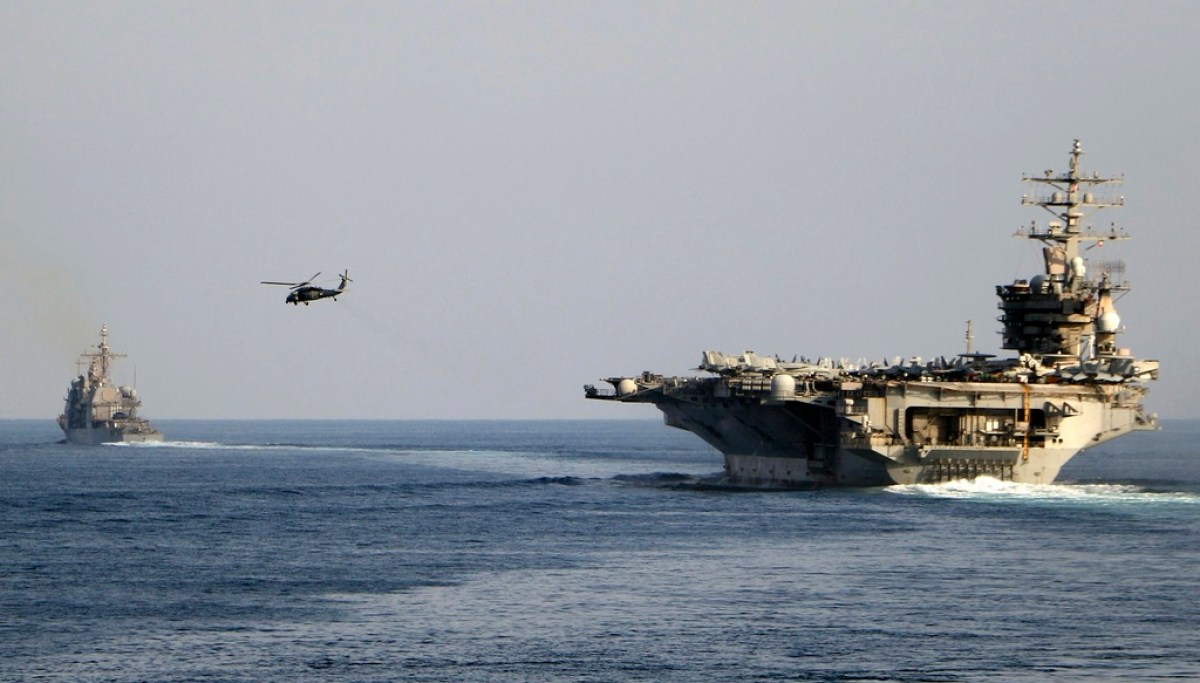
The Navy effectively left the Gulf at the war’s start and hasn’t been back since, precisely because the risks of getting within range of Iranian missiles have been deemed prohibitively high.
asserted
risks → leave → missiles
The job the U.S. military has recently done to loosen Iran’s chokehold on Hormuz and get more oil out has been extraordinary, but far from a classic naval “escort” mission.
asserted
military → do → mission
Instead, the operational burden has fallen to aerial and unmanned assets — fighter jets, autonomous vehicles, helicopters, anti-missile systems — to establish a protective dome over commercial ships as they surreptitiously sail through Hormuz at night, absent a naval convoy.
asserted
they → fall → convoy
The heart of the Navy, its capital ships, has been left enforcing the blockade from hundreds of miles outside Hormuz, maintaining a cautious distance from threatening Iranian fire.
asserted
heart → leave → fire
Between abandonment and the status quo ante, there may be a third option that reconceives what a naval headquarters entails and is better suited to 21st-century warfare.
uncertain
headquarters → reconceive → warfare
Rather than large ships manned by thousands of sailors, maybe it means a new and newly hardened command and control center at NSA-Bahrain that oversees offensive, defensive, and intelligence operations conducted by thousands of cheap drones operating above, on, and beneath the Gulf’s waters.
asserted
that → man → waters
Hormuz’s future has become a key benchmark by which the U.S. war against Iran will be judged.
asserted
war → become → Iran
But it’s imperative that U.S. officials understand the full magnitude of what’s at stake.
asserted
what → ’ → stake
It will also be whether the most powerful navy on Earth can again operate effectively in waters where it ruled supreme for decades.
asserted
it → operate → decades
The answer, whatever it is, will echo far beyond the Gulf.
asserted
it → echo → Gulf
John Hannah served in the George H.W. Bush, Bill Clinton, and George W. Bush administrations, including as national security adviser to former Vice President Dick Cheney.
asserted
Hannah → serve → Cheney
 The Aporia