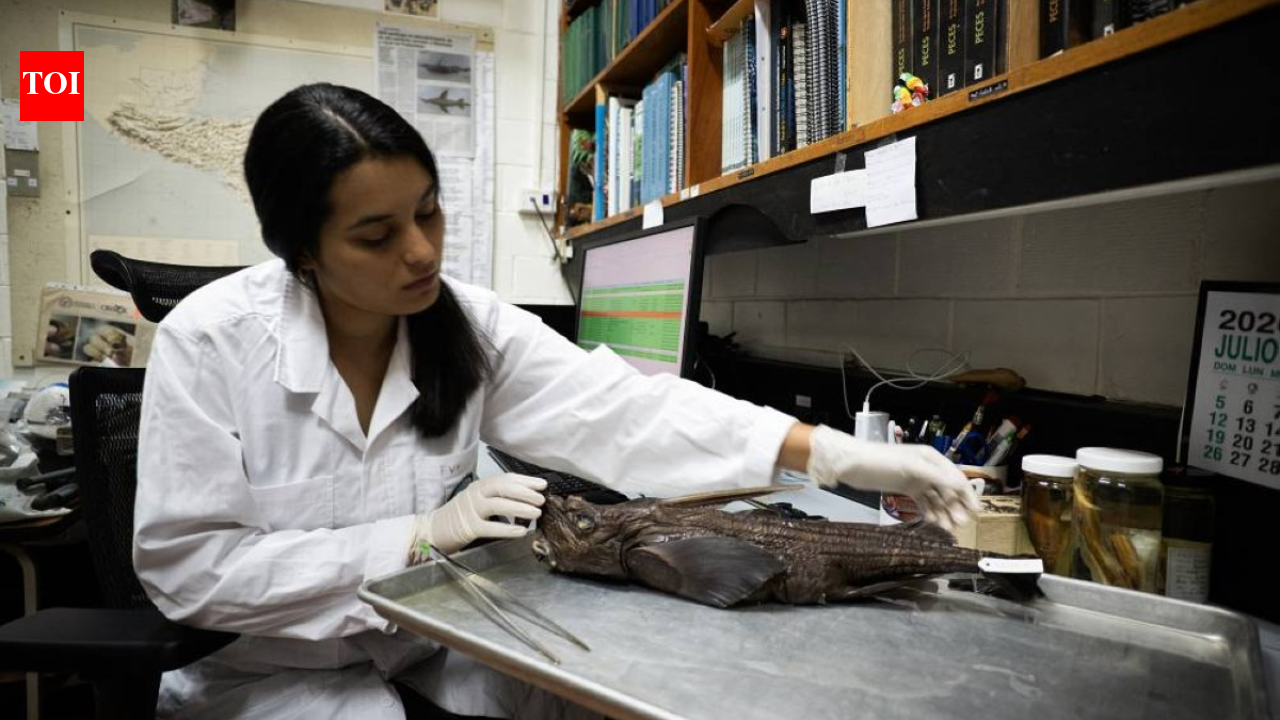
Far below the surface of Costa Rica’s Pacific coast, where sunlight disappears and fishing grounds give way to deep water, three unusual fish specimens had been sitting in scientific collections for years.
asserted
specimens → disappear → years
They would eventually become the basis for describing a species unknown to science.
asserted
They → become → science
At the centre of that work was Naidely Valeria Vidaurre-Quesada, a biology student at the University of Costa Rica who became the lead author of the study.
asserted
who → become → study
The fish belonged to the chimaera family, a little-known group of cartilaginous animals related to sharks and rays and often called ghost sharks.
asserted
fish → belong → sharks
The species, named Rhinochimaera costaricana, was formally described in Zootaxa on June 10, 2026.
asserted
species → name → June
Costa Rica’s deep waters held clues to a new ghost shark species
asserted
waters → hold → species
According to the study published in Zootaxa, titled, ‘
A new species of Rhinochimaera Garman 1901 (Holocephali: Chimaeriformes: Rhinochimaeridae) from the Eastern Pacific Ocean’ reveals the first of the three specimens was collected in 2000 near Isla del Caño.
uncertain
first → publish → Caño
Two more were recovered much later, in 2023, during fisheries research off Cabo Blanco in Puntarenas.
asserted
Two → recover → Puntarenas
All three were male, measuring between 775 and 830 millimetres long.
asserted
three → measure → ?
Their habitat was far removed from the familiar coastal waters of Costa Rica.
asserted
habitat → remove → Rica
The specimens came from depths between 390 and 787 metres, placing them in a part of the Pacific that remains difficult to study directly.
asserted
that → come → Pacific
For years, individual specimens can exist in collections without their significance being fully understood.
asserted
significance → exist → collections
In this case, bringing the material together allowed Vidaurre-Quesada and her colleagues to examine whether the fish represented a known species or something that had escaped scientific recognition.
asserted
that → bring → recognition
She was the lead author of the scientific study that formally described Rhinochimaera costaricana, a previously unrecognised deep-sea ghost shark from Costa Rica’s Pacific waters.
asserted
that → describe → waters
As reported by The Costa Rican News ,as part of the research, she travelled to the Natural History Museum in London, where she examined older specimens and records of the Rhinochimaera genus.
asserted
she → report → genus
This helped the team determine that the Costa Rican specimens were distinct from the three species already known.
asserted
specimens → help → species
Her work shows how museum collections, fisheries research and modern genetic analysis can come together to reveal species that have remained scientifically overlooked for years.
asserted
that → show → years
DNA evidence revealed the fish was unlike the three known species
The Rhinochimaera genus already contained three recognised species: R. africana, R. atlantica and R. pacifica.
asserted
genus → reveal → species
Establishing a fourth required the Costa Rican specimens to be compared with those existing species.
asserted
specimens → establish → species
DNA sequences provided another line of evidence.
asserted
sequences → provide → evidence
The specimens showed genetic differences of 3.9% from R. africana, 4.5% from R. atlantica and 4.7% from R. pacifica.
asserted
specimens → show → pacifica
Taken alongside the anatomical characteristics, those differences supported the conclusion that the Costa Rican fish was not simply a regional form of one of the existing species.
asserted
fish → take → species
The scientific name reflects its origin.
asserted
name → reflect → origin
Rhinochimaera costaricana places the animal within its genus while identifying Costa Rica in its species name.
asserted
costaricana → place → name
PC: Costa Rican News
Old museum specimens helped Vidaurre-Quesada confirm a new species
Museum collections can provide a useful second look at discoveries like this.
asserted
collections → help → this
A specimen that appears unusual in one collection may turn out to resemble an animal preserved decades earlier somewhere else.
uncertain
that → appear → animal
Comparing historical material helps researchers avoid giving a new name to something that has already been documented.
asserted
that → compare → something
In Vidaurre-Quesada's case, the work helped establish that the Costa Rican specimens represented a species distinct from the three Rhinochimaera species already recognised.
asserted
specimens → help → species
How fisheries research helped uncover the shark
The discovery also says something about where scientific knowledge can come from.
asserted
knowledge → help → where
Two of the specimens were obtained during fisheries research rather than a dedicated search for a previously unknown chimaera.
asserted
Two → obtain → chimaera
That connection between fisheries work and zoological collections gave researchers access to animals from depths that are difficult to reach and observe routinely.
asserted
that → give → depths
Once transferred to the UCR Museum of Zoology, the specimens could be examined, compared and preserved for future work.
uncertain
specimens → transfer → work
The collaboration stretched beyond Costa Rica as well.
asserted
collaboration → stretch → Rica
The UCR and Incopesca worked with researchers at the Federal University of Pará in Brazil, while the examination of historical material took Vidaurre-Quesada to the Natural History Museum in London.
asserted
examination → work → London
 The Aporia