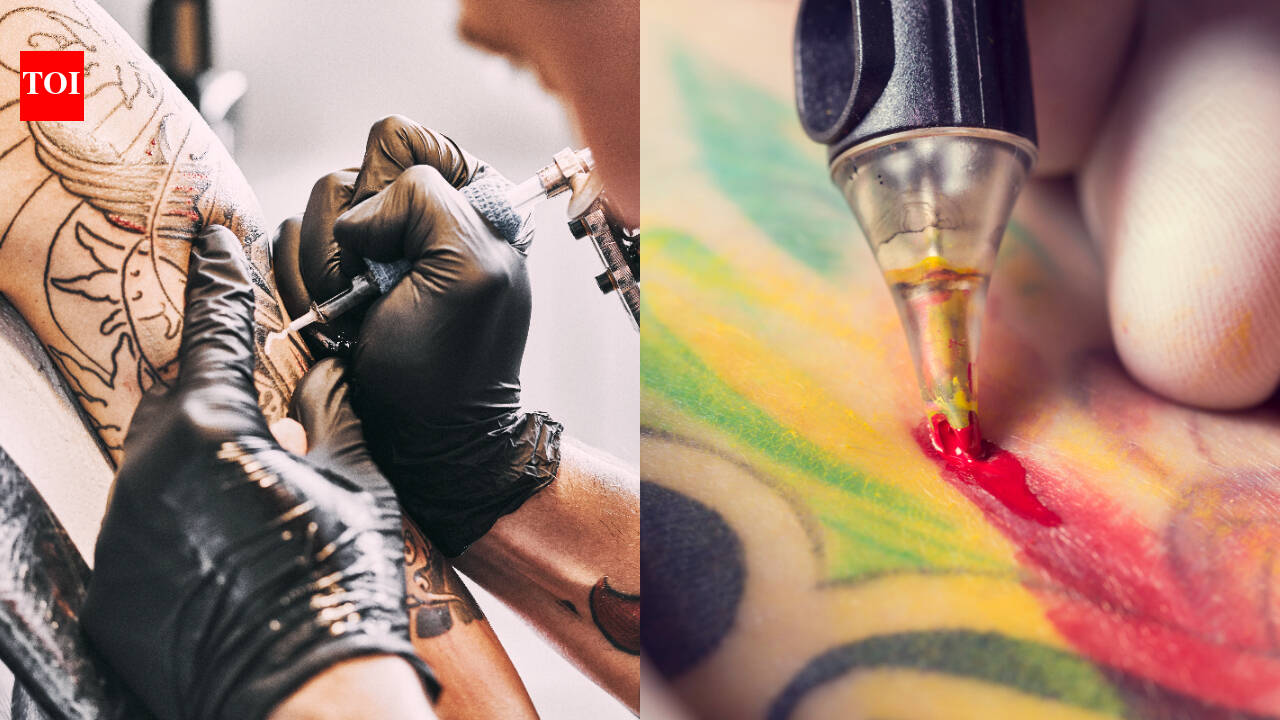
A tattoo has traditionally been a commitment etched into the skin, with removal often involving multiple laser sessions, discomfort and considerable expense.
asserted
removal → etch → sessions
But what if body art could be switched on for a night out and made to disappear the next morning?
uncertain
art → switch → night
Researchers are developing a light-sensitive tattoo ink that could make that possibility a reality, while opening up intriguing applications in medicine.
uncertain
possibility → develop → medicine
According to a report by Live Science, the technology, called PhotoTat, uses specially engineered pigments that respond to different wavelengths of light.
uncertain
that → accord → light
Developed by a team including Carson Bruns, an associate professor of biomedical engineering at the University of Colorado Boulder, the system could eventually allow tattoos to change colour, remain hidden until needed or disappear from view without removing the pigment from the skin.
uncertain
tattoos → develop → skin
Ink that responds to light
asserted
that → respond → light
According to Live Science report, PhotoTat uses three primary-colour inks — blue, magenta and yellow, containing photochromic dyes.
uncertain
PhotoTat → accord → dyes
These compounds alter their molecular structure when exposed to particular wavelengths of light, changing how they appear.
asserted
they → alter → light
The dyes are enclosed in nanoparticles made from polymethyl methacrylate (PMMA), a glass-like plastic also used in certain medical implants and dermal fillers.
asserted
dyes → enclose → implants
This formulation allows the pigments to be incorporated into the skin while retaining their ability to respond to light.
asserted
pigments → allow → light
A 365-nanometre ultraviolet LED can activate the pigments in approximately two to three seconds.
asserted
LED → activate → seconds
Once switched on, the colours can remain visible for hours or even days under ordinary indoor lighting.
asserted
colours → switch → lighting
Exposure to bright outdoor sunlight, however, makes them fade within seconds, the report adds.
asserted
report → make → seconds
The effect does not mean the tattoo pigment vanishes from the body.
asserted
pigment → mean → body
Instead, the ink changes its visible appearance, allowing the design to become effectively concealed.
asserted
design → change → appearance
In tests, the researchers found that the three PhotoTat colour channels remained switchable in the skin for periods ranging from 1.4 to 2.2 years.
asserted
channels → find → years
A tattoo that can change its look
Different wavelengths can activate different sections of a design, giving wearers greater control over how their tattoos appear.
asserted
tattoos → change → control
Magenta elements, for instance, can be activated with green light, while blue light can bring out yellow pigments.
asserted
light → activate → pigments
The technology can also be combined with conventional tattoo ink.
asserted
technology → combine → ink
A permanent black design could contain PhotoTat details that remain largely invisible until activated, creating artwork with an additional visual dimension, explains the report.
uncertain
report → contain → dimension
Bruns has tested successive versions of the ink on his own skin, arranging different formulations into a series of scale-shaped tattoos.
asserted
Bruns → test → tattoos
The experimental designs allow him to observe how individual pigments respond to light and how the system behaves over time.
asserted
system → allow → time
For people who enjoy body art but hesitate over its permanence, the approach could offer a different kind of flexibility.
uncertain
approach → enjoy → flexibility
It might also help tattoo enthusiasts temporarily conceal designs for professional or personal reasons without resorting to clothing or makeup.
uncertain
enthusiasts → help → clothing
From body art to medical applications
According to the report, the more consequential possibilities may lie beyond aesthetics.
uncertain
possibilities → accord → aesthetics
Patients undergoing radiation therapy sometimes receive small permanent tattoos to help medical teams align radiation beams accurately.
asserted
teams → undergo → beams
PhotoTat could potentially make such markings visible during treatment and conceal them once they are no longer required.
uncertain
they → make → them
Similar applications might be explored in surgical settings, where temporary visual markers could help clinicians during procedures without leaving permanently visible marks afterward.
uncertain
markers → explore → marks
Bruns has also worked on other smart tattoo technologies, including designs intended to measure ultraviolet exposure and indicate exposure to dangerous gamma radiation.
asserted
Bruns → work → radiation
Such developments could eventually offer specialised monitoring tools for people working in environments where radiation presents a risk, the report claims.
uncertain
report → offer → risk
What comes next?
asserted
What → come → ?
PhotoTat is still an emerging technology, and its broader applications will require further research.
asserted
applications → emerge → research
So far, only the purple ink has been commercialised, following third-party medical testing.
asserted
ink → commercialise → testing
It is available for around $100 for a small bottle, making affordability another hurdle before widespread adoption.
asserted
affordability → make → adoption
Researchers hope to bring additional colours to market and reduce production costs as development progresses.
asserted
development → hope → costs
Questions about long-term safety, performance and practical use will also matter as the technology advances.
asserted
technology → matter → safety
For now, the idea of a tattoo that can disappear without being removed remains a promising experiment.
asserted
that → disappear → tattoo
If further research supports its potential, light-sensitive ink could eventually transform body art from a permanent statement into something far more adaptable and give medicine another way to make useful markings visible only when needed.
uncertain
markings → support → way
 The Aporia