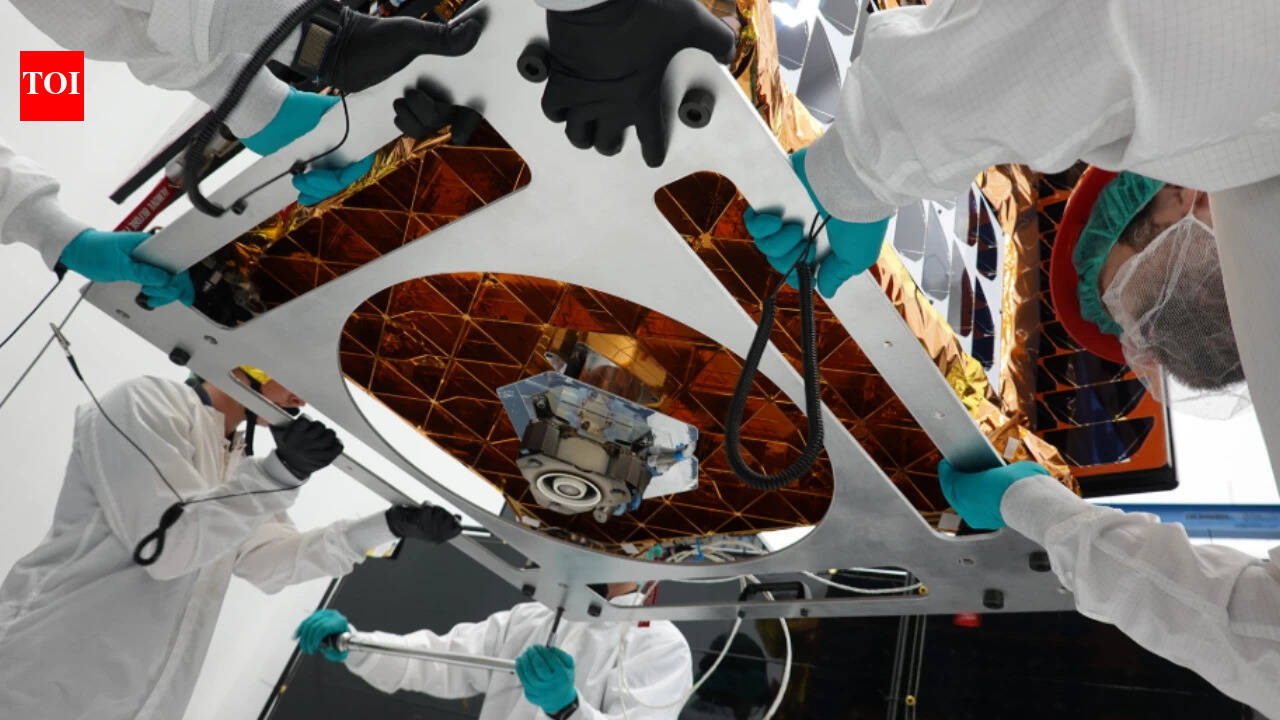
A spacecraft about the size of a washing machine is preparing to approach objects that are no longer working in Earth's orbit.
asserted
that → prepare → orbit
The mission, supported by
NASA
asserted
mission → support → NASA
, will test whether a spacecraft can independently navigate towards inactive satellites and rocket bodies, examine their condition and move between different orbits.
asserted
spacecraft → test → orbits
The technology could eventually help repair spacecraft or remove unwanted objects from space.
uncertain
technology → help → space
The mission, called Small Spacecraft Propulsion and Inspection Capability (SSPICY), was launched on October 1 from Vandenberg Space Force Base in California.
asserted
mission → call → California
It involves a spacecraft named Otter, developed by US-based company Starfish Space.
asserted
It → involve → Space
According to NASA, Otter will approach up to four inactive space objects of US origin in low Earth orbit, including satellites and rocket bodies.
uncertain
Otter → accord → satellites
The inspections are expected to begin in early 2027.
asserted
inspections → expect → 2027
During this phase, Otter will travel to within hundreds of yards of each object and examine it without making physical contact.
asserted
Otter → travel → contact
Much of the navigation will be handled by the spacecraft's own software, with minimal assistance from controllers on Earth.
asserted
Much → handle → Earth
The mission is not intended to repair satellites or remove space debris immediately.
asserted
mission → intend → debris
Instead, it will test several technologies together to determine whether they can support such operations in the future.
asserted
they → test → future
NASA says this will be the first time these capabilities are demonstrated as an integrated system.
asserted
capabilities → say → system
How will spacecraft inspect objects in orbit?
asserted
spacecraft → inspect → orbit
Approaching an inactive satellite is different from approaching one that is still operating.
asserted
that → approach → one
A spacecraft that is no longer functioning may be spinning or positioned in a way that makes it difficult for another spacecraft to approach safely.
uncertain
spacecraft → function → way
To carry out the inspections, Otter will use autonomous guidance and control software.
asserted
Otter → carry → software
This means the spacecraft will be able to make navigation decisions without waiting for instructions from ground controllers at every stage.
asserted
spacecraft → mean → stage
Its computer vision system and sensors will help it observe nearby objects and determine how to approach them.
asserted
it → help → them
The software will use this information to make navigation decisions in real time as Otter moves closer to its targets.
asserted
Otter → use → targets
During each inspection, the spacecraft will collect information about the object's spin rate, orientation and surface condition.
asserted
spacecraft → collect → rate
Spin rate refers to how quickly an object rotates, while orientation describes the direction in which it is positioned.
asserted
it → refer → which
Examining the surface will provide information about its physical condition.
asserted
Examining → examine → condition
These observations are important for understanding how a future spacecraft might safely approach an object that is no longer under active control.
uncertain
that → understand → control
How will Otter travel between different objects?
asserted
Otter → travel → objects
The SSPICY mission will also demonstrate how a small spacecraft can move between objects travelling in different orbits.
asserted
spacecraft → demonstrate → orbits
Otter is equipped with an electric propulsion system that will allow it to travel between inspection targets.
asserted
it → equip → targets
The mission will test how this system works alongside other technologies needed for precise movement in space.
asserted
system → test → space
Another important component is an articulating robotic boom.
asserted
component → articulate → ?
This movable structure will be used to test the positioning of the spacecraft's thrusters, which provide the force needed to change its movement.
asserted
which → use → movement
By adjusting the direction in which the thrusters point, the spacecraft will test precise manoeuvring between different orbits.
asserted
spacecraft → adjust → orbits
NASA says the combination of electric propulsion, autonomous navigation, sensors and the robotic boom is central to the demonstration.
asserted
combination → say → demonstration
Although these technologies have different functions, the mission will examine how they perform together during a series of close approaches.
asserted
they → have → approaches
Why is NASA testing this technology?
asserted
NASA → test → technology
The mission comes as increasing numbers of satellites are being launched into Earth's orbit.
asserted
numbers → come → orbit
Thousands of satellites are launched each year to support services such as communications, weather forecasting and navigation.
asserted
Thousands → launch → communications
However, satellites and rocket bodies can remain in orbit after they stop working.
asserted
they → remain → orbit
Objects that experience problems or are no longer in service may collide with one another or break apart.
uncertain
that → experience → one
Such incidents can produce orbital debris, ranging from large fragments to much smaller particles.
asserted
incidents → produce → particles
These objects create concerns for spacecraft operating in the same environment.
asserted
objects → create → environment
…and 10 more, not listed.
 The Aporia