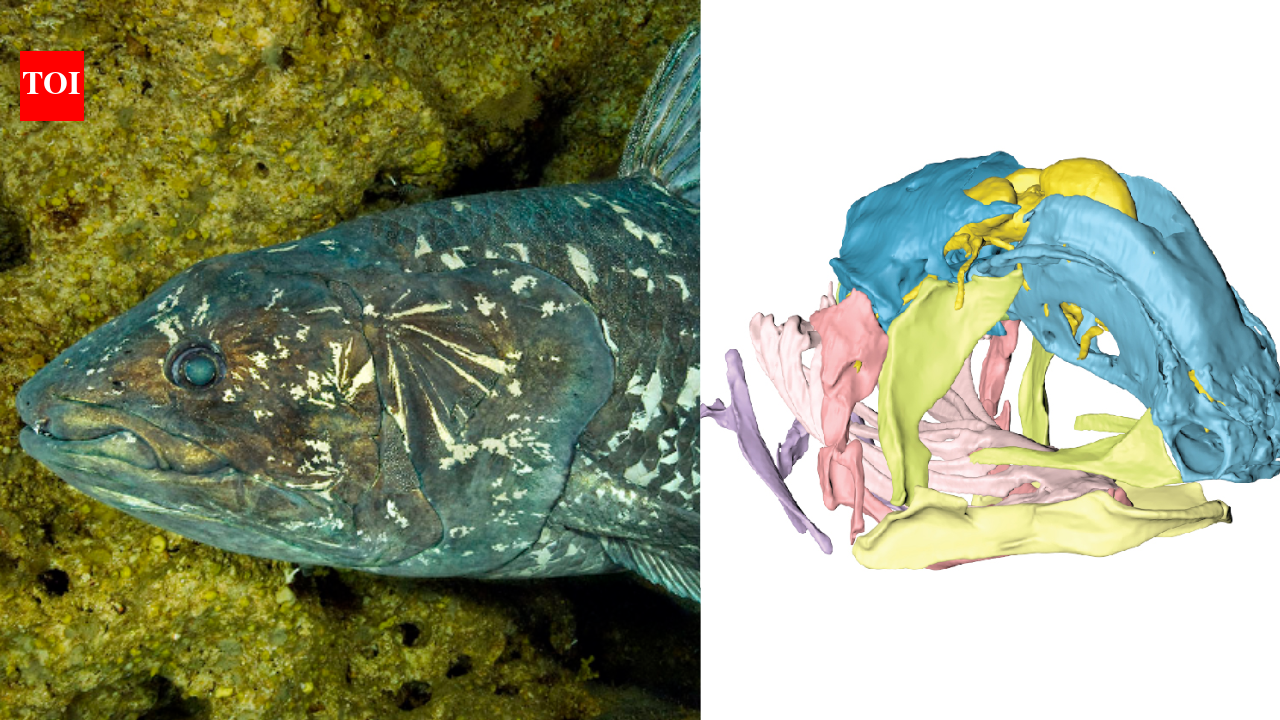
Scientists have revealed how coelacanths' skulls grow while keeping their brains small, using advanced imaging techniques on rare museum specimens. Published in Nature in 2019, the study led by Hugo Dutel from the University of Bristol found that the coelacanth's braincase is split by a joint and its brain occupies just one percent of the cavity, an unprecedented mismatch among living vertebrates. The research sheds light on the development of this deep-sea fish thought extinct for seventy million years until 1938 when it was rediscovered off South Africa.
Written locally by qwen2.5:14b on 2026-10-10,
using this article's own text rather than the other coverage of the
same event (that is the story summary below).
In 2019, scientists unveiled the first observations of how the skull and brain develop in the living coelacanth, Latimeria chalumnae, a deep-sea fish once thought extinct for seventy million years.
asserted
skull → unveil → years
A team working with the National Museum of Natural History in Paris scanned rare museum specimens without damaging them and published the results in the journal Nature.
asserted
team → work → journal
The findings shed light on a hinged braincase and a surprisingly small brain.
asserted
findings → shed → braincase
The coelacanth's braincase is split by a joint, and its brain fills only one per cent of the cavity, a mismatch unequalled among living vertebrates.
asserted
brain → split → vertebrates
This opened new avenues for research.
asserted
This → open → research
A coelacanth thought extinct for seventy million years was caught alive in 1938
The European Synchrotron explains that the coelacanth is a marine fish closely related to tetrapods, the four-limbed vertebrates that include amphibians, mammals and reptiles.
asserted
that → think → amphibians
Scientists believed coelacanths had died out seventy million years ago, until a South African fisherman accidentally caught a living one in 1938.
asserted
fisherman → believe → 1938
Eighty years after that discovery, Latimeria still matters to researchers who want to understand where tetrapods came from and how their closest fossil relatives, the lobe-finned fishes, evolved.
asserted
relatives → matter → where
The study ‘
Neurocranial development of the coelacanth and the evolution of the sarcopterygian head’ was led by Hugo Dutel, a research associate in palaeobiology at the University of Bristol, and was published in Nature in April 2019.
asserted
study → lead → April
A hinged braincase and a tiny brain, the puzzling features of the living coelacanth
According to the report, one of the coelacanth's most unusual features is its hinged braincase.
uncertain
one → hinge → features
Among the other animals that share it are many fossil lobe-finned fishes from the Devonian period, roughly 410 to 360 million years ago.
asserted
fishes → share → period
A joint called the intracranial joint splits the coelacanth's braincase completely into a front part and a back part.
asserted
joint → call → part
The brain itself sits far to the rear of the skull and fills only one per cent of the cavity that houses it.
asserted
that → sit → it
The article says this mismatch is unequalled among living vertebrates.
asserted
mismatch → say → vertebrates
How the skull grows and why the brain stays so small had puzzled scientists for years, so the team examined specimens at different stages of development from several public natural history collections.
asserted
team → grow → collections
Coelacanths live in the deep ocean and are a critically endangered species (Image: ESRF)
Scanning a five-centimetre fetus with X-rays to build three-dimensional models
Adult coelacanths are well represented in museums, but fetuses are extremely rare.
asserted
fetuses → live → museums
The researchers therefore used advanced imaging to see inside the specimens without harming them.
asserted
researchers → use → them
The European Synchrotron reports that they digitised a fetus only five centimetres long, the earliest stage available for Latimeria, using synchrotron X-ray microtomography on a beamline called ID19.
asserted
they → report → beamline
The team combined those data with magnetic resonance imaging and micro-computed tomography scans to build detailed three-dimensional models.
asserted
team → combine → models
The models showed how the skull, the brain and the notochord, a tube running below the brain and spinal cord in early life, change from fetus to adult.
asserted
skull → show → adult
The researchers also compared their observations with what is known about skull formation in other vertebrates.
asserted
what → compare → vertebrates
An enlarging notochord may shape the braincase and the brain's relative size
In most vertebrates, the report explains, the vertebral column replaces the notochord early in embryonic development.
uncertain
column → enlarge → development
In Latimeria, the notochord instead expands considerably.
asserted
notochord → expand → Latimeria
The authors suggest this enlargement likely influences how the braincase is patterned and might underpin the formation of the intracranial joint.
uncertain
braincase → suggest → joint
It may also affect the brain, whose relative size drops dramatically during development.
uncertain
size → affect → development
 The Aporia