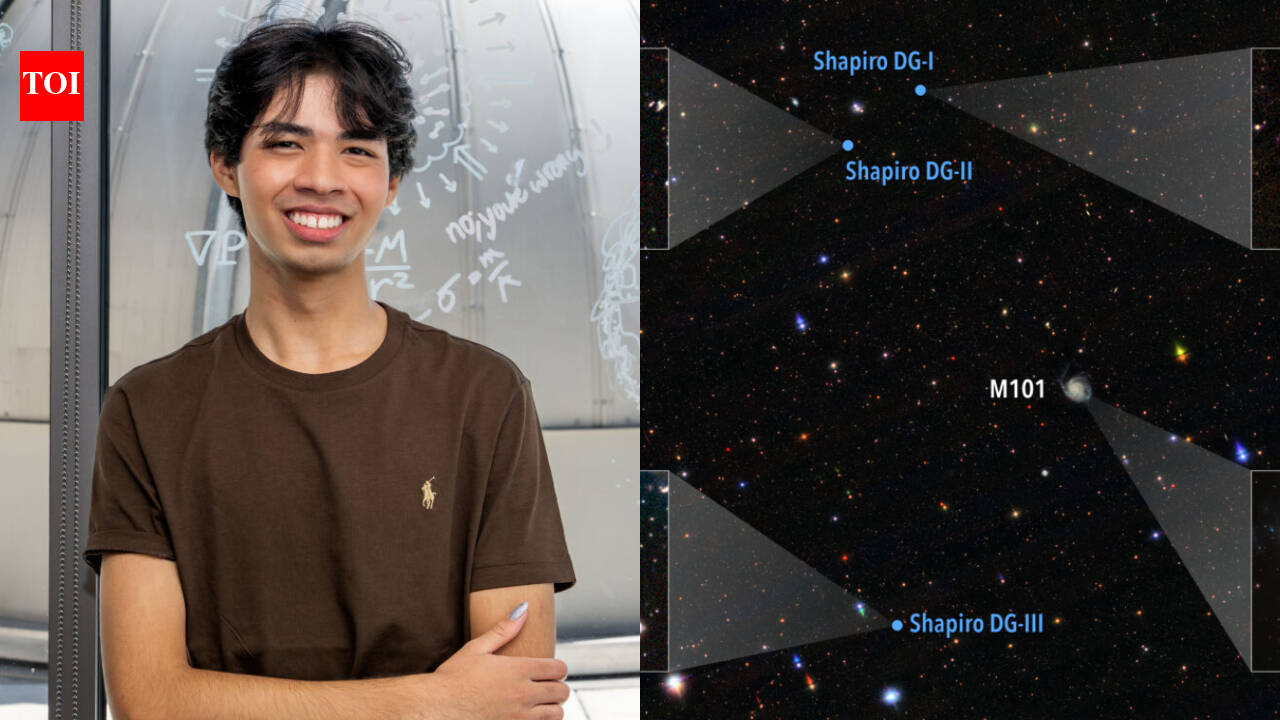
Eighteen-year-old Julian Shapiro discovered three unusual dwarf galaxies while still in high school, leading to recognition as a 2026 Davidson Fellow and authorship of an Astrophysical Journal paper alone. These galaxies, now named Shapiro Dwarf Galaxies I, II, and III, are notable because they appear isolated from other galaxies yet have stopped forming stars—contrary to expectations. One possible explanation is that these galaxies were once closer to a massive galaxy like the Pinwheel Galaxy, where forces stripped away their star-forming gas before ejecting them into more distant regions of space. Shapiro’s findings challenge existing models and provide evidence for the existence of backsplash galaxies predicted by the Lambda-CDM model.
Written locally by qwen2.5:14b on 2026-10-10,
using this article's own text rather than the other coverage of the
same event (that is the story summary below).
Some astronomical discoveries begin with powerful telescopes pointed at distant corners of the universe.
asserted
discoveries → begin → universe
Others begin much closer to home, with a teenager willing to spend hours combing through publicly available data and asking why something does not quite fit the expected picture.
asserted
something → begin → picture
For Julian Shapiro, that curiosity led to three peculiar dwarf galaxies, an Astrophysical Journal paper with his name alone on it and recognition as a 2026 Davidson Fellow, states the latest report by Berkeley News.
asserted
report → lead → News
Now an undergraduate astrophysics student at UC Berkeley, the 18-year-old New Yorker made the discovery while still in high school.
asserted
Yorker → make → school
Three galaxies that broke the pattern
The galaxies, now catalogued as Shapiro Dwarf Galaxies I, II and III, share an unusual combination of characteristics.
asserted
galaxies → break → characteristics
They are small, relatively isolated from other galaxies and, most importantly, appear to have stopped forming stars, states the report.
asserted
report → appear → stars
If we go by the Berkeley News report, dwarf galaxies in sparsely populated regions of space are generally expected to retain the cold gas required to create new stars.
asserted
galaxies → go → stars
By contrast, quenched dwarf galaxies, those that have effectively switched off their star-making activity are more commonly found close to massive galaxies.
asserted
that → quench → galaxies
There, gravitational and hydrodynamic forces can strip away the gas that fuels star formation.
asserted
that → strip → formation
Shapiro’s three discoveries appear to sit in the wrong neighbourhood for their condition, the report claims.
uncertain
report → appear → condition
The backsplash galaxy theory
One possible explanation is that the galaxies were not always as isolated as they appear today.
asserted
they → appear → ?
According to the report, Shapiro’s research suggests they could be examples of so-called backsplash galaxies.
uncertain
they → accord → galaxies
These are dwarf galaxies that once travelled close to a much larger galaxy, passed through its gravitational environment and lost much of their star-forming gas before being propelled back into a more distant region of space.
asserted
that → travel → space
The Pinwheel Galaxy, also known as Messier 101, is considered the leading candidate for the massive host that may have interacted with the newly identified dwarfs, the online report adds.
uncertain
report → know → dwarfs
A second possibility applies particularly to Shapiro Dwarf Galaxy II.
asserted
possibility → apply → Galaxy
Its position near the spiral galaxy NGC 5585 leaves open the possibility that it could actually be a faint satellite rather than a backsplash galaxy.
uncertain
it → leave → possibility
Either scenario could help explain how galaxies that appear isolated today became unable to form new stars.
uncertain
that → help → stars
Testing a long-standing prediction
The discovery has implications beyond three unusual objects, adds the report.
asserted
report → test → objects
The standard cosmological model, known as Lambda-CDM, predicts that backsplash galaxies should exist in significant numbers.
asserted
galaxies → know → numbers
Finding convincing examples in the nearby universe, however, has proved difficult.
asserted
Finding → find → universe
Shapiro used simulations to estimate where such galaxies should be found around a Milky Way-like galaxy and where existing telescope archives would be capable of detecting them.
asserted
archives → use → them
He then developed methods for identifying potential candidates and assessing whether their apparent isolation was genuine.
asserted
isolation → develop → candidates
A significant portion of the work involved estimating distances.
asserted
portion → involve → distances
Without accurate measurements, a galaxy that appears isolated could simply be much farther away from Earth than its apparent neighbours.
uncertain
that → appear → neighbours
And follow-up observations using high-resolution space telescopes could help establish the galaxies’ precise locations and determine whether their unusual lack of star formation is indeed the result of a past encounter.
uncertain
lack → follow → encounter
From high school to Berkeley
What makes the discovery particularly striking is when it happened.
asserted
it → make → Berkeley
Shapiro conducted the research while still in high school, before beginning his undergraduate studies at Berkeley.
asserted
Shapiro → conduct → Berkeley
His work has now earned him the 2026 Davidson Fellowship, which carries a $25,000 award, as well as the Astronomical League’s National Young Astronomer Award in 2025.
asserted
which → earn → 2025
As per the report, at Berkeley, he is pursuing astrophysics alongside mathematics and physics coursework.
asserted
he → pursue → coursework
He has also joined the research group of renowned astronomer Alex Filippenko; his next projects include investigating the Hubble tension, the continuing disagreement over how quickly the universe is expanding.
asserted
universe → join → tension
 The Aporia