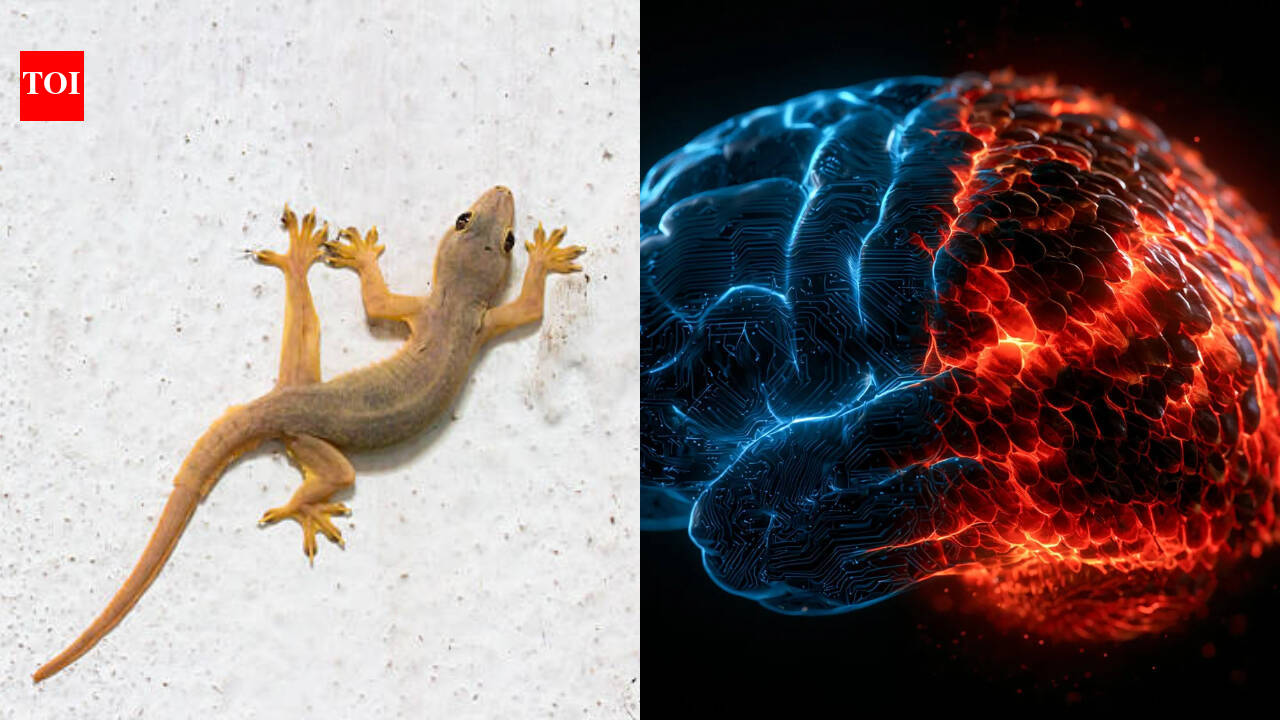
Scientists challenge 70-year-old ‘Lizard brain’ theory of human intelligence

Times of India · collected 2026-09-07 · by TOI Science Desk
Read the original at Times of India ↗

Summary

Researchers from Georgia Tech have published a study in Science Advances challenging the 70-year-old "lizard brain" theory of human intelligence, which posits that the brain is divided into separate layers of primitive and rational functions. The new research suggests that instead of distinct regions, different systems in the brain interact and change together across species, with a trade-off between neocortical and limbic system sizes. According to the study, this dynamic may be driven by how brains are wired before birth, with two fundamental approaches to neural connections: localized or distributed. The findings suggest that the traditional view of the brain's evolution is overly simplistic.
Written by the local model on 2026-09-07, using this article's own text rather than the other coverage of the same event (that is the story summary below).

Signals How these are calculated →

Claims extracted
38
claim-shaped sentences
Uncertain
21%
8 of 38 hedged
Leaning
not political
takes no side on a contested political question
Publisher trust
94.3
red-flag proxy, not a credibility rating
Outlets on this story
1
Science
Narrative spread
1
articles carrying this framing
Analyzed 2026-09-07 · how these are computed

AI analysis (generated at analysis time, not now)

Story summary

Scientists from Georgia Tech have challenged a 70-year-old theory of human intelligence that describes the brain as having three distinct layers, with a "lizard brain" at the bottom responsible for emotions and instincts. This old model was developed in the 1950s and has been widely accepted until now. However, researchers claim that this view is too simplistic and doesn't accurately reflect how the brain evolved. According to their study published in Science Advances, a new framework suggests that the brain's evolution was influenced by competition between different neural systems for limited space, rather than a hierarchical structure of layers. This research draws on comparisons with artificial neural networks and real biological brains to propose a more complex understanding of human intelligence.

Written for “Challenging Lizard Brain Theory” on 2026-09-07, grounded in this article and the 0 other(s) covering the same event.
Why this leaning score
This article does not take a side on a contested political question, so it has no leaning score. That is an answer rather than a gap: a match report or a rescue can be warmly or critically written without being left or right, and scoring it anyway is how approval of a subject gets recorded as a political position.
No political leaning scored for article 6761 · logged 2026-09-07

Story

📰 Challenging Lizard Brain Theory
Science · 1 article(s) covering the same event. This is the one the site leads with.

How this is being covered How these are calculated →

Article leaning vs. publisher reliability
Source leaning vs. consistency

Compared with similar articles

Nothing to compare against. No article is close enough to this one for the pipeline to have linked or judged the pair.

Publisher

Times of India · 213 article(s) · 0 correction(s) detected
No corrections detected for this publisher. That may mean careful reporting, or simply that nothing has been checked.

Who wrote this

TOI Science Desk
35 article(s) here · 1 carrying a prediction
🔮 Visitors may notice the bees, especially on warm, sunny days, but the insects are generally non-aggressive and focused on foraging and nest building rather than defending a large communal hive.
🔮 The temporary abundance is exciting; however, it may upend local fishing economics.
🔮 From the surface a lake might look like it is not changing at all but underneath it is a very different story.
🔮 Based on the surveys conducted, the team calculated that the total population could easily exceed 20,000 individuals.
🔮 Instead, scientists suggest, it may have been a competition between fundamentally different ways of wiring neural circuits, with limited brain space forcing different systems to compete, which influenced brain evolution.
🔮 The information from acoustic sonar could help wildlife authorities plan future maintenance and construction work.
🔮 Understanding these sounds could become increasingly important as Arctic ice continues to break up and retreat.
🔮 A single breeding pair of rats could, within a few years, rebuild a population large enough to threaten seabirds again.
🔮 The study looks at the Kv1.3 voltage-gated potassium channel, an ion channel found on immune cells that researchers believe may help control neuroinflammation linked to Alzheimer’s disease and other neurodegenerative conditions.
🔮 In the summer of 2026, workers and residents around the Williston Reservoir in northern British Columbia witnessed something that sounded like folklore: a large, forested island broke free from the shoreline, drifted across the lake, disappeared from view, and then turned up again about 30 kilometres away, still carrying mature trees, nesting birds and other wildlife.
Wire or desk byline, not an individual reporter.
Also by TOI Science Desk
Nothing else under this byline is closely related to this article, so these are simply their most recent.
All 35 articles by TOI Science Desk →

Topics

Georgia Tech Science Advances

Subjects

Georgia Tech ORG · 2× Science Advances ORG · 1×

Narrative

The old model was devised in the 1950s and perceived the brain in evolutionary layers, with basic bodily functions at the bottom, followed by an emotion-driven reptilian brain and finally the complex neocortex associated with human reasoning.
framing: mixed · carried by 1 article(s) · first seen 2026-09-07
🔮 Instead, scientists suggest, it may have been a competition between fundamentally different ways of wiring neural circuits, with limited brain space forcing different systems to compete, which influenced brain evolution.

Claims (38 extracted, 8 hedged)

That’s a good reason why we sometimes feel stuck between impulse and logic. asserted
we → ’ → impulse
New research from Georgia Tech challenges the popular notion of a primitive “lizard brain” sitting below a newer, rational brain. asserted
research → challenge → brain
Instead, scientists suggest, it may have been a competition between fundamentally different ways of wiring neural circuits, with limited brain space forcing different systems to compete, which influenced brain evolution. uncertain
which → suggest → evolution
Published in Science Advances, the study draws on comparisons of biological brains and experiments on artificial neural networks to suggest a new framework for understanding the evolution of intelligence. asserted
study → publish → intelligence
The old model was devised in the 1950s and perceived the brain in evolutionary layers, with basic bodily functions at the bottom, followed by an emotion-driven reptilian brain and finally the complex neocortex associated with human reasoning. asserted
model → devise → reasoning
But researchers now say this view is overly simplistic. asserted
view → say → ?
The neocortex is involved in functions including vision, perception and reasoning. asserted
neocortex → involve → vision
The so-called limbic system, often loosely described as the “reptilian brain,” is much more complicated. asserted
system → call → brain
Its components play a role in memory, smell, navigation and emotional regulation and other functions. asserted
components → play → memory
Rather than looking at the regions as separate structures, the Georgia Tech team examined how those regions change together across species. asserted
regions → look → species
They discovered that if one part of the limbic system was relatively large, then other parts of the limbic system were likely to be larger as well. asserted
parts → discover → system
At the same time, the neocortex generally occupied less of the brain. asserted
neocortex → occupy → brain
That coordinated pattern suggests these regions may function as interconnected systems whose sizes shift together during evolution. uncertain
sizes → suggest → evolution
This finding raised another question: what could drive this trade-off? uncertain
what → raise → off
Perhaps the answer lies in the wiring of the brain before birth. asserted
answer → lie → birth
Two different ways to wire a brain Neocortical circuits often are arranged as spatial maps. asserted
circuits → wire → maps
Adjacent parts of the body correspond to parts of the brain, and visual and auditory information can also be organized in terms of spatial relationships. asserted
information → correspond → relationships
The limbic system goes the other route. asserted
system → go → route
Its connections are more distributed, like a barcode, with specific patterns of neural activity representing complex information such as smells or memories. asserted
connections → distribute → smells
To see if these differences were fundamental or just learned through experience, the researchers used artificial neural networks. asserted
researchers → see → networks
Networks with localized connections performed well on vision, sound and touch tasks. asserted
Networks → localize → tasks
Distributed wiring, meanwhile, was better suited to smell recognition and memory tasks. asserted
wiring → distribute → tasks
An evolutionary struggle for brain space The team then modeled how these two wiring strategies would compete for scarce neural resources. asserted
strategies → model → resources
The system in an artificial environment that rewarded smell, grew while the simulated neocortex shrank. asserted
neocortex → reward → smell
When vision became more important, the balance shifted. asserted
balance → become → ?
The model shows differences seen in real animals. asserted
model → show → animals
The nine-banded armadillo has a relatively large limbic system, which is heavily reliant on smell. asserted
which → have → smell
Squirrel monkeys are highly visually dependent and their brains are dominated by the neocortex. asserted
brains → dominate → neocortex
And in 182 species, the scientists saw evidence that evolution isn’t just adding new layers of intelligence. asserted
evolution → see → intelligence
Instead, it may be allocating scarce neural real estate to whatever wiring strategy best suits an animal's surroundings. uncertain
strategy → allocate → surroundings
What this could mean for AI The finding could have implications beyond understanding the evolution of biology. uncertain
finding → mean → biology
Contemporary artificial intelligence systems usually rely on large scale training data. asserted
systems → rely → data
But biological brains start out with a lot of prewired architecture and then combine that built-in structure with experience. asserted
brains → start → experience
Recreating some of that architecture in artificial neural networks could one day lead to artificial intelligence systems that learn with less data and consume less energy. uncertain
that → recreate → energy
Thus, the research suggests an alternative view of intelligence, not as a simple hierarchy of ancient and modern brain regions, but as the result of an evolutionary balancing act between different ways of processing information. uncertain
research → suggest → information
The "lizard brain" is a catchy metaphor, but the truth appears to be far more complicated. asserted
truth → appear → ?
Evolution didn't just build a smarter brain on top of an older one. asserted
Evolution → build → one
It may have been all the time negotiating what kind of wiring was worth the space. uncertain
kind → negotiate → wiring

💬 Give feedback
🕘 History 🎫 Support