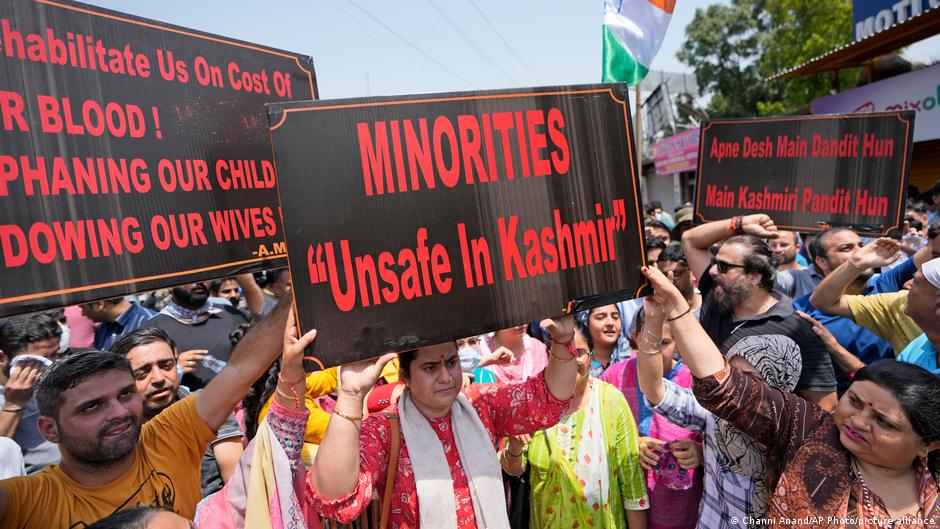
A new wave of threatening letters targeting Kashmiri Pandits — members of the Hindu minority community who fled the Muslim-majority Kashmir Valley during a militant uprising in the 1990s — has deepened fears among those who have returned to the region as civil servants under an Indian government federal rehabilitation scheme.
asserted
who → target → scheme
The latest letters, which surfaced in the last week of August, named several employees.
asserted
which → surface → employees
The letters also included their Jammu residential addresses, vehicle registration numbers and phone numbers.
asserted
letters → include → addresses
Personal details exposed
"Similar threat letters surfaced in early August, but the latest contains our Jammu residential address, vehicle and phone numbers, which have also been shared on social media," Anil Koul, a government employee, told DW, urging authorities to investigate the source of the leak.
asserted
Koul → expose → leak
The letters have been attributed to a little-known group calling itself the United Liberation Council, which security officials suspect could be a front for the Pakistan-based Islamist militant outfit Lashkar-e-Taiba.
uncertain
officials → attribute → outfit
The group reportedly first surfaced in July, when it released a poster marking the death anniversary of a former militant commander.
uncertain
it → surface → commander
Authorities have yet to confirm the letters' authenticity or the existence of the group behind them.
asserted
Authorities → have → them
The latest letters also distinguish between Pandits who never left the Valley — and are therefore "safe" — and those recruited under New Delhi's rehabilitation program, who are accused of working for "masters" outside Kashmir.
asserted
who → distinguish → Kashmir
The fresh threats have also triggered a political row.
asserted
threats → trigger → row
Jammu and Kashmir National Conference (JKNC) president and former Jammu and Kashmir chief minister, Farooq Abdullah, called them a "conspiracy" aimed at delaying the restoration of statehood, which the region lost in 2019.
asserted
region → call → 2019
Abdullah also questioned why Hindu officers from outside the region were not facing similar threats.
asserted
officers → question → threats
His remarks drew sharp criticism from Kashmiri Pandit groups and the ruling Hindu nationalist Bharatiya Janata Party (BJP), which accused him of being insensitive to the community's fears.
asserted
which → draw → fears
Government records show 44,167 Kashmiri migrant families registered as having left since 1990 citing security concerns, of which 39,782 were Hindu.
asserted
39,782 → show → which
Sanjay Tickoo, president of the Kashmiri Pandit Struggle Committee (KPSS), said the threats should be viewed against the backdrop of targeted killings and repeated security concerns faced by Pandit government employees in the Valley.
asserted
threats → say → Valley
He blames security lapses and says repeated meetings with officials since a wave of killings in 2022 have failed to resolve their concerns.
asserted
meetings → blame → concerns
"Since 2022, meetings have resulted in nothing," Tickoo told DW.
asserted
Tickoo → result → DW
He also wondered how those making the threats have access to employees' personal details.
asserted
those → wonder → details
"How are these details being posted on social media?" Tickoo asked.
asserted
Tickoo → post → media
Targeted killings have occurred sporadically in the years since.
asserted
killings → target → years
At least seven Kashmiri Pandits were killed by militants during a spike in violence between 2020 and 2022.
asserted
Pandits → kill → 2020
One of the starkest cases was that of Rahul Bhat, a Pandit revenue official who was shot dead inside his government office in Budgam in May 2022.
uncertain
who → shoot → May
The last confirmed targeted killing of a Kashmiri Pandit was in October 2022, when Puran Krishan Bhat, an orchard farmer, was shot dead in Shopian district.
asserted
Bhat → confirm → district
Former Jammu and Kashmir police chief S P Vaid described the latest threats as part of a familiar militant playbook.
"There is nothing new in this," Vaid told DW, calling it "a ploy by Pakistan to Islamize society."
asserted
Vaid → describe → society
He said similar tactics had been used against migrant workers in the Valley.
asserted
tactics → say → Valley
Personal data that should not have been so easily accessible has been made public, and no clear explanation of how it was leaked has been provided.
asserted
it → make → ?
The KPSS estimates roughly 6,500 Pandits who never left the Valley, along with another 4,000 who have returned as government employees under a federal rehabilitation scheme, live in India-administered Kashmir.
But the reintegration of those who fled decades ago has proved challenging.
asserted
who → estimate → those
Rahul Pandita, a journalist and author of "Our Moon Has Blood Clots: A Memoir of a Lost Home in Kashmir," said the government's record on rehabilitation was inadequate.
asserted
record → say → rehabilitation
"The BJP has had no rehabilitation policy for Kashmiri Hindus," Pandita told DW, arguing that the government employees in the Valley had returned under a policy introduced during the previous government of former Prime Minister Manmohan Singh.
asserted
employees → have → Singh
Some land has been returned and cases of killings investigated, he said, but "it is too little and too late."
asserted
it → return → killings
Pandita said the bigger problem was that no government could guarantee a completely secure environment for a mass return.
uncertain
government → say → return
"No matter what the government does, the situation will never be conducive enough for the Pandits to return," he said, arguing that as long as Islamist militancy exists in the region, Kashmiri Hindus would still be targeted.
asserted
Hindus → do → region
"It's for them then to decide if they are willing to take such a risk," he said.
asserted
he → decide → risk
Beyond government employees, some Pandits who have returned and established businesses in the Valley are already living there quietly, Pandita said.
"That is the best-case scenario for Kashmiri Pandits in Kashmir Valley," he said.
asserted
he → return → Valley
Sushobha Barve, executive secretary of the Center for Dialogue and Reconciliation, said the latest threats expose a wider security paradox.
asserted
threats → say → paradox
"Despite claims of normalcy, a tiny group of active militants has successfully disrupted the lives of migrant families.
uncertain
group → disrupt → families
Breaking the cycle of panic is essential," Barve told DW.
asserted
Barve → break → DW
She said there was also growing political frustration over the delay in restoring Jammu and Kashmir's statehood, arguing that this grievance cut across the region.
asserted
grievance → say → region
Amitabh Mattoo, an academic and professor of international relations at Jawaharlal Nehru University who has written extensively on Kashmir, said any return of Kashmiri Pandits had to be both secure and dignified.
asserted
return → write → Pandits
"The state has an essential role in ensuring their physical security and in protecting their property, cultural and other legitimate rights.
asserted
state → have → property
But security measures alone will not suffice," Mattoo told DW.
asserted
Mattoo → suffice → DW
…and 1 more, not listed.
 The Aporia