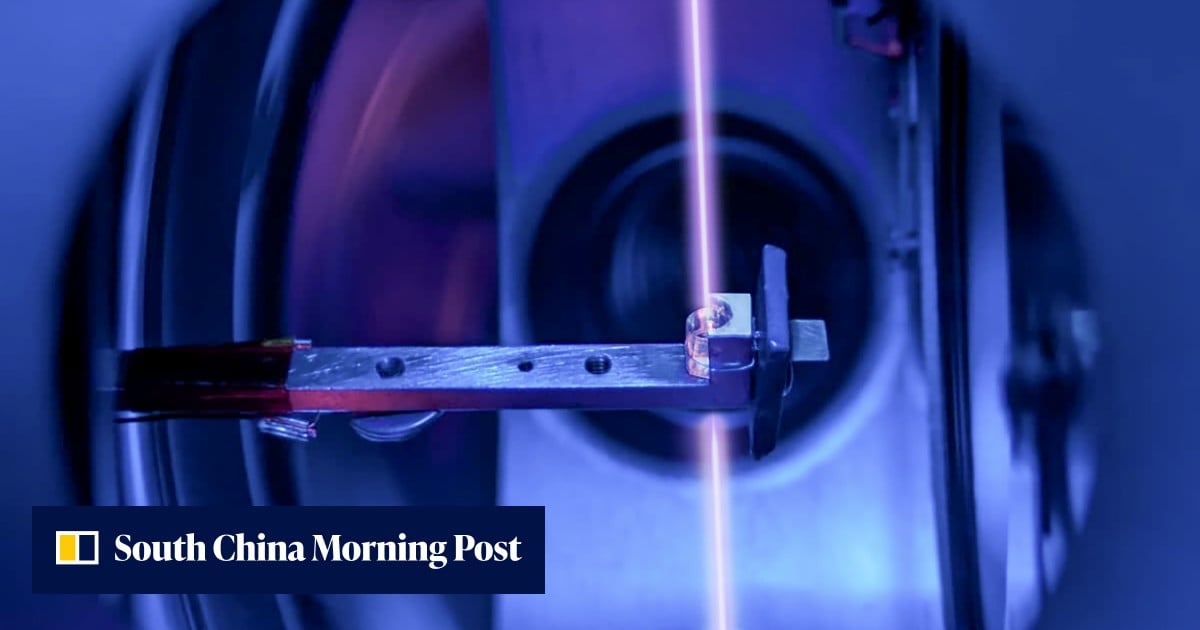
China’s thorium-229 nuclear clock beats Vienna’s on stability, studies show

Read the original at South China Morning Post ↗
South China Morning Post · collected 2026-10-07 · by Ling Xin

Quick Summary

Chinese and European teams have developed the world’s first nuclear clocks using thorium-229 nuclei embedded in crystals, with initial results showing China’s clock is six times more stable than Vienna’s. Both studies, published in Nature, demonstrate that these new timepieces measure time based on the nucleus of an atom rather than its electrons. The Chinese team also found their crystals could consistently keep accurate time when grown separately, while the European researchers attempted to detect dark matter with their device but were unsuccessful.
Written locally by qwen2.5:14b on 2026-10-07, using this article's own text rather than the other coverage of the same event (that is the story summary below).

AI analysis runs on qwen2.5:14b, locally

Story summary

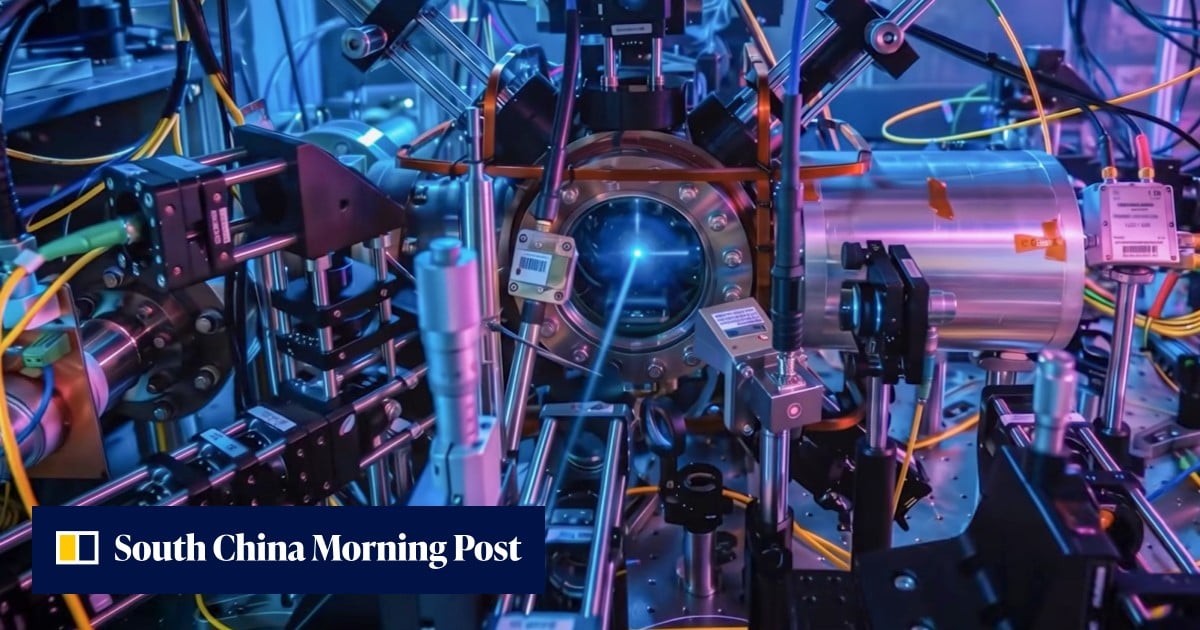
Two teams of scientists from Tsinghua University in China and Vienna University of Technology (TU Wien) have independently built the world's first nuclear clocks, which could become the most accurate timekeeping devices ever created. Published in the journal *Nature*, both clocks rely on thorium-229 nuclei embedded in crystals to track the steady rhythm within atomic cores rather than the orbiting electrons used by traditional atomic clocks. The Chinese team’s clock is six times more stable than its European counterpart, and it demonstrated consistent timekeeping across different crystal samples. These nuclear clocks have potential applications in navigation, mining, earthquake prediction, and exploring new physics realms but are currently in experimental stages with significant room for improvement.
Written for “Nuclear Clocks Accuracy Competition” on 2026-10-07, grounded in this article and the 1 other(s) covering the same event.

Signals How these are calculated →

Claims extracted
5
claim-shaped sentences
Uncertain
40%
2 of 5 hedged
Leaning
not political
takes no side on a contested political question
Correction & hedging signals
66.6
corrections and hedging in what we collected; not a measure of accuracy
Outlets on this story
2
Science
Narrative spread
1
articles carrying this framing
Analyzed 2026-10-07 · how these are computed

Story

📰 Nuclear Clocks Accuracy Competition
Science · 2 article(s) covering the same event. See how they differ ↓

How this is being covered How these are calculated →

Article leaning vs. publisher reliability
Source leaning vs. consistency

Compared with similar articles

This article reads unscored and hedges 40% of its claims. Each row says how that neighbour differs.
ABC News (AU)
⚖️ leaning not scored 🔴 28% hedged 11 of 39 📰 publisher trust 61
“Both articles discuss the first working nuclear clocks developed independently but contemporaneously, highlighting initial comparisons between the Chinese and Austrian clocks.”

Publisher

South China Morning Post · 1807 article(s) · 4 correction(s) detected
Running correction rate · 4 correction(s)
2026-10-04
Flight to Okinawa diverts back to Hong Kong after suspected landing gear fault
2026-10-04
Tennessee prisons chief resigning after botched execution of Christa Pike
2026-09-29
Indonesian prison chief suspended over secret VIP compound for inmates
2026-09-28
Trump ‘arms offer’ to China jolts Washington into moves to contain the fallout

Who wrote this

Ling Xin
8 article(s) here · 1 carrying a prediction
🔮 According to the latest papers, the Beijing scientists also showed that two crystals grown separately kept the same time – a sign such clocks could be reliably reproduced, they said.
🔮 David vs Goliaths: Singapore builds most accurate clock ever, leaves US and China in dust The decade-long project could help to pave the way for a redefinition of the second, researchers claim in a new paper The clock, built with a single ion of a rare earth metal element known as lutetium, is so precise that it would lose one second every 260 billion years – nearly 20 times the age of our universe.
🔮 Claims China’s BeiDou satellite was refuelled in orbit could change space race
🔮 That made it impossible for ground controllers to intervene in real time, wrote researchers from the China Academy of Space Technology – the country’s main spacecraft manufacturer – in a paper that will be published in the Journal of Deep Space Exploration.
🔮 China uses 100,000 home-grown AI chips to build leading weather forecast system The Sugon 8,000 system can predict weather 10 days in advance, bringing the country closer to its ambitious forecasting goals China said it can now predict weather 10 days in advance at a cutting-edge resolution of 5km (3.1 miles), finer than most major systems in routine use around the world.
🔮 The project will involve partners from at least five other countries as they track the development of space weather China has started an international project to build a three-dimensional satellite network between Earth and the moon that will track solar activity and study some of the universe’s most powerful explosions.
Also by Ling Xin
Nothing else under this byline is closely related to this article, so these are simply their most recent.
All 8 articles by Ling Xin →

Topics

China Chinese European Nature Vienna

Subjects

Vienna GPE · 4× Beijing GPE · 2× China GPE · 2× Chinese NORP · 2× European NORP · 2× Nature ORG · 2× TU Wien ORG · 1× Thorsten Schumm PERSON · 1× Tsinghua University ORG · 1×

Narrative

The clocks were developed independently but both the Chinese team, led by Tsinghua University in Beijing, and the researchers at Vienna’s TU Wien used thorium-229 nuclei embedded in crystals to keep time by the steady rhythm of the atom’s core, rather than the electrons whirling around it, as in atomic clocks.
framing: mixed · carried by 1 article(s) · first seen 2026-10-07
🔮 According to the latest papers, the Beijing scientists also showed that two crystals grown separately kept the same time – a sign such clocks could be reliably reproduced, they said.
2026-10-07 · South China Morning Post
China’s thorium-229 nuclear clock beats Vienna’s on stability, studies show · mixed framing

Claims (5 extracted, 2 hedged)

China’s thorium-229 nuclear clock beats Vienna’s on stability, studies show Chinese and European teams in ‘fierce but friendly’ competition to develop the next-generation timepieces Initial results from the world’s first two working nuclear clocks indicate that China’s timepiece is about six times as stable as the one in Vienna, according to papers published this week by the journal Nature. uncertain
timepiece → beat → journal
The clocks were developed independently but both the Chinese team, led by Tsinghua University in Beijing, and the researchers at Vienna’s TU Wien used thorium-229 nuclei embedded in crystals to keep time by the steady rhythm of the atom’s core, rather than the electrons whirling around it, as in atomic clocks. asserted
team → develop → clocks
When Nature reported in June that the two teams had separately developed the radical new devices, Thorsten Schumm, a member of the European team, said that “now we have a fierce but friendly global competition”. asserted
we → report → competition
According to the latest papers, the Beijing scientists also showed that two crystals grown separately kept the same time – a sign such clocks could be reliably reproduced, they said. uncertain
they → accord → sign
Meanwhile, the Vienna team used its clock to hunt for dark matter, without success. asserted
team → use → success
💬Give feedback
🕘History 🎫Support