In short:
Two teams of scientists have built the first working "nuclear clocks", which could become the world's most accurate timekeepers.
uncertain
which → build → clocks
The clocks could be used in navigation, mining, earthquake prediction, and potentially discovering new areas of physics.
What's next?
Both clocks are in their experimental stages, but researchers say they will be rapidly improved.
A pair of crystals illuminated with lasers could become the world's most accurate clocks.
uncertain
pair → use → lasers
Two teams of scientists have made the world's first "nuclear clocks", which keep time by tracking tiny changes in the centre of atoms.
asserted
which → make → atoms
Both clocks are so accurate that if they ran for 30 million years, they would only be off by a second.
asserted
they → run → second
This accuracy does not surpass the best clocks in operation right now, but both teams are confident they will be able to improve their clocks significantly.
asserted
they → surpass → clocks
The researchers have published their work in two papers in the journal Nature.
asserted
researchers → publish → journal
University of New South Wales physicist Victor Flambaum said nuclear clocks had the potential to become the "most accurate instrument humans have ever built".
asserted
humans → say → potential
Professor Flambaum said the studies, which he was not involved with, represented an exciting step forward.
asserted
he → say → step
The clocks could be used to improve technology such as GPS, mining surveys and solve physics mysteries.
uncertain
clocks → use → mysteries
How does a nuclear clock work?
asserted
clock → work → ?
Atoms, which compose all the matter we interact with, are made from a "nucleus" containing a dense cluster of protons and neutrons, surrounded by a spacious cloud of electrons.
asserted
we → compose → electrons
Atomic clocks, currently the most accurate measures of time in the world, work by tracking changes in the electrons around the nucleus of a caesium atom.
asserted
clocks → work → atom
But these clocks are approaching a point where it is physically impossible to make them more accurate.
asserted
them → approach → point
Nuclear clocks use a similar logic to atomic clocks, but they track even smaller changes in the nucleus of an atom.
asserted
they → use → atom
"A nucleus is very small compared to [a whole] atom," Professor Flambaum said.
asserted
Flambaum → compare → atom
Because it is thousands of times smaller, a nucleus could be used to measure much more subtle changes in time, leading to a more accurate clock.
uncertain
nucleus → use → clock
Why couldn't we build nuclear clocks before?
asserted
we → build → clocks
Nuclear clocks have been theorised for more than two decades, but until recently technological and theoretical constraints have made them impossible to build.
asserted
them → theorise → decades
Thorsten Schumm, co-author on one of the new studies and a physicist at Vienna University of Technology, said the main turning point in his team's research came a couple of years ago.
asserted
point → say → years
In early 2024 the team used a laser to produce the predicted change in an atomic nucleus that would allow time to be measured.
asserted
time → use → nucleus
Professor Flambaum said progress had been "very rapid" since that discovery.
asserted
progress → say → discovery
Tsinghua University physicist and study co-author Shiqian Ding said his team needed to solve several different problems to make the nuclear clock.
asserted
team → say → clock
The problems included making a material with the right clock nuclei inside it and developing lasers precise enough to produce reliable changes.
"There was no single step that suddenly made the clock possible," Dr Ding said.
asserted
Ding → include → changes
What is a nuclear clock made from?
asserted
clock → make → What
A specific type of thorium atom, thorium-229, has the properties to make it usable as a timekeeper.
asserted
it → have → timekeeper
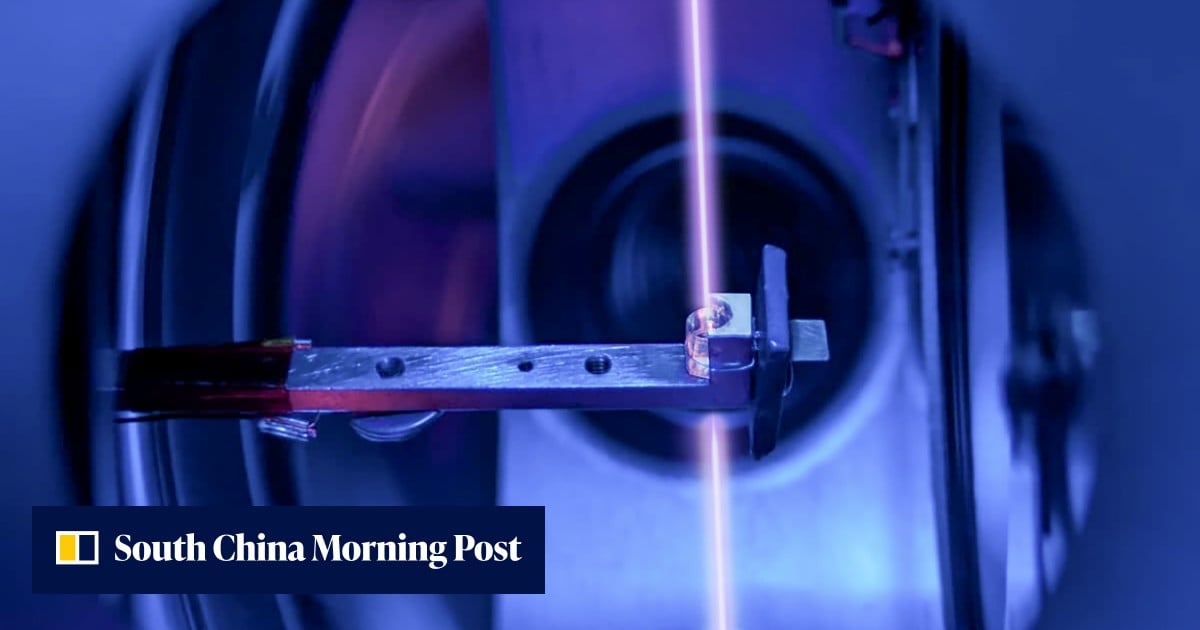
Both teams grew crystals containing thorium-229, then suspended them under ultra-precise lasers that could produce tiny, nucleus-sized "ticks" in the thorium.
The researchers also have plans to improve nuclear clocks so they can outperform atomic clocks.
uncertain
they → grow → clocks
Professor Schumm said thorium-229 had potential to be more stable than atomic clocks, meaning nuclear clocks could become very small and practical to move around.
uncertain
clocks → say → clocks
"We envision a chip-scale device," he said.
asserted
he → envision → device
What would nuclear clocks be used for?
asserted
clocks → use → What
Nuclear clocks could be used to improve navigation systems such as GPS, which has driven military interest in the latest iterations of atomic clocks.
uncertain
which → use → clocks
Professor Flambaum said nuclear clocks could be accurate enough to measure the manipulation of time by gravity, per Einstein's theories of relativity.
uncertain
clocks → say → relativity
This could make them useful in mining exploration or earthquake prediction.
uncertain
them → make → exploration
“By measuring, accurately, the gradient of gravitational fields, we can see what is under the earth,” Professor Flambaum said.
asserted
Flambaum → measure → earth
The super-accurate timekeeping could also be used in physics research, particularly in probing mysterious dark matter.
uncertain
timekeeping → use → matter
"I am particularly excited about using nuclear clocks to test fundamental physics," Dr Ding said.
asserted
Ding → use → physics
Professor Schumm's team has already used their nuclear clock to detect evidence of dark matter, as proof of concept.
asserted
team → use → concept
He is planning to install a second nuclear clock in Innsbruck within a year, to accompany the clock in Vienna and measure subtle changes in Earth's movement around the Sun.
asserted
He → plan → Sun
Professor Flambaum said there was a "race" among several other groups to make practical nuclear clocks and that any one of them could be the first to outperform atomic clocks.
uncertain
one → say → clocks
"The progress is so fast, I expect it will be soon," he said.
asserted
he → expect → ?
 The Aporia