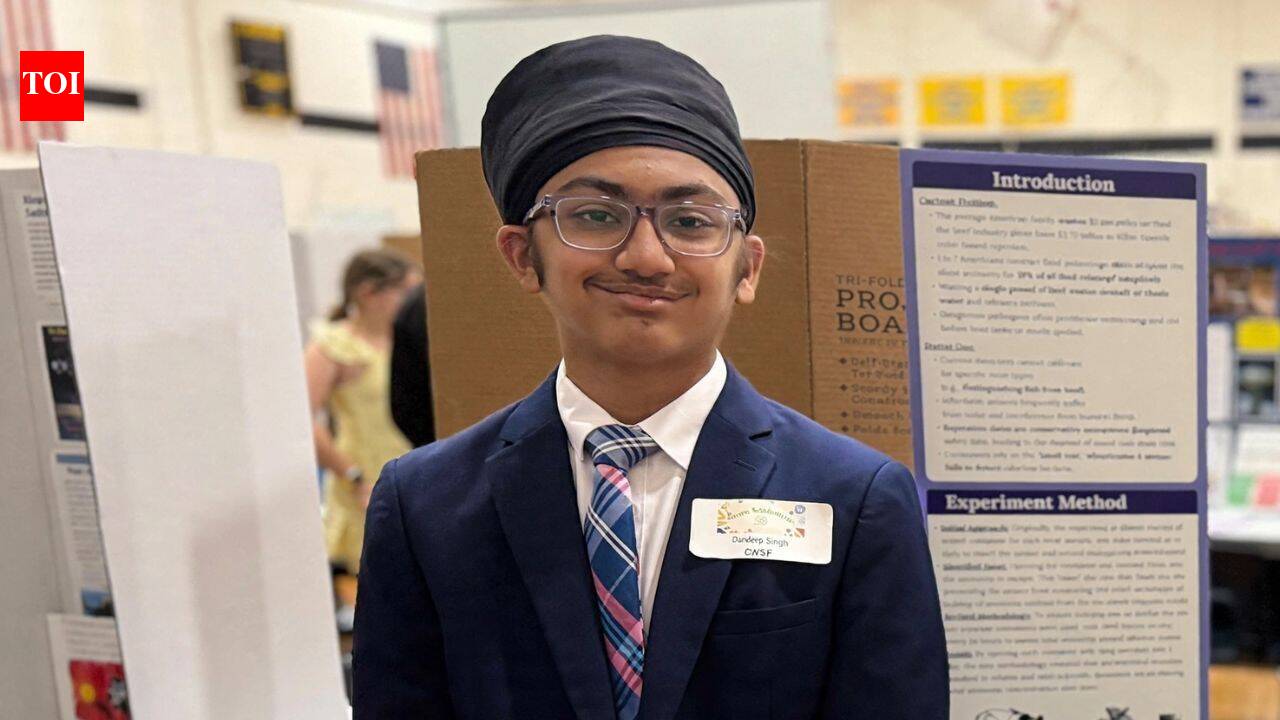
Sartaj Singh Gandhi, a seventh grader from Monroe Township Middle School in New Jersey, has developed a device called the Meat Freshness Monitor that detects spoiled meat by tracking ammonia gas levels. Using a Raspberry Pi and an ammonia gas sensor inside a 3-D printed container, Sartaj tested turkey, chicken, pork, and beef over ten days, finding peak ammonia levels on day six for chicken, turkey, and pork. He plans to refine the device for home use and test it with other foods like pizza and spaghetti.
Written locally by qwen2.5:14b on 2026-10-06,
using this article's own text rather than the other coverage of the
same event (that is the story summary below).
Story summary
Sartaj Singh Gandhi, a seventh-grader from Monroe Township Middle School in New Jersey, developed the Meat Freshness Monitor. The device uses an ammonia gas sensor connected to a Raspberry Pi to detect spoilage more accurately than traditional methods like checking expiration dates or smelling meat. Sartaj tested various meats, including turkey, chicken, pork, and beef, over 10 days and found that ammonia levels in poultry and pork peaked on day 6. This innovation aims to reduce the risk of food poisoning and minimize waste by providing a more precise way to determine if meat is still safe for consumption.
Written for “Student Builds Meat Spoilage Sensor” on 2026-10-06,
grounded in this article and the 0 other(s) covering the same event.
A seventh grader in New Jersey has built a device that can monitor meat freshness by tracking ammonia gas released as meat decays.
asserted
meat → build → decays
Sartaj Singh Gandhi, a student at Monroe Township Middle School in Monroe Township, NJ, created the Meat Freshness Monitor after learning that many people check the expiry date or smell the meat to see if it is still safe to eat.
asserted
it → create → meat
According to the Society for Science, Sartaj wanted to find a low-cost and easy way to check if meat was still fresh.
uncertain
meat → accord → way
He connected an ammonia gas sensor to a Raspberry Pi and placed it inside a 3-D printed specialty container.
asserted
He → connect → container
He then tested turkey, chicken, pork, and beef for 10 days.
asserted
He → test → days
The sensor showed that ammonia levels in chicken, turkey, and pork peaked on day 6.
asserted
levels → show → day
How did Sartaj Singh Gandhi build the Meat Freshness Monitor
asserted
Gandhi → build → Monitor
Sartaj Singh Gandhi built the ‘Meat Freshness Monitor’ after wondering whether chicken in a refrigerator was still safe to eat.
asserted
chicken → build → refrigerator
He learned that people rely on printed expiration dates or the ‘smell test’ to decide if food is safe to eat.
asserted
food → learn → dates
He said getting that decision wrong could put someone at risk of food poisoning, or it could also lead to perfectly good meat being thrown away.
uncertain
meat → say → poisoning
He was surprised there were no low-cost, easy ways to determine if meat is fresh.
asserted
meat → be → ?
Sartaj decided to create a reliable way to monitor meat and determine if it has spoiled.
asserted
it → decide → meat
He used the ammonia gas released during meat decay to track changes in its freshness.
asserted
He → use → freshness
He found that ammonia levels rise from 8 to 15 parts per million as the meat spoils.
asserted
meat → find → million
The device tracked ammonia from four types of meat
Sartaj connected an ammonia gas sensor to a Raspberry Pi and placed it inside a 3-D printed speciality container to track the gas.
asserted
Sartaj → track → gas
He then put samples of turkey, chicken, pork, and beef into the device.
asserted
He → put → device
He tested each type of meat for 10 days, collecting 10 samples each day.
asserted
He → test → samples
The sensor showed that chicken, turkey, and pork released ammonia during the testing period.
asserted
chicken → show → period
Ammonia levels in these meats reached their highest point on day 6.
asserted
levels → reach → day
The results also showed that each type of meat spoiled at a slightly different rate.
asserted
type → show → rate
The device allowed Sartaj to track the gas released by each meat sample throughout the testing period.
asserted
Sartaj → allow → period
How does Sartaj Singh Gandhi plan to improve his Meat Freshness Monitor
Sartaj wants his ‘Meat Freshness Monitor’ to be used in home refrigerators.
asserted
Monitor → plan → refrigerators
After testing turkey, chicken, pork, and beef, he plans to continue developing the device.
asserted
he → test → device
His next goal is to test it on other foods, including ‘slices of pizza or a plate of spaghetti’.
asserted
goal → test → spaghetti
The project started with meat samples, but Sartaj now wants to see how the monitor responds to different foods.
asserted
monitor → start → foods
He also found that each type of meat spoiled at a slightly different rate.
asserted
type → find → rate
The runner and STEM student aiming for a future in heart surgery
Sartaj also runs cross country and attends STEM summer programs focused on science and medicine.
asserted
Sartaj → aim → science
He said, “Often, your stomach is cramping, and you’re desperate for water, but you know there is only half a kilometer left”.
asserted
you → say → water
“Embracing that physical grind allowed me to climb from a rank of 24th to 12th by the end of the season.
asserted
me → embrace → season
Sartaj also enjoys catching up on the latest sci-fi movies.
asserted
Sartaj → enjoy → movies
He wants to become a cardiothoracic surgeon, a career that combines surgical precision with the physiology of the heart and lungs to save lives.
asserted
that → want → lives
 The Aporia