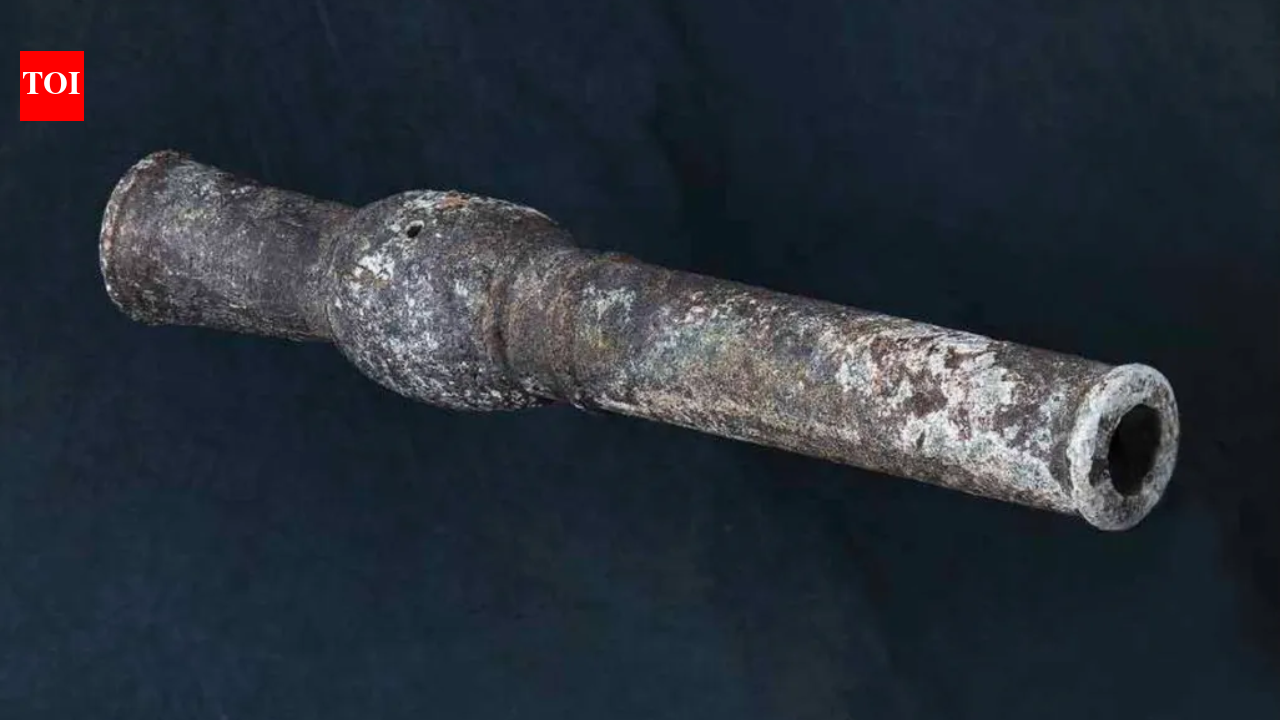
In November 2023, troops sweeping for a suspected minefield on Mount Geumseong in southwestern South Korea ended up uncovering a small bronze object about four inches beneath the soil.
asserted
troops → sweep → soil
Rather than a landmine, it was a gun, one that may have been buried for more than 600 years, according to a report by Smithsonian Magazine.
uncertain
that → bury → Magazine
After nearly three years of analysis, researchers with the Naju National Research Institute of Cultural Heritage have identified the object as a Hwangja Hwatong, an early handheld gunpowder weapon.
asserted
researchers → identify → Hwatong
Also called the "fire tube", it is a ten-inch bronze instrument dating back to the 14th or 15th century.
asserted
it → call → century
The weapon has three main sections: a socket that would hold a wooden handle, a gunpowder chamber, and a muzzle from which the projectile would be released.
asserted
projectile → have → which
According to researchers, the weapon likely discharged arrows or other projectiles.
uncertain
weapon → accord → arrows
An archaeological miracle
The weapon weighs a little more than two pounds and is carved with 28 Korean characters.
asserted
weapon → weigh → characters
Twenty-seven appear in six columns on the handle socket, recording its name, weight, manufacturing supervisor, craftsman, and an incomplete date.
asserted
seven → appear → name
A separate character on the muzzle, 八, meaning “eight,” may have served as an inventory or production number.
uncertain
character → mean → number
The Heritage Service translates them to read: “In the 12th month of the Jeongsa year, the Hwangja Hwatong was made.
asserted
Hwatong → translate → year
“This is an extraordinary discovery with immense academic, historical and cultural value,” Cho Mi-soon, director of the Naju National Research Institute of Cultural Heritage, said at a recent press event, per the Korea Times.
asserted
soon → say → Times
“It comes from a crucial transitional period between the late Goryeo and early Joseon dynasties, when physical artefacts of firearms are exceptionally rare.”
asserted
artefacts → come → firearms
According to the agency's statement, “Hwangja” is a class designation; “geun” and “nyang” are traditional units of weight; and “Noksa” is the title of the official who oversaw the gun’s creation.
uncertain
who → accord → creation
As for the date: Koreans used to measure time in 60-year cycles, and the 57th year in each sexagenary cycle was the Jeongsa year.
asserted
year → use → cycle
So researchers analysing the hwatong determined that it was made in 1377 or 1437.
asserted
it → analyse → 1377
In 1377, near the end of the Goryeo Dynasty, military official and inventor Choe Mu-seon persuaded the government to establish the Hwatong Dogam, an agency devoted to producing gunpowder weapons.
asserted
seon → persuade → weapons
If the cannon dates to that year, it could be a surviving object from the very beginning of state-organised firearm production in Korea.
uncertain
it → date → Korea
The alternative, 1437, places it under King Sejong the Great, when Korean engineers were actively improving firearms.
asserted
engineers → place → firearms
Korean weapons makers standardised new firearm designs several years later, in 1445.
asserted
makers → standardise → 1445
However, the CT scans revealed a rounded powder chamber unlike later Sejong-era firearms, which incorporated wooden wads to transfer more of the gunpowder's force into the projectile.
asserted
which → reveal → projectile
Its simpler construction therefore resembles an earlier stage of firearm engineering.
asserted
construction → resemble → engineering
Metallurgical analysis showed that the cannon makers cast it from copper, tin, and lead, keeping the tin content below 10% of the alloy.
asserted
makers → show → alloy
Microscopy also revealed traces left by casting and impurities characteristic of the rather poor refining methods from that era.
asserted
Microscopy → reveal → era
Researchers found no identifiable gunpowder residue inside the chamber.
asserted
Researchers → find → chamber
As for why the hwatong was found lying on the ground on Geumseongsan Mountain?
asserted
hwatong → find → Mountain
It might have been used by Koreans defending their land.
uncertain
It → use → land
Eo Changsun, head of academic research at the Naju National Research Institute of Cultural Heritage, told the Chosun Daily’s Heo Yun-hee that Japanese pirates once sailed up the Yeongsan River to plunder and the mountain was a geographical stronghold against them.
asserted
mountain → tell → them
The mountain is near the Yeongsan River region, which has historically served as an important area in terms of military strategy.
asserted
which → serve → strategy
The summit, for instance, has been used by the military as an air-defence station since 1966.
asserted
summit → use → 1966
The oldest weapon
“Either way, it is the earliest gunpowder weapon found in Korea,” per the Heritage Service.
asserted
it → find → Service
Gunpowder, which is essentially a mixture of sulfur, potassium nitrate and charcoal, was invented by Daoist alchemists in ninth-century China.
asserted
which → invent → China
The monks were trying to create an elixir of life, but what they made became an instrument of death.
asserted
made → try → death
Black powder was initially used only in fireworks and signals.
asserted
powder → use → fireworks
In the tenth century, though, Chinese inventors packed it into projectiles in bamboo tubes, creating early, short-range guns.
asserted
inventors → pack → guns
By the late 1200s, these guns were metal, and the technology had spread.
asserted
technology → spread → 1200s
Previously, the earliest nationally designated Korean firearm with a securely inscribed manufacturing year was a Cheonja Chongtong from 1555, according to reporting by Kyunghyang Shinmun.
uncertain
firearm → designate → Shinmun
If the Hwangja Hwatong dates to 1437, it pushes that physical record back 118 years.
asserted
it → date → record
If it was made in 1377, the gap grows to 178 years.
asserted
gap → make → years
Kyung Hee University Museum currently houses two other apparently early small cannons, but because no one recorded their original findspots, researchers cannot date them securely.
asserted
researchers → house → them
The newly discovered weapon now gives archaeologists a well-documented point of comparison.
asserted
weapon → discover → comparison
…and 2 more, not listed.
 The Aporia