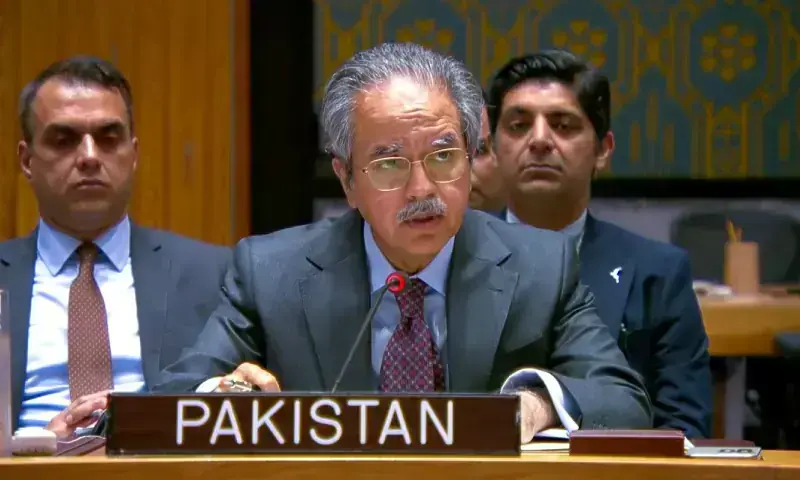
Pakistan opposes adding new permanent members to the UN Security Council and instead advocates for increasing the number of elected, non-permanent members. Asim Iftikhar Ahmad, who is set to become Pakistan's foreign secretary, made this statement while reflecting on his tenure as Pakistan’s UN envoy from 2025 to 2026. He emphasized that Pakistan has been actively involved in advocating for a more democratic and representative Security Council structure, highlighting the country’s commitment to conflict prevention and peaceful dispute settlement.
Written locally by qwen2.5:14b on 2026-10-06,
using this article's own text rather than the other coverage of the
same event (that is the story summary below).
Story summary
In an interview with Dawn, Ambassador Asim Iftikhar Ahmad, Pakistan’s UN envoy and soon-to-be foreign secretary, stated that Islamabad opposes adding new permanent members to the UN Security Council (UNSC). Instead, Pakistan favors increasing the number of elected non-permanent seats within the 15-member body. This view is based on recent criticisms of the current permanent members' roles and a belief in the need for a more democratic, representative, and accountable council structure.
During his tenure from 2025 to 2026, Ahmad highlighted Pakistan's role in peaceful dispute settlement, including its stance on resolving the Kashmir conflict. He emphasized that Pakistan will continue advocating for peaceful solutions to international crises.
Written for “Pakistan Security Council Stance” on 2026-10-06,
grounded in this article and the 0 other(s) covering the same event.
• Asim Iftikhar says Islamabad backs more elected seats on UNSC
•
asserted
Islamabad → say → UNSC
Foreign secretary-designate highlights country’s role in peaceful dispute settlement
•
asserted
designate → highlight → settlement
Notes Islamabad presses for peaceful settlement of Kashmir dispute
asserted
Islamabad → note → dispute
Pakistan opposes adding new permanent members to the UN Security Council and instead favours increasing the number of elected, non-permanent members of the 15-member body, Pakistan’s UN envoy Ambassador Asim Iftikhar Ahmad, who is set to take charge as the country’s new foreign secretary next week, told Dawn.
asserted
who → oppose → Dawn
Assessing Pakistan’s stint on the Security Council, from 2025 to 2026, he discussed the major international crises and diplomatic initiatives that marked his tenure.
asserted
that → assess → tenure
Mr Ahmad is returning to Islamabad after serving as Pakistan’s permanent representative to the UN and will take charge as the new foreign secretary.
asserted
Ahmad → return → secretary
“Developments in recent years in the peace and security landscape and within the Security Council, as well as increased criticism of the role of the permanent members, have further reinforced the belief of a wide majority of member states that we need a more democratic, representative and accountable Security Council,” he said.
asserted
he → increase → Council
“Adding any new individual permanent members would only aggravate the problem.
asserted
Adding → add → problem
Pakistan, he said, had advocated, along with members of the Uniting for Consensus group and other like-minded countries, a reformed Council with more elected members, including medium-term seats based on periodic elections and rotation.
asserted
he → say → elections
“Pakistan and many other countries are eminently qualified to bring their contribution to the Security Council and the maintenance of international peace and security,” Mr Ahmad said.
asserted
Ahmad → bring → peace
“Member states should be ready to fulfil that responsibility without permanence and privilege.”
asserted
states → fulfil → permanence
For Mr Ahmad personally, it was his third consecutive Council assignment, having previously served on Pakistan’s teams in 2003-04 and 2012-13.
asserted
it → serve → 2003
“It is such a great and singular honour to have the opportunity to represent Pakistan at the United Nations including at the Security Council,” he said.
asserted
he → have → Council
He said Pakistan entered its latest Council term with considerable diplomatic and institutional experience and had identified conflict prevention and peaceful settlement of disputes, peacekeeping, counterterrorism and cooperation with regional organisations as key priorities.
asserted
Pakistan → say → priorities
“We were able to achieve a lot in all of those domains,” he said.
asserted
he → achieve → domains
The term, however, unfolded against a backdrop of deep geopolitical tensions, including a sharp deterioration in relations between India and Pakistan that culminated in a four-day military confrontation in May 2025, bringing the two nuclear-armed neighbours dangerously close to a wider conflict.
uncertain
that → unfold → conflict
Mr Ahmad said the crisis also reinforced Pakistan’s emphasis on peaceful settlement of disputes and highlighted the importance of diplomacy in preventing conflicts from escalating.
asserted
crisis → say → conflicts
He pointed to Security Council Resolution 2788, adopted unanimously during Pakistan’s presidency of the Council in July 2025, as one of the major achievements of the country’s term.
asserted
He → point → term
The Pakistan-sponsored resolution placed renewed emphasis on the mechanisms provided by the UN Charter for the peaceful settlement of international disputes.
asserted
resolution → sponsor → disputes
Despite what Mr Ahmad described as a “polarised Council”, Pakistan was able to forge consensus around the resolution.
asserted
Pakistan → describe → resolution
“This landmark resolution has been the most widely referred Council decision ever since its adoption, something that testifies to its importance and relevance to Council’s work,” he said.
“It is also worth recalling that Pakistan initiated and steered this resolution that lays emphasis on peaceful resolution of disputes, having inflicted a crushing defeat to the Indian aggression in May 2025,” he said.
uncertain
he → refer → May
Mr Ahmad also highlighted what he described as Pakistan’s practical contribution to peaceful dispute settlement beyond the Security Council.
asserted
he → highlight → Council
He said Pakistan had played an important role in mediating between the United States and Iran, helping bring about a ceasefire in April, facilitating the Islamabad talks and contributing to the process that led to the signing of the Islamabad Memorandum of Understanding in June.
asserted
that → say → June
“Our leadership remains closely engaged with all sides and other friends and partners to advance the prospects of peace,” he said.
asserted
he → remain → peace
On Palestine, Mr Ahmad said Pakistan had remained a “forceful voice” in the Council and played a key role in supporting the Comprehensive Plan on Gaza and Security Council Resolution 2803.
asserted
Pakistan → say → Gaza
The measures, he said, helped bring about a ceasefire, opened humanitarian space in Gaza and, importantly, restored a political horizon for Palestinian self-determination and statehood.
asserted
he → say → determination
Pakistan also used several Arria Formula meetings of the Security Council to focus attention on the unresolved Jammu and Kashmir dispute and the need for its peaceful settlement in accordance with international legitimacy and relevant Security Council resolutions.
asserted
Pakistan → use → legitimacy
 The Aporia