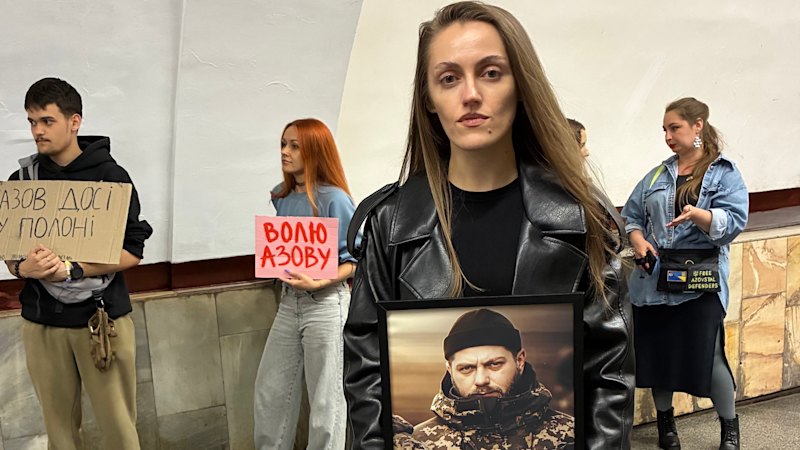
The tunnel to the Kyiv Metro is busy with pedestrians when Natalie Kolodko stops next to a curved wall to hold up a framed photograph of her older brother.
asserted
Kolodko → stop → brother
The picture shows a bearded soldier in army fatigues with the intense look of a warrior ready for battle.
asserted
picture → show → battle
Kolodko, 30, is here at a weekly gathering to honour soldiers who are imprisoned in Russia or missing after combat, and support their family and friends.
asserted
who → honour → family
“We are standing to remind everyone that this is not just a war when you go into the shelter during the night because Kyiv, or any other city, is under attack,” she tells me.
asserted
she → stand → me
“There are guys who are dying at the front line, and if you will not support them, you have no idea what Russia will do in the next couple of years and where the front line will be.
asserted
line → be → years
It is early evening on a recent Sunday night and the group has decided to hold this week’s rally at the bottom of the long escalators down to the metro station near Independence Square, known as Maidan Nezalezhnosti.
asserted
group → decide → Nezalezhnosti
The friends and families of the soldiers would normally gather in the open air, choosing a different park or plaza each week, but the air war over Kyiv has intensified dramatically.
asserted
war → gather → Kyiv
Most members of the group are mothers, sisters and wives of those who are missing or in prison, but not all the missing are men.
asserted
missing → miss → prison
Thousands of women serve in combat roles, and women now make up about 10 per cent of the Armed Forces of Ukraine.
asserted
women → serve → Ukraine
A few of the families have heard from the soldiers, thanks to sporadic letters that are vetted by the Russians before they are sent, but nobody can rely on these messages to be sure family members are alive and well.
asserted
members → hear → messages
Kolodko’s brother, Andriy, went missing after serving in the Donbas region in the east.
asserted
brother → go → east
She does not know where he is.
asserted
he → know → ?
“He was a big figure in my life, and he still is,” she says.
asserted
she → say → life
Andriy was born in 1993, two years before Natalie.
asserted
Andriy → bear → Natalie
They come from a big family with two grandmothers and several aunts, as well as their parents and a younger sister.
asserted
They → come → grandmothers
Andriy worked in a pharmacy and appeared set for a career in health and biology, or perhaps technology.
asserted
Andriy → work → health
Early in 2024, however, with Ukraine turning to its young people to expand its army and stop Russian forces in the east, he chose to sign up of his own accord.
asserted
he → turn → accord
At first, he was based in air defence at a military base where he supported crews intercepting drones.
asserted
he → base → drones
This changed when the army needed more recruits for its brigades in the east.
asserted
army → change → east
Andriy was sent to the Donbas, the scene of gruelling combat along a “kill zone” patrolled by drones from both sides.
asserted
Andriy → send → sides
He went missing within a year of signing up.
asserted
He → go → year
“Something very, very opposite to justice happened,” Kolodko says.
asserted
Kolodko → happen → justice
She does not want to talk about his brigade or the specific events around his service in the east.
asserted
She → want → east
Other members of the group hold up their photographs and signs as Kolodko speaks.
asserted
Kolodko → hold → photographs
Air rushes through the metro tunnel as a train arrives.
asserted
train → rush → tunnel
The weekly gatherings began as rallies for the “Free Azov” group that has met for years to remember the soldiers captured by Russian forces after the siege of the Azovstal Iron and Steel Works in the city of Mariupol in the months after the full-scale invasion of February 2022.
asserted
that → begin → February
More than 600 of the Azov defenders remain in Russian prisons, singled out for harsher treatment because of their defence in the siege.
asserted
600 → remain → siege
One commander, Colonel Bohdan Hrishenkov, said last month that 270 of the prisoners were convicted of terrorism on fabricated charges.
asserted
270 → say → charges
The Sunday rallies broadened over time to include families of other soldiers who are missing or in prison.
asserted
who → broaden → prison
It is important for Kolodko to see her friends each week at these meetings, where they share their feelings about the missing family members.
asserted
they → see → members
“People who aren’t affected by this war, they do not understand us,” she says.
asserted
she → affect → us
Simply being understood by others who have the same experience makes a difference, she adds.
asserted
she → understand → difference
Nobody can be sure about the number missing in the war.
asserted
Nobody → miss → war
About 275,000 people have been reported missing, says the International Committee of the Red Cross (ICRC).
asserted
Committee → report → Cross
It said last month it received about 10,000 new tracing requests each month, but it does not break this down between Ukrainian and Russian forces.
asserted
it → say → forces
In a sign of the extreme conditions at the front and the nature of the losses from drone attacks and artillery fire, the Ukrainian government said last week it was yet to identify 26,000 repatriated bodies and remains.
asserted
it → say → bodies
The head of the presidential office, Kyrylo Budanov, said on Friday that a new group would be set up to use forensic science to speed up the identifications.
asserted
group → say → identifications
“Every fallen hero will be found and honoured with dignity,” Budanov said.
asserted
Budanov → fall → dignity
Kolodko has produced a YouTube documentary, Mother, Bride, Sister, to highlight the impact on families.
asserted
Kolodko → produce → families
“It is very important to not stay silent.
asserted
It → stay → ?
…and 8 more, not listed.
 The Aporia