Story summary
In September, Kemi Badenoch, the leader of the Conservative Party in the U.K., addressed her party's annual conference in Birmingham. She presented a 95-page document titled "The Right Way," aimed at outlining principles for future governance and positioning the Tories as a reformed entity distinct from their previous image, especially after suffering their worst-ever electoral defeat in 2024.
Badenoch emphasized the party's commitment to being the "common sense" alternative to Labour under Prime Minister Andy Burnham. She dismissed criticism that her policies on welfare cuts and prison expansion might revive the Tories' historical reputation as the "nasty party," asserting instead that these measures reflect a pragmatic approach to governance.
At the conference, Badenoch also highlighted plans to scrap environmental bodies like the Environment Agency and Natural England, arguing this would streamline regulations and accelerate infrastructure projects. This move reflects her strategy of focusing on economic growth, an area where Labour has shown less emphasis compared to other political parties like Reform UK.
Badenoch's presentation was met with enthusiasm from Conservative activists and politicians who gathered at the conference venue in Birmingham. She aims to solidify her leadership and rally support for future elections by positioning herself as a leader of common sense and personal responsibility, distinct from what she perceives as Labour's less decisive approach under Burnham.
Written for “Tories Conference Pledges” on 2026-10-05,
grounded in this article and the 15 other(s) covering the same event.
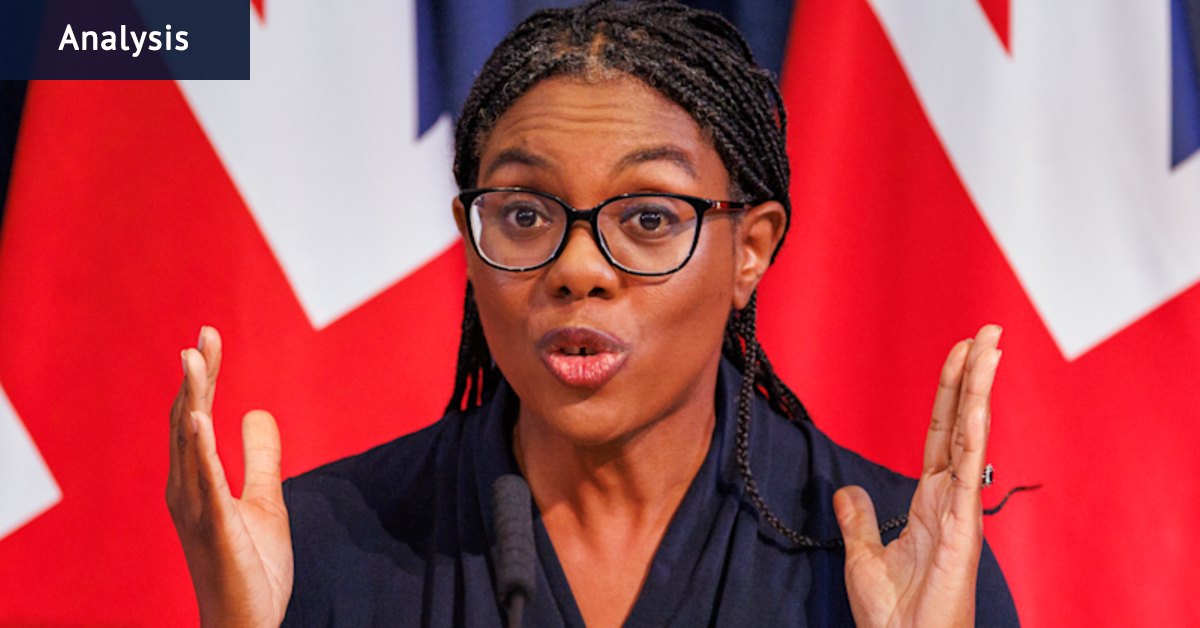
A sharp remark about British complacency highlighted the immense challenge for Kemi Badenoch, when the leader of the nation’s Conservative Party sought to outline her mission in a major speech on Sunday.
asserted
leader → highlight → Sunday
Her warning in the address also underscored a grim outlook for the country.
asserted
warning → underscore → country
Badenoch argued that the UK could simply not afford all the policies it would like to have and would have to cut its spending to suit the times.
uncertain
it → argue → times
This is not a popular position when families are being punished by rising prices and burdened by low wages.
asserted
families → punish → wages
Many voters expect the government to help them by spending more on household assistance and subsidies.
asserted
government → expect → assistance
But that did not stop Badenoch from attempting some “tough love” in her address to the annual Conservative Party conference.
asserted
that → stop → conference
It was also a contrast with Britain’s new prime minister, Andy Burnham, who used his address to the annual Labour Party conference one week ago to talk about spending increases, not cuts.
asserted
who → use → increases
“We are the lucky generation,” Badenoch told the event in Birmingham on Sunday.
asserted
Badenoch → tell → Sunday
“We didn’t have to deal with World War One or World War Two.
asserted
We → have → War
We haven’t had many of the problems that previous generations did.
asserted
generations → have → that
Advancements in medical technology or just general technology have made life pretty comfortable.
asserted
life → make → technology
“But I think that that is making us – across the West, to be honest, not just the UK – very complacent.”
asserted
us → think → UK
One example, she said, was the plan under former prime minister Keir Starmer, who was removed in June, to settle the future of the Chagos Islands in the Indian Ocean (and the Diego Garcia base the UK shares with the United States) by agreeing to pay billions of dollars to Mauritius to “lease” the territory.
asserted
UK → say → territory
“This belief that we are rich because we are rich and we are always going to be rich,” Badenoch said.
asserted
Badenoch → go → ?
“So we can spend loads of money on foreign aid and we can give away the Chagos Islands and pay £35 billion ($66 billion) for it.
asserted
we → spend → it
And we can do all sorts of foolish and silly things because the money is just there.
asserted
money → do → things
We have to make the money so we can do everything else.”
asserted
we → have → everything
Badenoch is yet to prove she can replace Burnham.
asserted
she → prove → Burnham
She has led the Conservatives for about two years and made some small gains in the polls, but
asserted
She → lead → polls
most of the attention on the right of the political spectrum goes to Nigel Farage and his anti-immigration party, Reform UK.
asserted
most → go → Farage
The Conservative leader does a good line in light mockery, however, and is trying to leap ahead of Farage when he is under scrutiny for accepting big donations from crypto investors.
asserted
he → do → investors
The latest YouGov survey showed 25 per cent of voters backed Reform, 24 per cent supported Labour and 19 per cent backed the Conservatives.
asserted
cent → show → Conservatives
She was born in London to Nigerian parents and initially raised in Nigeria before joining her mother, a professor, in the United States.
asserted
She → bear → States
She was educated in the UK from the age of 16, went to university to study engineering and law, and became a software engineer.
asserted
She → educate → engineering
Active in Conservative politics since she was 25, Badenoch married Hamish Badenoch, a banker, when she was 32.
asserted
she → marry → Badenoch
They have two daughters and a son.
asserted
They → have → daughters
Her speech to the opening day of the Conservative conference came at a testing time for her and the party.
asserted
speech → come → her
Badenoch shone when she was skewering Starmer in parliament during his long slide towards resignation, but she has a harder task with Burnham.
asserted
she → shine → Burnham
Put simply, she is now up against a much better communicator.
asserted
she → Put → communicator
While she projects her policies with a smile, she is anathema to the progressive side of politics.
asserted
she → project → politics
She stands for cutting welfare, cancelling net-zero climate goals, easing the regulation of businesses and developing more oil and gas deposits.
asserted
She → stand → deposits
She argued that those who arrived should embrace British values so the country would maintain one shared culture.
asserted
country → argue → culture
That language goes to the heart of the unease in Britain over the number of migrants, especially asylum seekers who arrive by boat in the English Channel.
asserted
who → go → Channel
“I don’t want lots of little ghettoes of separatist communities where they’re recreating the place that they came from,” she said.
asserted
she → want → that
“That will ruin the United Kingdom.
asserted
That → ruin → Kingdom
We’ve never had race-based citizenship in this country, but I do want to emphasise that British culture means something.”
asserted
culture → have → something
Badenoch had no instant solutions in her address.
asserted
Badenoch → have → address
In fact, one of her policy ideas is to widen the eligibility for childcare assistance – a new spending, not a saving.
asserted
one → widen → assistance
She had no plan to stop the boats in the English Channel, nor any thorough proposal on how to restrict migration without hurting economic growth.
asserted
She → have → growth
What she had, instead, was an uncomfortable truth for the public: the country was not as rich as they thought.
asserted
they → think → public
…and 18 more, not listed.
 The Aporia