Scientists previously believed that Oklahoma’s Ames impact structure was formed around 470 million years ago due to a meteor event. However, new research published in Meteoritics & Planetary Science suggests that the crater may actually be nearly 370 million years old, placing it in the Late Devonian period rather than the Ordovician. This conclusion is based on radioisotopic dating of zircon from impact-melted granite, where 10 out of 11 measurements indicated an age close to 370 million years, shifting the Ames impact's timeline closer to a major extinction event known as the Frasnian-Famennian boundary.
Written locally by qwen2.5:14b on 2026-10-05,
using this article's own text rather than the other coverage of the
same event (that is the story summary below).
For decades, scientists linked Oklahoma’s Ames impact structure to a meteor event that swept across Earth nearly 470 million years ago.
asserted
that → link → Earth
According to research published in Meteoritics & Planetary Science titled ‘
The Ames impact structure, Oklahoma: New radioisotopic constraints and implications for North American impact chronology’, new evidence points to a very different timeline.
uncertain
evidence → accord → timeline
By dating zircon from impact-melted granite, researchers may have found a distinct group of grains with an age of nearly 370 million years, suggesting the crater formed during the Late Devonian.
uncertain
crater → date → Devonian
That would place the impact close to the Frasnian-Famennian boundary and the Upper Kellwasser Crisis, a major extinction event.
asserted
That → place → boundary
How did new dating place the Ames impact near a major extinction
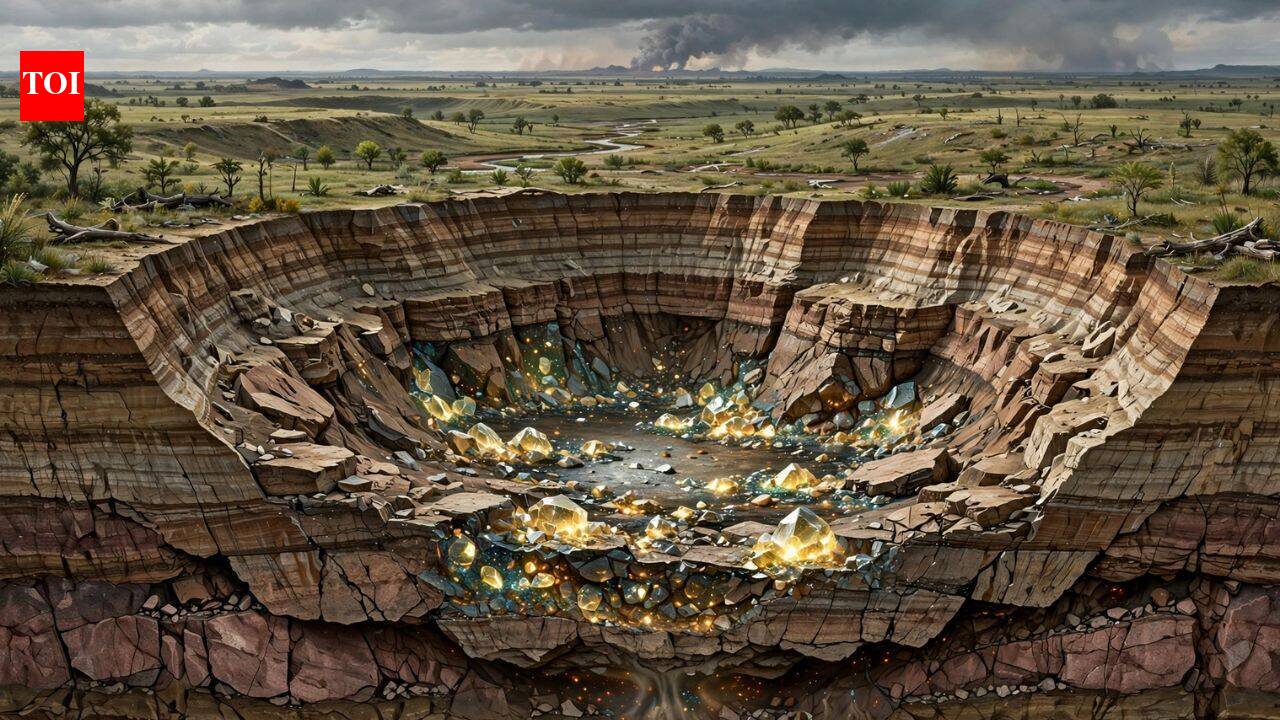
The Ames impact structure lies beneath Ames, Oklahoma, with an outer rim measuring 14-16 km in diameter.
asserted
structure → place → diameter
It was previously considered one of the largest impact structures associated with the Ordovician Meteor Event, which began about 466-468 million years ago.
asserted
which → consider → Event
This connection was based on conodonts and moulds identified in material filling the crater.
asserted
connection → base → crater
To test the age of the impact, researchers used radioisotopic dating on zircon and plagioclase from impacted granite.
asserted
researchers → test → granite
The youngest zircon population had a weighted mean age of nearly 370 million years.
asserted
population → have → years
The researchers interpret this as a maximum age for the impact event.
asserted
researchers → interpret → event
If correct, this would place the Ames impact in the Late Devonian rather than the Ordovician, changing its position in North American impact chronology.
asserted
this → place → chronology
How did zircon dating reveal the age of the Ames impact
Researchers analysed zircon from the impact-melt portion of the Ames structure using secondary ion mass spectrometry and laser ablation-inductively coupled plasma-mass spectrometry.
asserted
Researchers → reveal → spectrometry
They made 37 measurements.
asserted
They → make → measurements
The youngest zircon dates formed a distinct population.
asserted
dates → form → population
10 of the 11 analyses gave a weighted mean age of nearly 370 million years after one statistical outlier was excluded.
asserted
outlier → give → years
Most zircons, including the youngest Devonian-age grains, retained their primary oscillatory zoning and showed no signs of deformation.
asserted
zircons → include → deformation
Two zircons displayed impact-related textures, including low-angle grain boundaries within microcracks and granular zircon arrays crossing their growth zoning.
asserted
zircons → display → zoning
Why did the earlier fossil evidence place the Ames impact in the Ordovician
asserted
evidence → place → Ordovician
The earlier Ordovician age for Ames came from Middle Ordovician conodonts and moulds found in the Crater Shale.
asserted
age → come → Shale
The study says this age was based on only four small chips and that the Crater Shale has poorly understood and debated stratigraphic relationships.
asserted
Shale → say → relationships
The researchers propose that the impact excavated Middle to Upper Ordovician Simpson Group strata and disrupted fossil-bearing sediments.
asserted
impact → propose → sediments
Those materials could then have been redeposited inside the crater during resurge and tsunami backwash.
uncertain
materials → redeposit → backwash
Under this interpretation, the conodonts came from older rocks struck by the impact and were later deposited inside the crater.
asserted
conodonts → come → crater
Rapid redeposition and burial inside the crater may also have helped preserve the delicate fossil remains.
uncertain
redeposition → help → remains
Ames impact dates to the period of the Late Devonian extinction
The nearly 370-million-year-old zircon age falls close to the Frasnian-Famennian boundary, which marks the Upper Kellwasser Crisis, an extinction event.
asserted
which → date → Crisis
The Ames result falls within the broader Middle to Late Devonian window of other North American impacts, though some are somewhat older.
asserted
some → fall → impacts
The paper lists Flynn Creek in Tennessee at about 382 million years, Nicholson Lake in Canada at about 385 million years, and the Alamo impact-related deposits in Nevada at 355-382 million years.
asserted
paper → list → years
If the zircon interpretation is correct, the Ames impact may provide additional evidence for one or more large bolide impacts during the Late Devonian.
uncertain
impact → provide → Devonian
The researchers say this could inform discussions about links between extraterrestrial impacts and environmental disturbances associated with the Frasnian-Famennian mass extinction.
uncertain
this → say → extinction
 The Aporia