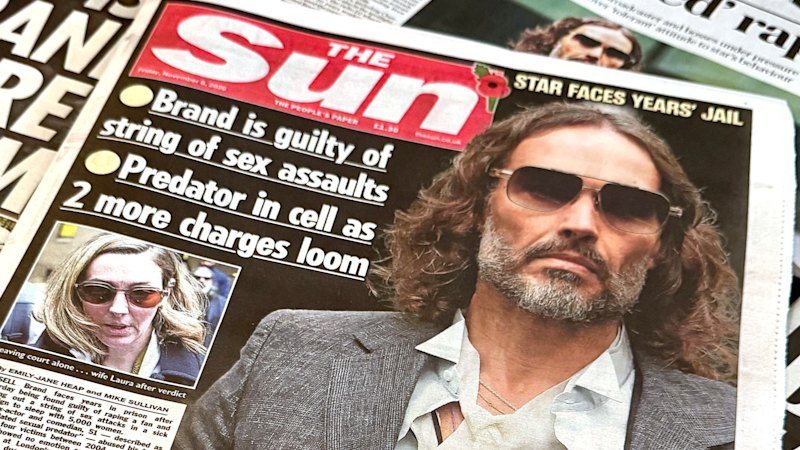
British authorities are investigating Russell Brand over a message from prison in which he declared his innocence despite a jury convicting him of rape and a judge sentencing him to a decade in prison.
asserted
he → investigate → prison
UK Prime Minister Andy Burnham is treating the statement as a potential breach of prison rules because it could cause distress to victims.
uncertain
it → treat → victims
The uproar came as debate intensified over changes to the age of consent to protect young people from “predatory” older men, with Conservative Party leader Kemi Badenoch backing an increase from 16 to 18.
asserted
Badenoch → come → 18
British television and theatre workers also called for an end to the “culture of open secrets” in the entertainment industry, with 400 signing an open letter saying too many looked away when abuse occurred.
asserted
abuse → call → letter
The arguments over the age of consent and industry culture have widened after a court allowed the media to name former Little Britain star David Walliams as the subject of complaints from women who said he had groomed them for sex.
asserted
he → widen → sex
He has denied the claims.
uncertain
He → deny → claims
Brand was sentenced last week and sent to Wandsworth prison in London before reports said he had been moved to a lower-security prison in Littlehey, west of Cambridge.
asserted
he → sentence → Cambridge
His wife, Laura Gallacher, released a podcast episode on YouTube on Sunday in which she read a statement from her husband.
asserted
she → release → husband
“As you know, I am not guilty,” she read.
asserted
she → know → ?
Prisoners are entitled to express their opinions and proclaim their innocence, but there are restrictions on whether they can talk to the media and whether their comments might cause distress to victims.
uncertain
comments → entitle → victims
A spokesperson for Burnham described the Brand statement as “clearly appalling” and said it was being urgently investigated.
asserted
it → describe → statement
“We expect action to be taken if he’s found to have broken the rules,” the spokesperson said.
asserted
spokesperson → expect → rules
“Prisoners are strictly banned from making statements that cause distress to victims and speaking to the media is only permitted in exceptional circumstances.
asserted
speaking → ban → circumstances
“Prisoners cannot get around these rules by having someone else publish these comments.”
asserted
someone → get → comments
Brand, 51, has become a vocal Christian in recent years and has released a regular Sunday podcast with his wife.
asserted
Brand → become → wife
He praised the prison staff at Littlehey in the statement read by his wife, and said he was “in no position to judge” his fellow prisoners.
“I don’t know which other men here are not guilty, and the ones that are, they are people that Christ died to save, like you and me.
asserted
Christ → praise → you
Let us all love, pray for and forgive one another as God forgave us,” he said.
asserted
he → let → us
Brand was sentenced to nine years in prison after a jury found him guilty of raping a 21-year-old woman at his home in 2009, when he was 34.
asserted
he → sentence → 2009
Brand was also found guilty of three counts of sexual assault, taking his prison sentence to 10 years and six months, and he was acquitted of two charges of rape.
asserted
he → find → rape
One of those who spoke to the media about Brand three years ago, Mia Latter, went public on the weekend with claims that she was raped by Brand when she was 16 and he was 30.
uncertain
he → speak → Brand
Latter called for a “staggered” age of consent to stop men over 30 having sex with teenagers.
asserted
men → call → teenagers
Badenoch said she backed an increase in the age of consent from 16 to 18, but she emphasised it was her personal view rather than that of the Conservative Party policy.
asserted
it → say → policy
“I would just make the age of majority 18 for everything,” she said on Monday.
asserted
she → make → Monday
Let childhood be childhood, everything at 18.”
asserted
childhood → let → 18
Under UK law, teenagers can drive when they are 17 and vote when they are 18, while the age of consent is 16.
asserted
age → drive → consent
Burnham has outlined draft laws to allow teenagers to vote from 16, but the Conservatives oppose this change.
asserted
Conservatives → outline → change
The open letter from actors, writers, directors and other entertainment industry workers said the latest cases should not be regarded as “one-offs” when there were “open secrets” about the behaviour of some stars.
asserted
cases → say → stars
“For this to be a turning point, the creative and entertainment industries must first acknowledge the role they play in enabling the behaviour on trial and at the centre of these convictions,” said the letter signed by 400 people.
asserted
letter → acknowledge → people
“And the industry cannot mistake the lack of formal reporting for the absence of systemic abuse when many victims feel able to share their stories only quietly.
“A perpetrator being a friend, a boss or a mentor does not and must not be allowed to invalidate the experience of victims.
asserted
perpetrator → mistake → victims
“Fear of retaliation and loss of work or opportunities cannot and must not be enabled as a tool of control to shape narrative, maintain perceptions and discredit victims.
asserted
Fear → enable → victims
“And a person’s credits and notoriety cannot and must not excuse their actions or attacks on those whose voices they believe beneath them.”
asserted
they → excuse → them
One of the signatories is Natalie Dormer, who appeared in The Tudors, Game of Thrones and The Hunger Games.
asserted
who → appear → Thrones
The letter was organised by writer and producer Ben Fletcher with actor Alexa Morden.
asserted
letter → organise → Morden
To afford such a label would be to ignore that it has taken some seventeen years for justice.
asserted
it → afford → justice
To ignore that one witness became the victim of death threats online.
asserted
witness → ignore → threats
To ignore that the rapist’s own lawyer found it necessary to refer himself for aggression towards the journalist who uncovered his client’s behaviour.
asserted
who → ignore → behaviour
For this to be a turning point, the creative and entertainment industries must first acknowledge the role they play in enabling the behaviour on trial and at the centre of these convictions.
asserted
they → acknowledge → convictions
Not through PR-drafted statements, vague promises or weak admissions that more could be done.
uncertain
more → draft → statements
But by accepting what was missed and that, collectively, the sector operates with a culture of open secrets and a belief that fame is a shield and status is a reason to look the other way.
asserted
status → accept → secrets
This cannot be dismissed as a one-off.
asserted
This → dismiss → off
…and 23 more, not listed.

 The Aporia