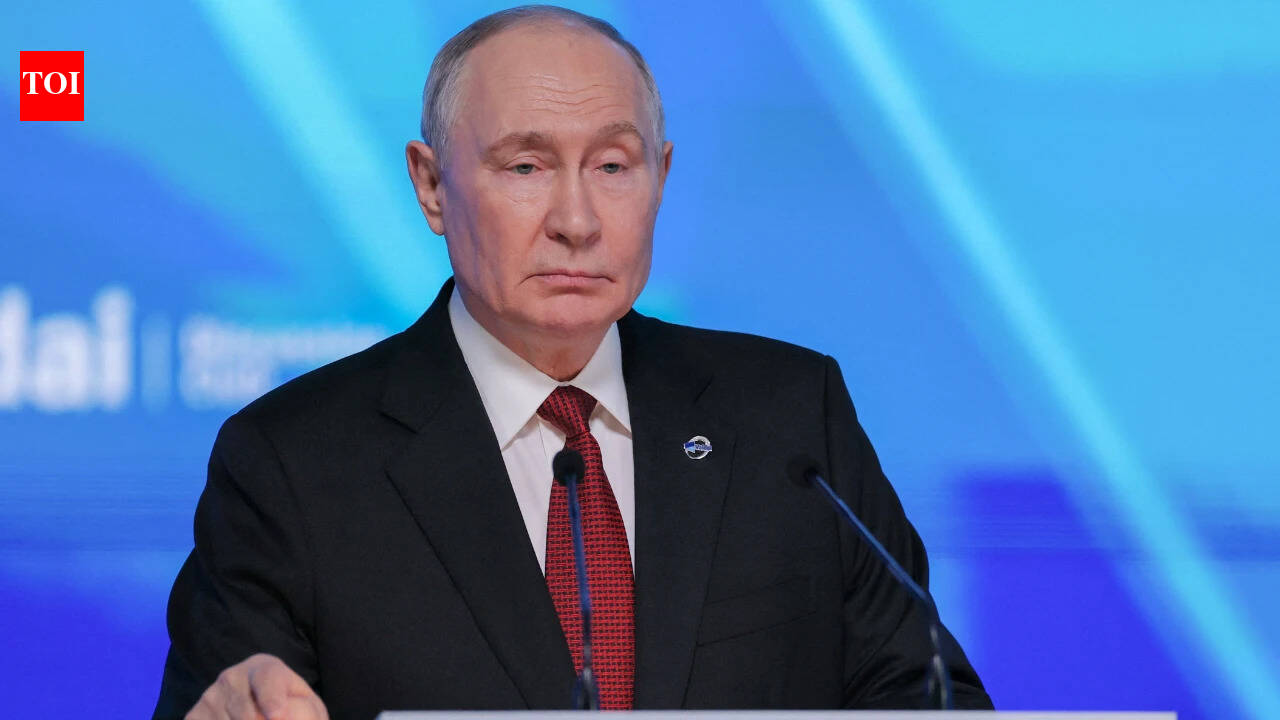
Russian President Vladimir Putin on Thursday warned that the world was living through a dangerous moment, saying escalating international conflicts could reach a “fatal point of no return” and stressing that weapons of mass destruction must never be used.
uncertain
weapons → warn → destruction
Speaking at the Valdai Forum of international Russia experts in Moscow, Putin said the world’s leading powers possessed arsenals capable of destroying all life or reducing the Earth to a “catastrophic state”.
asserted
powers → speak → state
He urged countries to recognise how quickly escalating retaliation could lead to an irreversible situation.
uncertain
retaliation → urge → situation
“We must realise that the moment when nothing can be changed any longer may come very quickly and unexpectedly for everyone.
uncertain
nothing → realise → everyone
The logic of escalating, increasingly harsh retaliatory measures leads to a fatal point of no return,” Putin said.
asserted
Putin → escalate → return
“At the heart of this escalation lie arrogance and overconfidence.
asserted
arrogance → lie → escalation
All the more so today, when the arsenals of the world’s leading powers contain weapons capable of destroying all life or, at the very least, reducing the Earth to a catastrophic state.
asserted
arsenals → lead → state
Can we be certain that these weapons will never be used?
asserted
weapons → use → ?
We must bear this in mind and avoid such an outcome.”
Putin warns of Western role in Ukraine conflict
Putin said Ukraine would not be able to carry out attacks deep inside Russia without Western technical support, arguing that such assistance amounted to direct involvement in the conflict.
asserted
assistance → bear → conflict
He said Russia viewed attempts to use Ukraine as a proxy to fight Russia as a threat.
asserted
Russia → say → threat
Putin also said Moscow was not planning to attack factories in other countries that manufacture weapons for Ukraine, but warned that Russia's military and intelligence services needed to closely monitor them.
asserted
services → say → them
“We are not going to attack tomorrow enterprises in countries which supply weapons to Ukraine, but that's a threat,” Putin said.
asserted
Putin → go → Ukraine
Putin also said Ukrainian strikes on Russian oil refineries had cost Russia 1% of its gross domestic product.
asserted
strikes → say → product
He said Ukraine had “partially achieved its objectives” through the attacks, but added that Russia was responding in kind.
asserted
Russia → say → kind
He further said Ukraine had damaged more than 100 Russian vessels in the Black Sea and that Moscow was now responding.
asserted
Moscow → say → Sea
Russia issues warning over Kaliningrad
asserted
Russia → issue → Kaliningrad
Putin said Russia would consider using the full range of weapons in its arsenal if its Baltic exclave of Kaliningrad came under threat.
asserted
exclave → say → threat
He maintained that Russia did not plan to attack anyone but would respond to aggression.
asserted
Russia → maintain → aggression
“We are not going to attack anyone, but will respond if we face aggression,” Putin said.
asserted
Putin → go → aggression
Kaliningrad is a Russian territory on the Baltic Sea separated from mainland Russia by other countries and located between Nato members Poland and Lithuania.
asserted
Kaliningrad → separate → members
The region has become a focus of tensions between Moscow and the alliance.
asserted
region → become → Moscow
In a separate development on Thursday, the Kremlin said Russia's recent letter to Nato on Kaliningrad should not be viewed as confrontational.
asserted
letter → say → Kaliningrad
The document accused the alliance of pursuing a “dangerous and reckless course” carrying “high risks of the outbreak of a direct armed conflict”.
asserted
document → accuse → conflict
Putin also said Russia was not threatening European countries and did not plan to attack them.
asserted
Russia → say → them
“We are not threatening anyone and we do not plan to attack any European countries, not in 2030, not in 2050,” he said.
asserted
he → threaten → 2050
Putin says global conflicts likely to continue
Putin said international conflicts were likely to continue as the global order undergoes fundamental changes, although he said the situation would improve as what he described as Western hegemony waned.
“Regardless of which scenario unfolds globally in the coming years, the continuation of international conflicts is, unfortunately, highly likely.
asserted
continuation → say → conflicts
This is due in part to the fact that ongoing fundamental shifts—and the opportunities they present—fuel ambitions and a willingness to take risks for the sake of a seemingly massive payoff,” Putin said.
asserted
Putin → present → payoff
He again stressed the need to avoid catastrophic scenarios.
asserted
He → stress → scenarios
Putin also said Russia supported a possible trilateral meeting with Chinese President
Xi Jinping and US President Donald Trump, although he said an agenda for such talks would first need to be worked out.
asserted
agenda → say → talks
On the Middle East, Putin said he hoped the Strait of Hormuz would remain open to shipping and that sanctions on Iran would be lifted.
asserted
sanctions → say → Iran
He also said Russia's proposals to deliver enriched uranium from Iran to Russia remained valid.
asserted
proposals → say → Russia
Putin said Russia remained interested in cooperation with Japan but was concerned about what he described as the country's militarisation.
asserted
he → say → militarisation
He added that Japanese companies continued to operate in Russia and that Moscow supported them and others working with Russia.
asserted
Moscow → add → Russia
He also criticised military drills and arrests of Russian vessels as forms of escalation and said Russia had a competitive advantage in defending itself.
asserted
Russia → criticise → itself
 The Aporia