Israelis divided as vote that could oust Netanyahu only weeks away

Read the original at The Guardian ↗
The Guardian · collected 2026-10-01 · by Lorenzo Tondo and Quique Kierszenbaum in Jerusalem; graphics by Ana Lucía González Paz

Quick Summary

An upcoming Israeli election scheduled within weeks could potentially end Benjamin Netanyahu's tenure as prime minister after over two years of polls indicating his coalition may fall short of the required 61 seats for forming a government. Former IDF chief Gadi Eisenkot, leading the Yashar party with projected support for 22 seats according to recent polling, faces challenges in securing a majority due to his refusal to ally with Palestinian parties expected to win 12 critical seats. The uncertainty and fragmentation of political support are causing widespread public disillusionment and mistrust among Israeli citizens who feel their future is unclear regardless of the outcome.
Written locally by qwen2.5:14b on 2026-10-01, using this article's own text rather than the other coverage of the same event (that is the story summary below).

AI analysis runs on qwen2.5:14b, locally

Story summary

On the streets of Jerusalem, uncertainty prevails as voters prepare for elections less than a month away, following 7 October 2023 Hamas attacks and nearly three years of war with Gaza, Lebanon, and Iran. The election could mark a turning point in Israel’s political landscape, with polls suggesting that Prime Minister Benjamin Netanyahu's coalition may fall short of the required 61 seats needed to form a government. His main rival, Gadi Eisenkot, faces challenges as well; he has ruled out forming a coalition with Palestinian citizens' parties, who are projected to secure 12 critical seats, leaving no clear path to power for either side.

Written for “Israeli Election Polls Close” on 2026-10-05, grounded in this article and the 0 other(s) covering the same event.

Signals How these are calculated →

Claims extracted
70
claim-shaped sentences
Uncertain
10%
7 of 70 hedged
Leaning
withheld
no quote in the article backed the model's score
Correction & hedging signals
68.3
corrections and hedging in what we collected; not a measure of accuracy
Outlets on this story
1
Politics
Narrative spread
1
articles carrying this framing
Analyzed 2026-10-01 · how these are computed

Story

📰 Israeli Election Polls Close
Politics · 1 article(s) covering the same event.

How this is being covered How these are calculated →

Article leaning vs. publisher reliability
Source leaning vs. consistency

Compared with similar articles

This article reads unscored and hedges 10% of its claims. Each row says how that neighbour differs.
Zeteo
⚖️ Leans strongly left 🔴 20% hedged 1 of 5
“The articles describe different events: one focuses on protests and actions during Netanyahu's UN address, while the other discusses public opinion ahead of an upcoming election.”
Times of India
⚖️ leaning not scored 🔴 34% hedged 10 of 29 📰 publisher trust 59
“Article A describes a visit and warning from Egypt's intelligence chief to Israel before an attack, while Article B discusses public sentiment and political uncertainty in the lead-up to an election following the attacks.”
Al Jazeera
⚖️ Leans left 🔴 0% hedged 0 of 12 📰 publisher trust 60
“Article A describes Smotrich's call for war, while Article B discusses public sentiment leading up to an upcoming election.”
Al Jazeera
⚖️ leaning not scored 🔴 9% hedged 5 of 57 📰 publisher trust 60
“Article A discusses Smotrich's call for war in the West Bank, while Article B focuses on public opinion and political uncertainty ahead of an upcoming election.”
Al Jazeera
⚖️ Centre 🔴 0% hedged 0 of 3 📰 publisher trust 60
“The articles cover different time periods and contexts, with Article A reporting on opposition leaders uniting to drive out Netanyahu during Sukkot closure, while Article B discusses uncertainty before an upcoming election weeks later.”
The Guardian
⚖️ Leans strongly left 🔴 0% hedged 0 of 29 📰 publisher trust 68
“The articles describe different events occurring at distinct times and places, with no overlap in specifics.”
The Guardian
⚖️ Leans strongly left 🔴 3% hedged 1 of 38 📰 publisher trust 68
“The articles discuss different aspects of the political climate in relation to Israel and Palestine, but do not describe the same specific incident or occurrence.”
The Hindu
⚖️ Leans left 🔴 15% hedged 5 of 33 📰 publisher trust 60
“Article A focuses on the specific vote to ban Arab parties from upcoming elections, while Article B discusses public sentiment and political uncertainty leading up to those same elections but does not describe the same specific incident.”
Washington Examiner
⚖️ leaning not scored 🔴 20% hedged 4 of 20 📰 publisher trust 72
“Article A discusses Netanyahu's warning video about an unspecified attack before the election, while Article B talks about public sentiment and polling trends regarding the upcoming election.”
Al Jazeera
⚖️ Leans left 🔴 21% hedged 7 of 34 📰 publisher trust 60
“The articles discuss different aspects of the political situation surrounding Netanyahu's election campaign and Israel's broader political climate, rather than a single specific incident.”

Publisher

The Guardian · 1247 article(s) · 4 correction(s) detected
Running correction rate · 4 correction(s)
2026-10-03
Tennessee’s top prison official resigning after botched execution of Christa Pike
2026-10-01
Tennessee governor suspends all executions after Christa Pike’s lethal injections fail
2026-09-28
Extra 1,000 prison beds announced in NSW as union warns against arresting ‘our way out of domestic violence’
2026-09-05
Australia’s housing prices are trending down. See which suburbs have had the biggest falls

Who wrote this

Lorenzo Tondo
2 article(s) here · 1 carrying a prediction
🔮 On the streets of Jerusalem, crowded with secular and ultra-Orthodox Jews, religious nationalists, settlers, Palestinians, and soldiers returning from deployments, uncertainty hangs over an election less than a month away that could mark a turning point for a country profoundly changed after the Hamas attacks of 7 October 2023 and nearly three years of war in Gaza, Lebanon and Iran.
🔮 NAZA, the award-winning documentary from Israeli film-makers Yuval Abraham and Rachel Szor, is set to be released in cinemas in more than 50 countries before a digital global release on theguardian.com.
Also by Lorenzo Tondo
Nothing else under this byline is closely related to this article, so these are simply their most recent.
Quique Kierszenbaum in Jerusalem; graphics by Ana Lucía González Paz
1 article(s) here · 1 carrying a prediction
🔮 On the streets of Jerusalem, crowded with secular and ultra-Orthodox Jews, religious nationalists, settlers, Palestinians, and soldiers returning from deployments, uncertainty hangs over an election less than a month away that could mark a turning point for a country profoundly changed after the Hamas attacks of 7 October 2023 and nearly three years of war in Gaza, Lebanon and Iran.
The only article under this byline in the corpus.

Topics

Hamas Israeli Jerusalem Jewish Palestinians

Subjects

Israeli NORP · 6× Netanyahu PERSON · 6× Hamas ORG · 3× Jerusalem GPE · 3× Jewish NORP · 3× Palestinians NORP · 3× Israel GPE · 2× Israelis NORP · 2× West Jerusalem GPE · 2× the Israel Democracy Institute ORG · 2×

Narrative

Yet Israel’s growing diplomatic isolation and the prospect of seemingly endless conflict on multiple fronts are beginning to worry voters even here, a few steps from the bustling Mahane Yehuda market, where giant election posters for Itamar Ben-Gvir, the far-right national security minister known for his anti-Palestinian rhetoric and championing a racist death penalty law that in practice applies only to Palestinians, loom over the streets.
framing: assertive · carried by 1 article(s) · first seen 2026-10-01
🔮 On the streets of Jerusalem, crowded with secular and ultra-Orthodox Jews, religious nationalists, settlers, Palestinians, and soldiers returning from deployments, uncertainty hangs over an election less than a month away that could mark a turning point for a country profoundly changed after the Hamas attacks of 7 October 2023 and nearly three years of war in Gaza, Lebanon and Iran.
2026-10-01 · The Guardian
Israelis divided as vote that could oust Netanyahu only weeks away · assertive framing

Claims (70 extracted, 7 hedged)

On the streets of Jerusalem, crowded with secular and ultra-Orthodox Jews, religious nationalists, settlers, Palestinians, and soldiers returning from deployments, uncertainty hangs over an election less than a month away that could mark a turning point for a country profoundly changed after the Hamas attacks of 7 October 2023 and nearly three years of war in Gaza, Lebanon and Iran. uncertain
that → crowd → Gaza
The political battle remains on a knife-edge. asserted
battle → remain → edge
For over two years most polls have predicted that the coalition of parties led by prime minister Benjamin Netanyahu will collectively slip below the 61-seat threshold needed to form a government. But there is no clear path to power for his main opponent, Gadi Eisenkot, the former chief of staff of the Israel Defense Forces, even if he maintains current levels of support, because he has ruled out going into coalition with any of the parties led by Palestinian citizens of Israel, who are projected to claim a critical 12 seats. uncertain
who → predict → seats
For Netanyahu to stay in power, he would have to either put together a different coalition or pull off an unprecedented election night surprise. asserted
he → stay → surprise
Another deeply fragmented Knesset seems likely, in which neither side is close to securing a majority. asserted
side → seem → majority
The latest Channel 13 poll, published last week, captured that deadlock: Jewish Israeli parties opposed to Netanyahu were projected to win 52 seats, against 51 for the prime minister’s bloc, with both falling short of the 61 required for a majority. asserted
both → publish → majority
Eisenkot’s Yashar party topped the poll with 22 seats, while Netanyahu’s Likud was projected to take 18. asserted
Likud → top → 18
The lack of clarity over the next government – with both main blocs on the right – is fuelling unease among Israelis, some of whom believe little will change whoever becomes prime minister. asserted
whoever → fuel → whom
“I’m not going to vote because I don’t trust anyone,” said Rachel, 42, an Israeli citizen living in West Jerusalem. asserted
Rachel → go → Jerusalem
“I used to vote for Yair Lapid,” she added, referring to the leader of the centrist Yesh Atid party. asserted
she → use → party
“The party’s name means ‘there is a future’. asserted
name → mean → ?
But today, I don’t see any future for this country.” asserted
I → see → country
Average public trust across the eight Israeli institutions measured consistently by the Israel Democracy Institute, a statistics body, stood at 34% in 2025, compared with 61% in 2012. An atmosphere of pessimism and indecision is palpable in Jerusalem, where tensions between Palestinians in occupied East Jerusalem – the majority of whom cannot vote in Israeli national elections – and rightwing Jewish Israelis have deepened since 7 October. asserted
majority → measure → October
The Hamas attack is likely to weigh heavily on the ballot: a recent poll by the Israel Democracy Institute found that 68% of Jewish respondents said 7 October would be a central factor in deciding how they voted. asserted
they → weigh → respondents
“After 7 October, everyone in this government has to take the blame,” said Ilda, who owns a clothing shop on Jaffa Street, one of Jerusalem’s oldest and busiest thoroughfares. asserted
who → have → thoroughfares
Referring to a Haaretz investigation claiming Netanyahu had been warned about the possibility of a major Hamas attack, which he denies, she said: “After journalists exposed what happened, look what they did: they attacked the journalists instead of taking responsibility.” asserted
they → refer → responsibility
West Jerusalem has long been considered fertile ground for Netanyahu and the Israeli right. asserted
Jerusalem → consider → Netanyahu
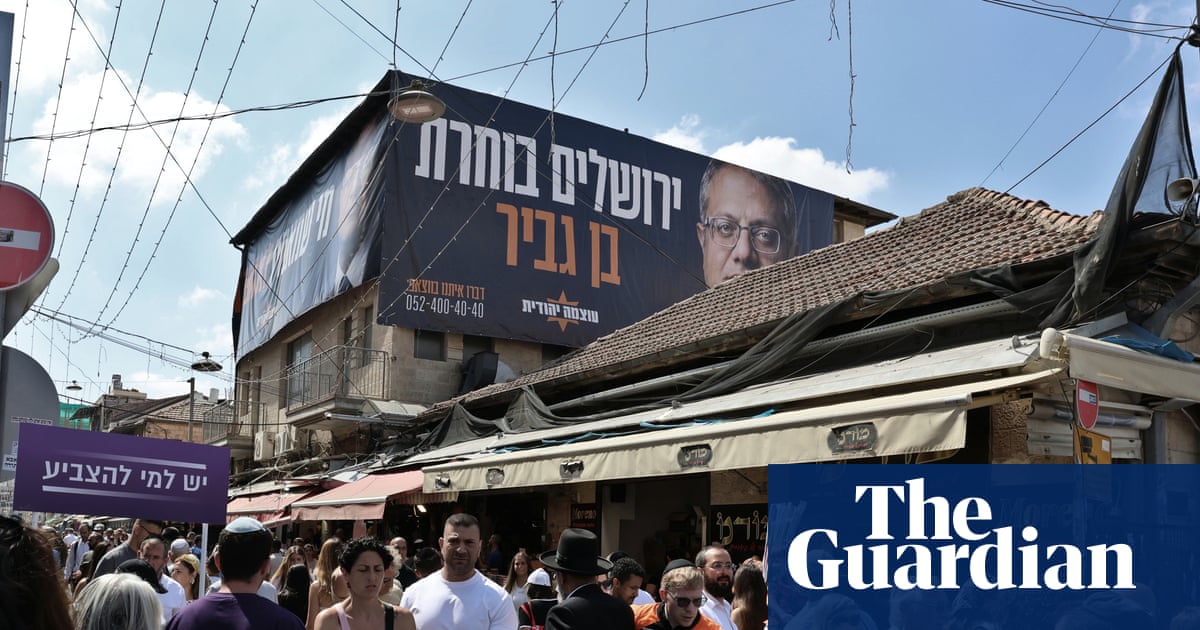
Yet Israel’s growing diplomatic isolation and the prospect of seemingly endless conflict on multiple fronts are beginning to worry voters even here, a few steps from the bustling Mahane Yehuda market, where giant election posters for Itamar Ben-Gvir, the far-right national security minister known for his anti-Palestinian rhetoric and championing a racist death penalty law that in practice applies only to Palestinians, loom over the streets. asserted
that → grow → streets
“This country needs radical change. asserted
country → need → change
I think I’ll vote for Naftali Bennett,” said Yosef, 26, a religious Israeli, referring to the rightwing former prime minister who now leads the B’Yachad alliance and is one of Netanyahu’s main political rivals. asserted
who → think → rivals
On one side are tens of thousands of Netanyahu supporters – called “Bibi-ists” in reference to the prime minister’s nickname – as well as backers of the far-right ministers Ben-Gvir and Bezalel Smotrich, who want to return the current coalition to power to “finish the job” in Gaza, Iran, Lebanon and the West Bank. asserted
who → call → Gaza
On the other are tens of thousands of voters who believe Israel is losing its standing in the world and needs a change of direction – something many see as embodied by the centre-right Eisenkot. asserted
many → believe → Eisenkot
His supporters argue that he would place greater emphasis on education, social policy and the economy, areas they say have been neglected by the current government. asserted
they → argue → government
“I’ll vote for anyone but the prime minister of 7 October,” said Turgeman as he enjoyed a coffee with his wife at a cafe in Jaffa during the Jewish high holiday season. asserted
he → vote → season
“I’ve never voted Likud in my life, and I’m certainly not going to start now. asserted
I → vote → life
I’ll vote for Eisenkot. asserted
I → vote → Eisenkot
We need a normal prime minister – someone who also cares about the economy and about prices, which have soared because of the war. asserted
which → need → war
Food prices in Israel have reached record highs amid the regional conflict and supply chain disruption, with food inflation outpacing the broader consumer price index. asserted
inflation → reach → index
The cost of food, including fresh fruit and vegetables, has risen by 9.5% over the past two years. asserted
cost → include → years
“They think about wars, while nobody is dealing with the economic crisis,” Turgeman said. asserted
Turgeman → think → crisis
“And what has Netanyahu done? asserted
Netanyahu → do → what
He has continued to provide financial support that benefits the Haredi [ultra-Orthodox] community.” asserted
that → continue → community
While most Jewish Israelis serve, Haredi men studying in religious seminaries have long been largely exempt. asserted
men → serve → seminaries
In 2024, amid war and growing pressure on reservists, the supreme court ruled there was no legal basis to continue the exemption, fuelling anti-draft protests, roadblocks and clashes with police. asserted
court → grow → police
Haredi parties have blamed Netanyahu for failing to pass legislation to protect the exemption. asserted
parties → blame → exemption
Ultra-Orthodox Jews, who make up about 14% of Israel’s population, have traditionally voted for parties backed by their rabbis, including the two main Haredi parties in Netanyahu’s coalition. asserted
who → make → coalition
But anger among younger Haredim over conscription and the policing of protests could lead some to defy their religious leaders this time. uncertain
anger → lead → leaders
“All the options in this election are junk, but I think I will vote for Eisenkot,” said Pinchas, 24, an ultra-Orthodox student who recently completed his military service. asserted
who → think → service
“I have the impression that this time people my age won’t vote according to what the rabbis tell them. uncertain
rabbis → have → them
Many are angry about the way Netanyahu handled the conscription law, and especially about the crackdown on those who protested against it. asserted
who → handle → it
…and 30 more, not listed.

💬Give feedback
🕘History 🎫Support