As every student of investment trends knows, any boom will ultimately culminate in a bust.
asserted
boom → know → bust
Yet almost invariably this truism – repeatedly proven by historical experience – is forgotten in the excitement of the boom du jour; or, rather, investors come to believe that in their particular case, the boom is perfectly sustainable.
asserted
boom → prove → case
Equally invariably, belief in “this time is different” turns out to be flawed.
asserted
time → turn → ?
As indeed it will be with the latest technological revolution to engulf the world of commerce: artificial intelligence.
asserted
it → engulf → commerce
I have to confess to being somewhat bewildered by the pace, scale and complexity of the change that AI is bringing about, and readily admit to lacking the expertise to fully understand both the technology and its path to monetisation.
asserted
AI → have → monetisation
I should add that this is not for want of trying.
asserted
this → add → trying
But I do know a bubble when I see one, and the current breathless pace of investment in AI is undoubtedly that.
asserted
pace → know → AI
It’s happening far too fast for the capital markets and the public to accommodate without mishap.
asserted
markets → happen → mishap
Ah, yes, but actually, say its cheerleaders, it is not nearly as big as some of those seen in the past; and unlike the dotcom boom of the late 1990s, or the British railway mania of the 1840s, it is substantially funded by the existing cash flows of the major tech giants.
asserted
it → say → giants
Both these observations are supported by the facts.
asserted
observations → support → facts
At its peak, annual capital spending on railways reached an astonishing 20 per cent of British GDP, and even the investment boom in broadband supporting infrastructure during the 1990s reached close to 2 per cent of US GDP.
asserted
boom → reach → GDP
Current data centre and associated hardware spending is “only” about 1.5 per cent of US GDP, and this is largely being met from the already burgeoning profits of “big tech”.
asserted
this → associate → tech
All the same, the suspicion that what we are witnessing is another giant misallocation of capital refuses to go away.
asserted
witnessing → witness → capital
Extreme levels of share price volatility among leading AI operatives already point to a basic, underlying lack of confidence in the highfalutin claims made for the earnings potential of this massive increase in capital spending.
Up like a rocket in initial trading after its IPO a couple of months ago, then down like a spent stick, shares in Elon Musk’s SpaceX now trade 17 per cent below the peak they reached shortly after the issue price.
uncertain
they → lead → price
News that the company plans to double down on investment in computing power went down badly with investors.
asserted
company → plan → investors
They thought they were investing in a rocket company, not another data centre behemoth.
asserted
they → think → company
Lately, even the so-called “picks and shovels” trade – the notion that the real money in any gold rush is to be made not by the prospectors themselves but by those selling them the enabling hardware, in this case high-end processing and memory chips – has come off the boil in anticipation of an eventual pronounced slowdown in demand.
asserted
money → call → demand
So far, there is still no sign of this in announced spending plans, but it doesn’t entirely quell fears of a sudden stop when investors and credit markets abruptly turn off the taps.
asserted
investors → be → taps
A number of recent developments have added to these concerns.
asserted
number → add → concerns
First and perhaps most important is the advent of our old friend, growing Chinese competition.
asserted
advent → grow → friend
This first became apparent with the launch in January last year of the Hangzhou-based DeepSeek, said to have been developed at a fraction of the cost of US frontier models but with equally powerful capabilities.
asserted
This → become → capabilities
Since then, there has been a steady stream of cheap and cheerful launches from China’s AI sector, including Alibaba’s Qwen 3.8 Max, which is said to be better in some respects than Anthropic’s flagship Fable 5.
asserted
which → include → Fable
Before that, we’d seen the launch of Moonshot AI’s Kimi K3, again said to be as good as many pricier Western models.
asserted
we → see → models
Already, these Chinese upstarts are beginning to make significant inroads into Western markets, where their open-source approach to AI is thought perfectly adequate and in some ways better for most needs.
asserted
approach → begin → needs
Yes, it follows exactly the same pattern as virtually every industry you care to think of.
asserted
you → follow → industry
In this case, as in many others, it is those slipstreaming in the wake of the pioneers that may reap the bigger harvest.
uncertain
that → slipstreame → harvest
Not that this has in any way lessened the appetite among US hyperscalers for AI infrastructure investment.
asserted
this → lessen → investment
The US already has 5400 operational data centres, with many more planned.
asserted
US → have → centres
China, by contrast, has fewer than 500, though they tend to be bigger in scale.
asserted
they → have → scale
In other words, China seems to be managing the AI transition on much smaller capital outlays than the US and Europe, thereby limiting the squeeze in overall capital spending that the AI leviathan inflicts on other industries and the fallout that might ensue from any slowdown in AI deployment.
uncertain
that → seem → deployment
In the West, there is a real danger of AI becoming a kind of all-consuming black hole that sucks the life out of all other forms of investment.
asserted
that → be → investment
The other factor that should concern investors and lenders is the increasingly vocal public backlash against AI, manifested in sometimes violent local opposition to the construction of more data centres.
asserted
that → concern → centres
This is something quite new to America, which generally has a more positive attitude to cutting-edge industrial development than most other Western economies, and it seems to be directly linked not just to the appalling aesthetics and energy-guzzling characteristics of data centres but to a genuine loathing of the power of the tech giants and what they represent.
asserted
they → have → what
Small-town America is not taking kindly to the tech bros of Silicon Valley remaking the world in their own image.
asserted
bros → take → image
Even Donald Trump, spooked by the growing number of cybersecurity incidents associated with OpenAI and Anthropic models, has begun to take note, though he qualifies support for more public control with the greater priority of winning the AI arms race with China.
asserted
he → spook → China
“We don’t want to restrict them where all of a sudden we come in second to China,” the US president said last week.
asserted
president → want → China
“Whoever wins with AI is going to win.
asserted
wins → win → AI
That’s how big it is ...
asserted
it → ’ → ?
I don’t want to restrict them from doing great work.”
asserted
I → want → work
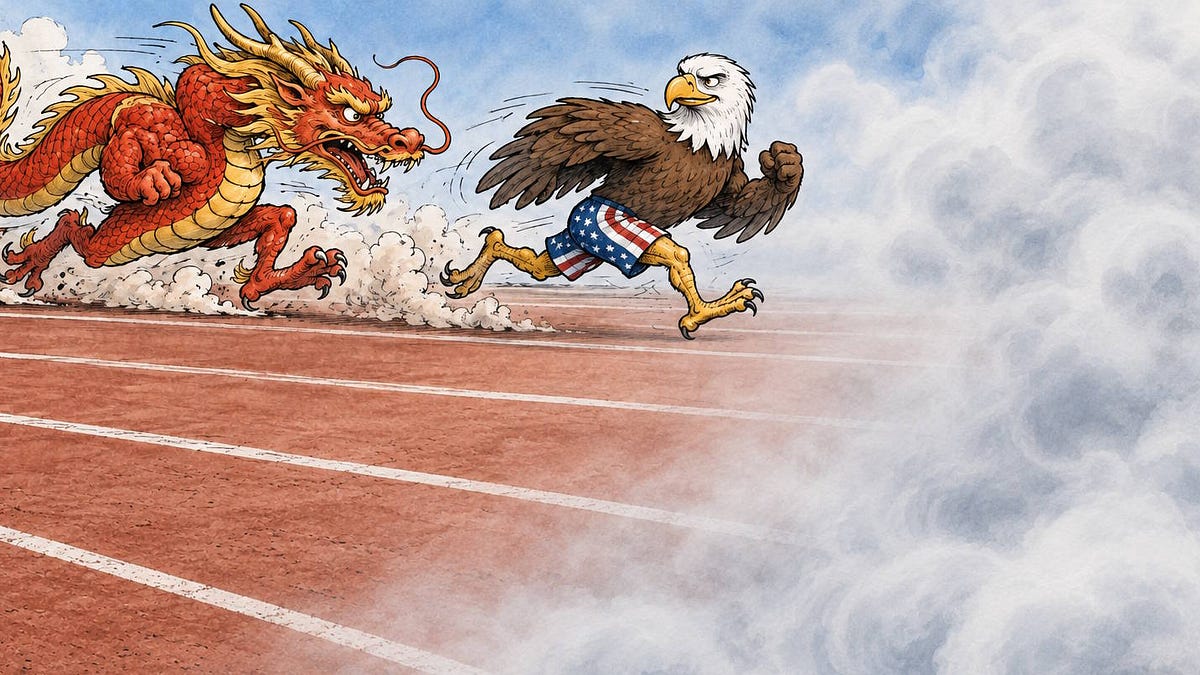
So the “great work” continues, turbocharged by China snapping at Silicon Valley’s heels.
asserted
China → continue → heels
…and 5 more, not listed.
 The Aporia