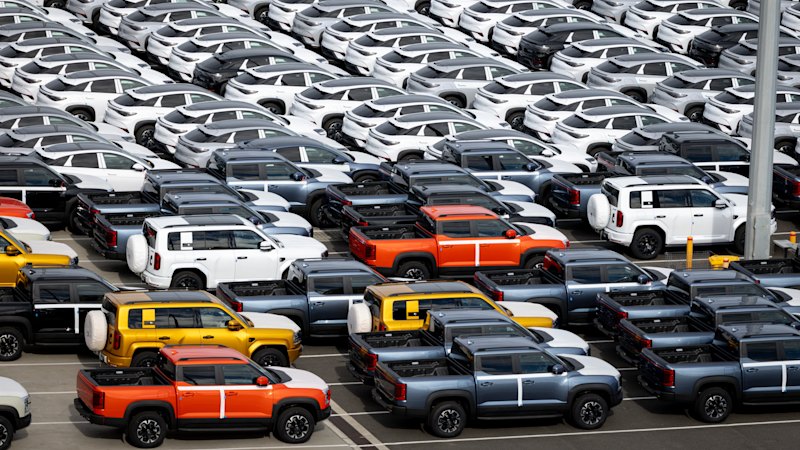
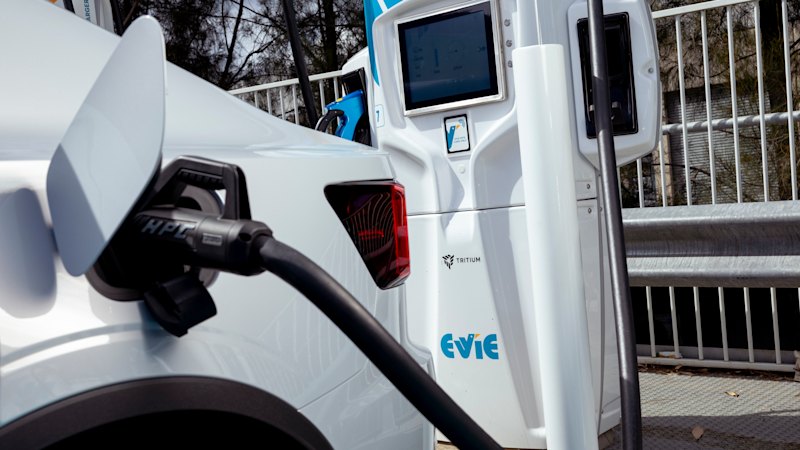
Photo via ABC News (AU)

One EV sold every 100 seconds as Australia catches up to the world

Read the original at ABC News (AU) ↗
Cite

Morris, N. (2026, September 30). One EV sold every 100 seconds as Australia catches up to the world. ABC News (AU). https://www.abc.net.au/news/2026-09-30/ev-sales-double-australia-one-in-four-new-cars-electric/107210480

Dated when The Aporia collected the article, usually within hours of publication. Check the original for its exact date and byline.

ABC News (AU) · collected 2026-09-30 · by Nathan Morris

Quick Summary

The Electric Vehicle Council reports that an electric car is sold every 100 seconds in Australia, marking a tenfold increase in EV sales within a decade. As of now, one in four new cars sold are electric vehicles, with suburban areas driving recent growth due to cost savings and government incentives like tax exemptions for fringe benefits. However, the report highlights that achieving Australia's climate goals will require a significant boost in EV adoption, as current figures place electric cars at just 3% of the national fleet of about 21 million vehicles.
Written by AI on 2026-09-30, from this article's own text only (the story summary below draws on all the coverage).
See how they differ ↓

AI analysis

Story summary

In the first half of 2023, an electric vehicle was sold every 100 seconds in Australia, marking a significant surge in EV adoption. The Electric Vehicle Council reported that 157,958 EVs were sold from January to June, more than double the number (72,476) during the same period in 2022. Fully battery-electric vehicles accounted for 103,716 of those sales, while plug-in hybrids made up the remaining 54,241. This rapid increase expanded EVs' share of Australia's new car market to over 25%, compared to just 10% a year prior.

Factors contributing to this growth include improved vehicle availability, better affordability, and rising petrol prices, which highlight the cost-saving benefits of electric cars. Despite concerns about range limitations for long-distance travel in such an expansive country like Australia, many barriers are now being overcome as more affordable EV models enter the market. However, despite this progress, electric trucks remain a small portion (less than 1%) of total truck sales, indicating further opportunities for growth in the broader transportation sector.

Written for “Electric Car Sales Surge Australia” on 2026-11-18, grounded in this article and the 2 other(s) covering the same event.

How they differ

3 outlets covered “Electric Car Sales Surge Australia”.

What each outlet says

One AI summary per outlet of its latest article on this story, written from that article alone and checked against it. Open the article for the outlet's own words.

ABC News (AU)This outlet30 Sep

The Electric Vehicle Council reports that an electric car is sold every 100 seconds in Australia, marking a tenfold increase in EV sales within a decade. As of now, one in four new cars sold are electric vehicles, with suburban areas driving recent growth due to cost savings and government incentives like tax exemptions for fringe benefits. However, the report highlights that achieving Australia's climate goals will…

One EV sold every 100 seconds as Australia catches up to the world (this article)
Sydney Morning Herald30 Sep

In Australia, an electric vehicle was sold every 100 seconds in the first half of this year, with sales reaching a record high of 157,958 units—more than double the number from the same period last year. This marks a significant shift towards EVs, which now make up over 25% of new car sales in Australia, driven by factors such as rising fuel prices and the influx of more affordable models from China.

One EV sold every 100 seconds: More electric cars to hit Australia’s roads →
The Guardian30 Sep

Australians purchased electric vehicles (EVs) at a record rate in the first half of 2026, with sales more than doubling year over year and reaching one EV sold every 100 seconds. The Electric Vehicle Council reported that 157,957 EVs were sold between January and June, marking an 117% increase from the same period in 2025. This surge is attributed to both policy initiatives like the national vehicle efficiency…

An EV sold every 100 seconds: Australian demand for electric cars more than doubles →

Where they agree and split

Framing

How the first headlines put it

Stated as fact3
The headlines (3)

One EV sold every 100 seconds: More electric cars to hit Australia’s roads Sydney Morning Herald · stated as fact

An EV sold every 100 seconds: Australian demand for electric cars more than doubles The Guardian · stated as fact

One EV sold every 100 seconds as Australia catches up to the world ABC News (Australia) · stated as fact

The full story: what happened, how it changed, and all 3 articles →

Compared with similar articles

This article reads unscored and hedges 15% of its claims. Each row says how that neighbour differs.
The Sydney Morning Herald
Hedges 4 of 24 claims Outlet record 61/100
The Sydney Morning Herald
Hedges 0 of 20 claims Outlet record 61/100
“The articles describe different events: one about EV sales trends and the other about Ampol's acquisition of an EV charging network.”
The Guardian
Hedges 2 of 20 claims Outlet record 64/100
“While both articles discuss record-breaking sales of EVs in Australia and cite similar statistics, they do not describe the exact same incident at the same time. ARTICLE A focuses on a report released by the Electric Vehicle Council about the first half of 2026, whereas ARTICLE B highlights the broader trend over a decade with specific mention of monthly data.”

Story

Electric Car Sales Surge Australia
Technology · 3 article(s) covering the same event. Compare every outlet's account →
How this article was measured signals, leaning charts, publisher record, byline, topics and claims

Signals How these are calculated →

Claims extracted
26
sentences that state something as happening or true
Uncertain
15%
4 of 26 hedged ("reportedly", "may", "according to")
Leaning
withheld
no quote in the article backed the model's score
Publisher signals
67/100
ABC News (AU)'s corrections and hedging, across everything collected from it. Not a measure of accuracy.
Outlets on this story
3
Technology
Same framing elsewhere
1
articles that frame the event the way this one does
Analyzed 2026-09-30 · how these are computed

How this is being covered How these are calculated →

Article leaning vs. publisher reliability
Source leaning vs. consistency

Publisher

ABC News (AU) · 6016 article(s) · 11 correction(s) detected
Running correction rate · 11 correction(s)

Who wrote this

Nathan Morris
5 article(s) here · 1 carrying a prediction
In short: The 2026 edition of the global carbon budget shows fossil fuel emissions are set to drop, but the world is on track to reach 1.5 degrees Celsius of warming within four years.
" Batteries getting bigger, able to run longer It was March 2017 when then-prime minister Malcolm Turnbull announced Snowy 2.0, during a heated national debate around climate and energy policy that would eventually factor in to his political downfall.
2026-10-30 · assertive framing · Snowy 2.0 still has a place in a world of batteries
Published ahead of the world's COP 31 climate conference in Turkiye, this year's Lancet Countdown report noted significant progress had been made on key climate goals that could reduce heating by 2100 from up to 3.5 degrees Celsius to 2.6C. It found the growth of energy from renewable sources had "vastly exceeded expectations", but that global action on climate change was "grossly insufficient", and that this had already led to significant harm to human health.
To make matters worse, several high transmission lines were also running below capacity due to maintenance, meaning huge amounts of mostly renewable energy and storage capacity could not be delivered to Sydney just when it needed it most.
" Long road to meet climate goals While 2026 may well become a turning point for passenger EVs, reaching Australia's climate targets will require a revolution in the national fleet.
Also by Nathan Morris
Nothing else under this byline is closely related to this article, so these are simply their most recent.

Topics

Australia Australian EVC EVs the Electric Vehicle Council

Subjects

Australia GPE · 8× EVC ORG · 7× Aman Gaur PERSON · 3× Australian NORP · 2× Australians NORP · 2× China GPE · 2× the Electric Vehicle Council ORG · 2× Julie Delvecchio PERSON · 1× Melbourne GPE · 1× Tarneit GPE · 1×

Narrative

The EVC report called Australia a "global laggard" when it came to adopting electric trucks, with heavy vehicle rules such as road weight limits "complex and notoriously difficult to reform." "With almost zero policy support and no dedicated charging infrastructure to speak of, electric trucks are yet to hit even 1 per cent of total truck sales. "This contrasts with European markets and New Zealand, where strong freight electrification policies are moving heavy EVs beyond the 'early adopter' cohort to everyday trucking fleets. "Electrifying Australia's heavy freight vehicles is the biggest unseized opportunity in Australia's energy transition."
framing: assertive · carried by 1 article(s) · first seen 2026-09-30
" Long road to meet climate goals While 2026 may well become a turning point for passenger EVs, reaching Australia's climate targets will require a revolution in the national fleet.
2026-09-30 · ABC News (AU)
One EV sold every 100 seconds as Australia catches up to the world · assertive framing

Claims (26 extracted, 4 hedged)

An electric car is being sold every 100 seconds in Australia, but there is still a long road ahead to decarbonise the country's transport sector, according to the Electric Vehicle Council. uncertain
car → sell → Council
The 10th anniversary edition of the annual State of Electric Vehicles Report shows how EVs have become mainstream within a decade, making up one in four new cars sold. asserted
EVs → show → cars
Sales have more than doubled within a year and last month, EVs outsold petrol and diesel cars for the first time. asserted
EVs → double → time
"EVs are being taken up as a cost of living measure by households across Australia," Julie Delvecchio, CEO of the Electric Vehicle Council, said. asserted
Delvecchio → take → Council
Owning an EV is no longer a luxury reserved for well-heeled inner-city dwellers as electric cars come close to price parity with petrol versions. asserted
cars → own → versions
Some are now selling for under $20,000. asserted
Some → sell → 20,000
This year's sales boom is being driven by suburban commuters, with the highest EV uptake in Tarneit, about 30 kilometres west of Melbourne. asserted
boom → drive → Melbourne
"It's very much an average Australian suburb with people who have mortgages in the six to seven hundred thousands," Aman Gaur, the EVC's Head of Legal, Policy and Advocacy, said. asserted
Gaur → have → Legal
"They rely on their cars, they do not have access to three forms of public transport outside their front door, and for them, the sensible economic choice is to get into an EV. asserted
choice → rely → EV
Australians now have access to nearly 200 electric models, and incentives such as the fringe benefit tax exemption have helped to drive uptake. asserted
incentives → have → uptake
The beginning of the conflict with Iran in February and the subsequent disruption to shipping through the Strait of Hormuz has seen fuel prices to surge this year, helping to further push the number of EVs currently on the road to more than 600,000. asserted
prices → ship → 600,000
"Australia is an island at the end of a long fuel supply chain, holding weeks' worth of reserves and importing almost all of its fuel," the Electric Vehicle Council (EVC) report said. asserted
report → hold → fuel
"Every car that plugs in instead of filling up is a permanent upgrade to our energy security. asserted
that → plug → security
" Long road to meet climate goals While 2026 may well become a turning point for passenger EVs, reaching Australia's climate targets will require a revolution in the national fleet. uncertain
reaching → meet → fleet
There are about 21 million cars on Australian roads, and EVs make up just 3 per cent compared to internal combustion engine (ICE) vehicles. asserted
EVs → be → vehicles
"While the doubling of EV uptake over the last year is great news, Australia needs to maintain this momentum to be on track to reach its climate targets," Helen Rowe, the transport lead at the Monash University's Climateworks Centre, said. asserted
Rowe → need → Centre
The EVC report notes that Australia's EV uptake is not on track to meet the emission reduction targets of 43 per cent below 2005 levels by 2030, and 62 to 70 per cent by 2035. asserted
uptake → note → 2035
"That 2035 target requires 5 million battery electric cars on the road by the middle of the next decade—a significant increase in pace from the current trajectory," the EVC's report said. asserted
report → require → trajectory
The other hurdle is charging infrastructure; it's increasing, but not quite keeping pace, according to the EVC's Aman Gaur. "We do need to have a coordinated charging plan that will help Australians have confidence that they can get out onto the roads and charge either their car or their truck or their van," he said. uncertain
he → charge → car
Addicted to diesel Per capita, Australia uses more diesel than the US, China and Saudi Arabia. asserted
Australia → addict → US
And the biggest user of diesel is the transport and freight sector, which has barely started to electrify. asserted
which → start → diesel
That's not because there are no electric trucks; while still more expensive, there are a growing number of options. asserted
That → be → options
"China, the undisputed leader on truck electrification, saw monthly sales breach 50 per cent in December 2025 and already appears advanced in meeting its new 2030 target for 40 per cent heavy electric truck sales," The EVC report said. asserted
report → see → sales
Most freight operators in Australia are small businesses, running on very tight margins, and according to the EVC's Aman Gaur, the cost of switching to electric trucks was still prohibitive. uncertain
cost → run → trucks
"There aren't enough financial incentives to get small mum and dad operators to make the switch to electric, which means that Australia is still importing diesel and our economy is still reliant on those imports," he said. asserted
he → be → imports
The EVC report called Australia a "global laggard" when it came to adopting electric trucks, with heavy vehicle rules such as road weight limits "complex and notoriously difficult to reform." "With almost zero policy support and no dedicated charging infrastructure to speak of, electric trucks are yet to hit even 1 per cent of total truck sales. "This contrasts with European markets and New Zealand, where strong freight electrification policies are moving heavy EVs beyond the 'early adopter' cohort to everyday trucking fleets. "Electrifying Australia's heavy freight vehicles is the biggest unseized opportunity in Australia's energy transition." asserted
Electrifying → call → transition

Give feedback · no sign-in needed

No sign-in needed for now. Your note is sent without a name, so it cannot be answered.

History Support