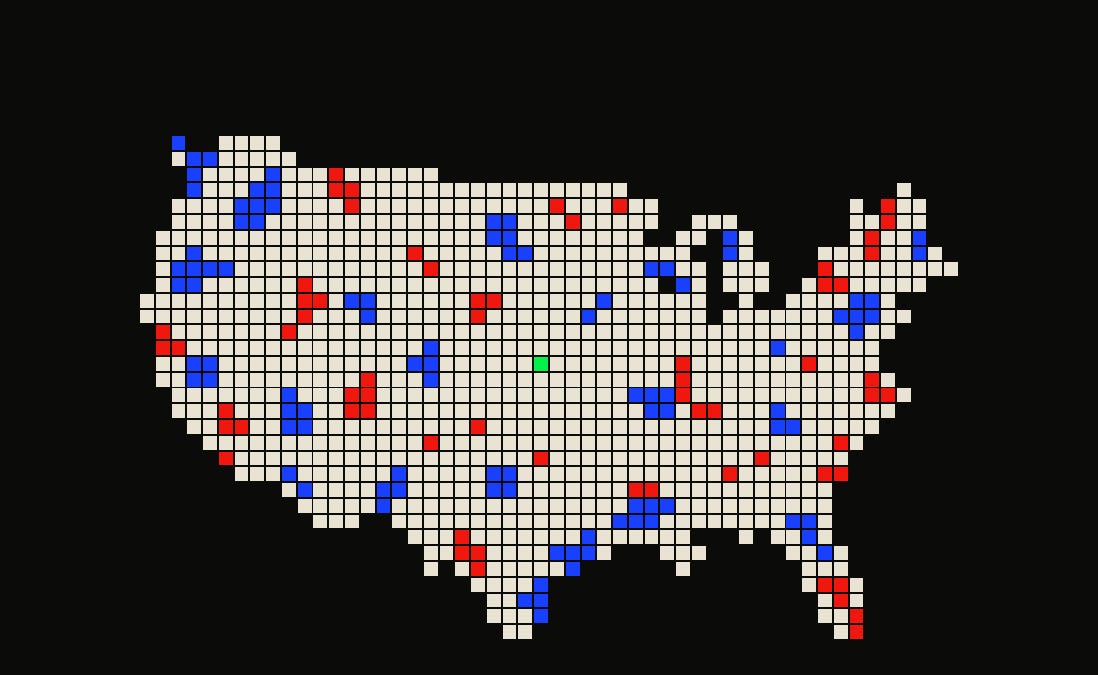
How FLIPR forecasts the midterm elections

Silver Bulletin · collected 2026-09-04 · by Nate Silver commentary
Read the original at Silver Bulletin ↗

Summary

The author of FiveThirtyEight introduces a new name for their midterm election forecasting model: FLIPR, which stands for Forecast with Leading Indicators, Polls and (Expert) Ratings. The model forecasts Congressional and gubernatorial races, and is trained on both midterm years like 2022 and presidential election years. FLIPR consists of three layers: polls, leading indicators (fundamentals), and expert ratings from groups like the Cook Political Report, with multiple versions available. The author notes that while FLIPR has a new name, it is likely not a fundamentally new model, but rather an evolution of previous models dating back to 2010.
Written by the local model on 2026-09-05, using this article's own text rather than the other coverage of the same event (that is the story summary below).

Signals How these are calculated →

Claims extracted
281
claim-shaped sentences
Uncertain
3%
8 of 281 hedged
Leaning
not political
takes no side on a contested political question
Publisher trust
not scored
Commentary is not rated for newsroom trust
Outlets on this story
2
Politics
Narrative spread
1
articles carrying this framing
Analyzed 2026-09-05 · how these are computed

AI analysis (generated at analysis time, not now)

Story summary

Nate Silver's election forecasting model, FLIPR 🐬, has been launched by Silver Bulletin to predict the outcome of the midterm elections. The model uses a combination of factors, including the incumbent's margin in their last competitive race, fundraising based on individual contributions, and party loyalty scores. It also considers the impact of redistricting and whether the incumbent is in their first elected term. FLIPR forecasts both Congressional and gubernatorial races, not just midterms, making the name "midterms model" a misnomer. The model runs 40,000 simulations every time it's updated to account for uncertainty. Despite this, Silver acknowledges that even the most carefully designed models can struggle with unusual events like pandemics or candidate changes.

Written for “Midterm Election Analysis” on 2026-09-05, grounded in this article and the 1 other(s) covering the same event.
Why this leaning score
This article does not take a side on a contested political question, so it has no leaning score. That is an answer rather than a gap: a match report or a rescue can be warmly or critically written without being left or right, and scoring it anyway is how approval of a subject gets recorded as a political position.
No political leaning scored for article 4400 · logged 2026-09-05

Story

📰 Midterm Election Analysis
Politics · 2 article(s) covering the same event. This is the one the site leads with.

How this is being covered How these are calculated →

Article leaning vs. publisher reliability
Source leaning vs. consistency

Compared with similar articles

This article reads unscored and hedges 3% of its claims. Each row says how that neighbour differs.
Beware big swings in midterm forecasts different event · 100%
Silver Bulletin
⚖️ leaning not scored 🔴 3% hedged 1 of 30
“The articles do not describe a single occurrence or incident, but rather discuss general topics related to midterm elections and forecasting models”
Silver Bulletin
⚖️ leaning not scored 🔴 7% hedged 4 of 54
“Both articles describe the launch of a new election forecasting model called FLIPR on September 4, 2026.”
Silver Bulletin
⚖️ leaning not scored 🔴 7% hedged 38 of 569
“Article A mentions the introduction of a new model name (FLIPR) and an informal discussion about their 'midterms model', while Article B is a more technical preview of the same model's launch with updated forecasts for the upcoming midterms, indicating two related but distinct events”

Publisher

Silver Bulletin · 20 article(s) · 0 correction(s) detected

Commentary. The three signals behind a trust score all measure a newsroom's record with its own reporting, so they are not computed for this source. How trust is scored.

No corrections detected for this publisher. That may mean careful reporting, or simply that nothing has been checked.

Who wrote this

Nate Silver
16 article(s) here · 1 carrying a prediction
🔮 The charts and tables will be updated regularly, and some of the text will change, too.
2026-09-05 · assertive framing · QBERT 2026 NFL quarterback ratings
🔮 Next week, we’ll launch our midterms model, with complete forecasts of the 435 U.S. House races, 35 Senate races, and 36 gubernatorial races on the ballot this November, as well as the overall likelihood of each party controlling each chamber and all kinds of other details.1 The model performed quite well in 2018 after the code was basically rewritten from scratch, and again in 2022 after some further tweaks mostly to reflect increasing political polarization.
2026-09-05 · assertive framing · What Trump's latest slump means for the midterms
🔮 The margin is narrow, but when there aren’t a lot of votes left, will be hard for Stevens to make up.
2026-09-05 · assertive framing · What to make of Michigan
🔮 In the Silver Bulletin/FiveThirtyEight tradition, we’ve always given names to our sports models (PELE, ELWAY) — but never to our election forecasts.
2026-09-04 · assertive framing · How FLIPR forecasts the midterm elections
🔮 Our midterms model, which we’re now calling FLIPR 🐬 — Forecast with Leading Indicators, Polls and (Expert) Ratings — launched today!
🔮 Not only am I profoundly interested in increasingly less abstract questions about how AI progress might disrupt society, but I’m also becoming much more of a power user because AI programming tools have reached the point where they’re now quite helpful with programming our various politics and sports models.
2026-09-04 · assertive framing · Why does everyone hate data centers?
🔮 But as responsible forecasters, we have to say: that’s usually not how congressional elections work, and that narrative is outdated in more than one way.
2026-09-04 · assertive framing · Beware big swings in midterm forecasts
🔮 The podcast, Still Counting, will be produced by Crooked Media.
🔮 That might change if Musk re-enters politics in a serious way.
2026-09-03 · assertive framing · How popular is Elon Musk?
🔮 The podcast, produced by Crooked Media, will officially debut in September.
2026-08-26 · assertive framing · Do I really buy that Texas could turn blue?
More on this subject from Nate Silver
FLIPR 2026 midterm election forecast
2026-08-24 · Silver Bulletin · 67% similar
What Trump's latest slump means for the midterms
2026-09-05 · Silver Bulletin · 62% similar
Beware big swings in midterm forecasts
2026-09-04 · Silver Bulletin · 62% similar
All 16 articles by Nate Silver →

Topics

FLIPR FiveThirtyEight House Lite Senate

Subjects

FiveThirtyEight ORG · 3× House ORG · 2× Senate ORG · 2× Congressional NORP · 1× Deluxe ORG · 1× ELWAY PERSON · 1× Lite ORG · 1× PELE ORG · 1× Silver Bulletin ORG · 1× the Cook Political Report ORG · 1×

Narrative

It uses the incumbent’s margin in her last competitive race, adjusting for the political environment at the time of the last election and changes in district boundaries; It looks at whether the incumbent is in their first elected term, and whether they defeated an incumbent in their previous race;23 And for states that have redistricted, the incumbency advantage is less when there’s little overlap between a member’s old and new districts. Fundraising, based on individual contributions only (so not party or PAC money) with a bonus for contributions from within a candidate’s home state;24 Elected experience on a 4-point scale from 0 (never elected to anything) to 3 (current or former elected senator or governor); Party loyalty scores based on congressional voting records.
framing: assertive · carried by 1 article(s) · first seen 2026-09-05
🔮 In the Silver Bulletin/FiveThirtyEight tradition, we’ve always given names to our sports models (PELE, ELWAY) — but never to our election forecasts.
2026-09-05 · Silver Bulletin
How FLIPR forecasts the midterm elections · assertive framing

Claims (281 extracted, 8 hedged)

In the Silver Bulletin/FiveThirtyEight tradition, we’ve always given names to our sports models (PELE, ELWAY) — but never to our election forecasts. asserted
we → give → forecasts
I suppose we’d like to think that our presidential model is renowned enough at this point that it doesn't necessarily need any further identifier. asserted
it → suppose → identifier
But we’ve decided we do need a name for what we informally call our “midterms model.” asserted
we → decide → what
That’s because “midterms model” is actually a misnomer. asserted
model → ’ → ?
The model forecasts both Congressional and gubernatorial races, but it’s trained on both midterm years like 2022 and years where these races coincide with presidential elections. asserted
races → forecast → elections
So now we’re calling our model FLIPR 🐬 instead.1 asserted
we → call → model
In line with our tradition of silly backronyms, FLIPR stands for Forecast with Leading Indicators, Polls and (Expert) Ratings. asserted
FLIPR → stand → Indicators
We like this name because it’s sort of a triple entendre: asserted
it → like → entendre
The principal goal of these elections is flipping individual seats, and ultimately the House and Senate. asserted
goal → flip → seats
FLIPR is a hat tip to the inherently probabilistic nature of the forecast — we run 40,000 simulations every time the model is updated. asserted
model → run → simulations
It’s not as simple as “flipping coins”, but the simulations are necessary because of the complex relationships between different types of races. asserted
simulations → ’ → races
FLIPR essentially consists of three different layers stacked on top of one another: polls, non-polling leading indicators (e.g., fundraising, incumbency) or what we sometimes call “fundamentals”, and then a final layer of race ratings from longstanding outside expert groups like the Cook Political Report. asserted
we → consist → Report
In fact, there are three versions of FLIPR that correspond to each layer: asserted
that → be → layer
Lite derives as much information as possible from polls alone; Classic is polls + fundamentals; And Deluxe is polls + fundamentals + expert ratings. While Deluxe is our default version, almost all of the charts and tables on the FLIPR landing page allow you to, uh, flip back and forth between these versions. asserted
you → derive → versions
The way FLIPR is designed, the expert ratings layer is probably the least important — the proverbial “icing on top.” asserted
layer → design → top
But if you want a forecast without any expert ratings, we have you covered with Lite and Classic. asserted
you → want → Lite
I’d say probably not. asserted
I → say → ?
If you’re a former FiveThirtyEight reader — I retained the rights to all of the models I designed for them per my deal with Disney — you’ll recognize that some of what I’ve just described sounds familiar. asserted
I → ’re → what
In fact, some of the code in FLIPR just celebrated its 16th birthday, having survived since the first midterms forecast I built back in 2010 when FiveThirtyEight was stationed at the New York Times. asserted
FiveThirtyEight → celebrate → Times
We think this track record is one of the things that makes FLIPR unique — competing models come and go, succeed and fail, but few have been around long enough to truly have any sort of long-term track record. asserted
few → think → record
And our midterms forecast performed quite well in both 2018 and 2022. asserted
forecast → perform → 2018
However, FLIPR and its predecessors have a lot of moving parts. asserted
FLIPR → have → parts
And we’ve made refinements every year. asserted
we → make → refinements
While the basic foundation is similar to 2010, nearly every component of the model has been swapped out for a new version at some point. asserted
component → swap → point
It’s a little bit like the paradox of the Ship of Theseus: if every component of a model has been upgraded at some point, is it still the same model? asserted
it → ’ → point
The model underwent a near-complete refit in 2018 when the Lite/Classic/Deluxe concept was introduced. asserted
concept → undergo → 2018
It also underwent another suite of changes in 2022 to reflect increasing political polarization. asserted
It → undergo → polarization
And even though we really liked the 2022 version of the model, we wound up making more changes and improvements this year (2026) than I was originally expecting — rather than just “turning it back on.” asserted
I → like → it
These changes have a common theme: they don’t change the underlying structure or philosophy of the model so much as seek to execute on our original design with more precision, robustness, and internal consistency. asserted
they → change → precision
I have complicated feelings about AI coding tools — and I very much disagree with the idea that they’re a substitute for human judgment. asserted
they → have → judgment
But as a complement to human judgment, they’re pretty nice. asserted
they → ’re → judgment
Probably, in fact, they’re better for reviewing and refining an existing model than for building one from scratch. asserted
they → ’re → scratch
Basically, every single line of code from our 2022 model2 has been audited and, in many cases, improved. asserted
line → audit → cases
Many of these improvements are not highly visible: they concern things like faster program runtime, better error detection, and better “code hygiene” that makes FLIPR easier to audit and update. asserted
FLIPR → concern → runtime
But having software that speeds up some of the most tedious aspects of coding also freed up time to test out different hypotheses and clear a long list of items off of our punch list. asserted
that → have → list
Some of these upgrades fell under a longstanding category of “would be nice to have, if only we had the time.” asserted
we → fall → time
For example, FLIPR now explicitly simulates ranked-choice voting, as used in Alaska and Maine. asserted
FLIPR → simulate → Alaska
Building that code took a couple of hours and relied heavily on our expertise; it’s not nearly as simple as telling an AI coder “ok do ranked-choice voting now.” asserted
it → build → voting
It probably would have taken a couple of days instead of a couple of hours in the world before Claude and ChatGPT, however. asserted
It → take → Claude
Still, ranked-choice voting is a fairly low-stakes problem since the other 48 states don’t use this process. asserted
states → rank → process
…and 241 more, not listed.

💬 Give feedback
🕘 History 🎫 Support