Artist Simon Weckert has created a "digital camouflage" shirt with flowery, blurry patterns that can confuse AI-powered surveillance cameras, which have been deployed in Berlin's Kotbusser Tor subway stop. The cameras use image recognition algorithms to detect people, vehicles, and other objects, but the shirt makes it difficult for them to do so. Weckert designed the shirt as a response to the growing use of such cameras, which can lead to police responses based on suspicious behavior or anomalies like lying down. According to Weckert, these cameras could potentially be used to detect homeless people, triggering police intervention.
Written by the local model on 2026-09-04,
using this article's own text rather than the other coverage of the
same event (that is the story summary below).
Story summary
Simon Weckert, an artist, has created a "digital camouflage" shirt that can confuse AI-powered surveillance cameras, which are becoming increasingly common worldwide. The shirt features blurry, green and pink patterns that render the image recognition AI unable to detect people. This is particularly relevant in Berlin, where police recently deployed these types of cameras outside the popular subway stop Kotbusser Tor. These cameras can detect various anomalies, such as people lying down or loitering, which may trigger a police response. Weckert's design was inspired by this specific use case and aims to highlight the potential consequences of relying on AI-powered surveillance. The camera outside Kotbusser Tor is reportedly the first police-run object recognition surveillance camera in Berlin.
Written for “AI-Foiled Surveillance Clothing” on 2026-09-05,
grounded in this article and the 0 other(s) covering the same event.
Why this leaning score
The article's own words the score was based on. Each is quoted
verbatim and was checked against the article text before being
stored, so you can find it in the original.
Leaning score -0.70 for article 4129 (medium confidence, 2 verified quotes) · logged 2026-09-04
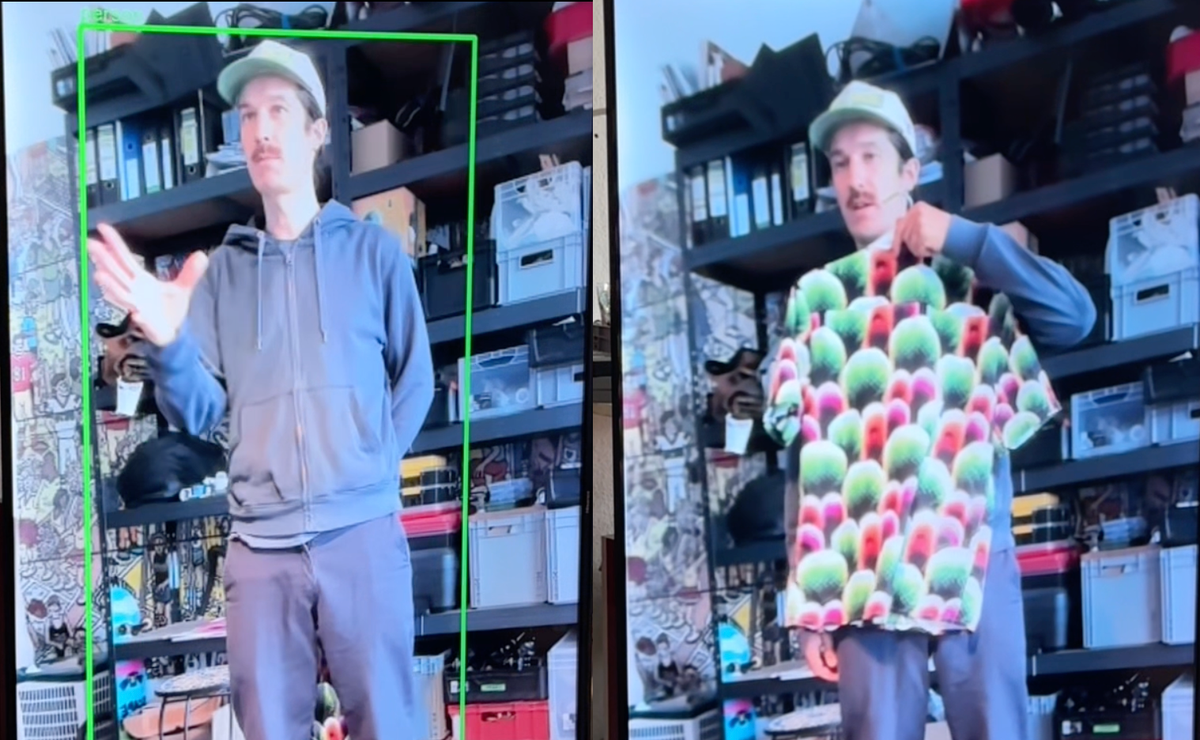
I am standing in front of a camera that’s streaming to a giant video screen.
asserted
that → stand → screen
The image recognition AI running on the camera puts a big green box around me.
asserted
AI → run → me
“PERSON,” it says.
asserted
it → say → PERSON
Artist Simon Weckert hands me his newest creation, a button-down shirt with flowery, blurry globs of green and pink.
asserted
Weckert → hand → green
I put the shirt in front of me.
asserted
I → put → me
The box and the word “PERSON” disappears.
asserted
box → disappear → ?
I pull the shirt away.
asserted
I → pull → shirt
The box pops back up.
asserted
box → pop → ?
I put the shirt in front of me.
asserted
I → put → me
It disappears.
asserted
It → disappear → ?
This is “digital camouflage,” and it has confused the algorithm.
asserted
it → confuse → algorithm
Weckert designed digital camouflage as a response to the proliferation of AI-powered surveillance cameras that detect people, vehicles, animals, bicycles, and other objects in their field of view.
asserted
that → design → view
Many of these AI-powered cameras can detect when a person is lying down, “anomalous behavior” such as people loitering, people fighting, or an abandoned package, which can lead to a police response.
asserted
which → power → response
These cameras are already relatively commonplace around the world, but Weckert created it because police recently deployed these types of cameras outside of Kotbusser Tor, a popular subway stop in Berlin.
asserted
police → create → Berlin
“Obviously people don’t like it because it means that AI is tracking the movements and behaviors of people.
asserted
AI → like → people
It’s one thing to have somebody behind the camera watching you, but now we have AI doing this kind of analysis,” Weckert told me.
asserted
Weckert → ’ → me
“It can detect if somebody’s laying on the ground so that means homeless people could be detected and police get triggered.”
uncertain
police → detect → ground