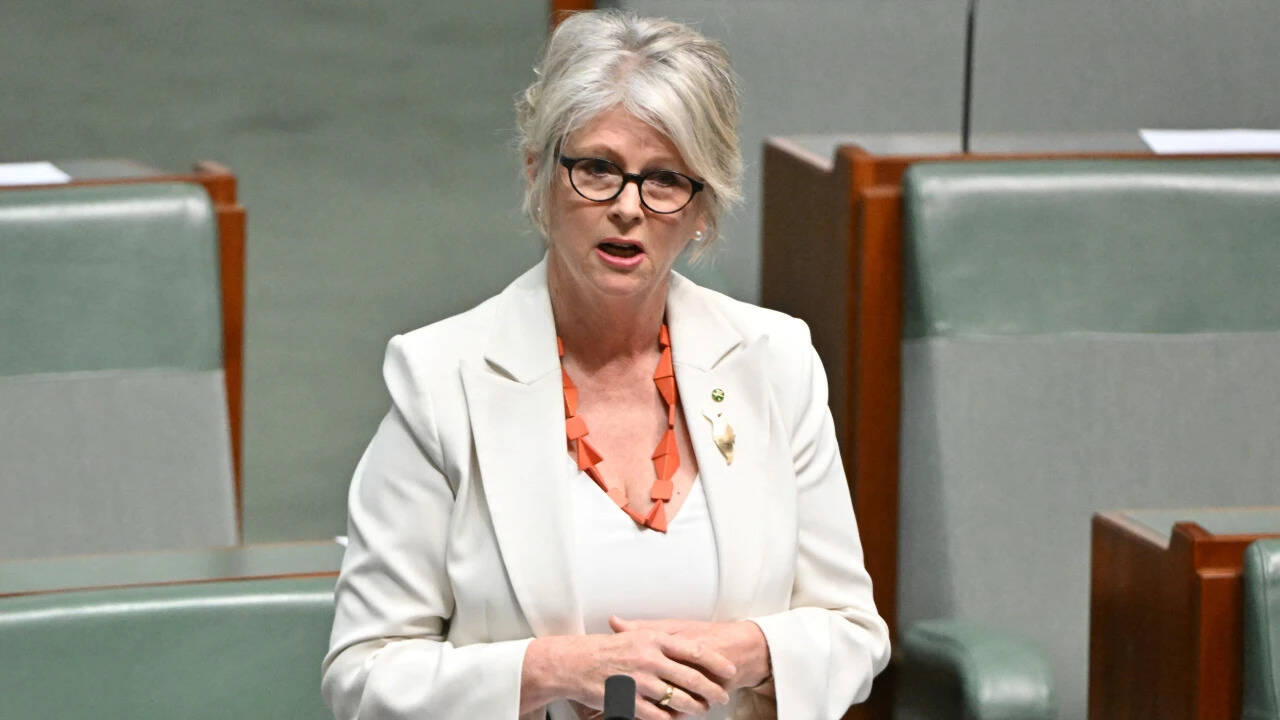
Photo via Times of India

$888 million for ads: US Republicans ramp up sends to defend 39 House seats once deemed 'safe'

Read the original at Times of India ↗
Cite

Mahajan, T. (2026, September 27). $888 million for ads: US Republicans ramp up sends to defend 39 House seats once deemed 'safe'. Times of India. https://timesofindia.indiatimes.com/world/us/888-million-for-ads-us-republicans-ramp-up-sends-to-defend-39-house-seats-once-deemed-safe/articleshow/134521408.cms

Dated when The Aporia collected the article, usually within hours of publication. Check the original for its exact date and byline.

Times of India · collected 2026-09-27 · by Trisha Mahajan

Quick Summary

Republicans are significantly increasing their advertising spending in an effort to defend 39 previously considered safe House seats ahead of the November 3 election. As reported by Reuters, major Republican groups have reserved $888 million for ads compared to Democrats’ $666 million since September 1. Economic challenges and concerns over voter dissatisfaction with Trump's policies are driving this unprecedented spending, despite many districts still being Republican strongholds. Republican strategists emphasize the need to make a strong case in the final weeks before the election to protect their slim House majority.
Written by AI on 2026-09-27, from this article's own text only (the story summary below draws on all the coverage).
See how they differ ↓

AI analysis

Story summary

Republican groups are intensifying their advertising efforts ahead of the November midterms, reserving $888 million for ads targeting more than three dozen U.S. House races previously considered safe for them. This marks a significant increase compared to Democrats' $666 million reservation, indicating growing concerns about potential losses. Since Labor Day, major Republican groups and megadonors have started spending in at least 39 additional House races where they hadn't initially planned to spend money this election cycle. Despite many of these districts being traditional Republican strongholds with candidates leading public polls, internal party polling suggests a higher risk than previously thought. Economic issues such as rising fuel, energy, and fertilizer costs are also impacting traditionally Republican areas, adding uncertainty. Party strategists fear voters might use the upcoming election to express dissatisfaction with President Donald Trump's policies.

Written for “US Republican Ad Spending” on 2026-11-18, grounded in this article and the 1 other(s) covering the same event.

How they differ

2 outlets covered “US Republican Ad Spending”.

What each outlet says

One AI summary per outlet of its latest article on this story, written from that article alone and checked against it. Open the article for the outlet's own words.

Times of IndiaThis outlet27 Sep

Republicans are significantly increasing their advertising spending in an effort to defend 39 previously considered safe House seats ahead of the November 3 election. As reported by Reuters, major Republican groups have reserved $888 million for ads compared to Democrats’ $666 million since September 1. Economic challenges and concerns over voter dissatisfaction with Trump's policies are driving this unprecedented…

$888 million for ads: US Republicans ramp up sends to defend 39 House seats once deemed 'safe' (this article)
South China Morning Post28 Sep

Republican groups are increasing their financial support in 39 previously considered safe US House races before the November midterms, according to internal polling suggesting vulnerability in these districts. Since September 1, major Republican organizations have reserved advertising and filed campaign finance documents indicating a shift towards more aggressive spending strategies amid concerns about voter…

Republicans pour cash into dozens of US House races previously seen as ‘safe’ →

Compared with similar articles

This article reads leans left and hedges 22% of its claims. Each row says how that neighbour differs.
CBS News
Outlet record 67/100
“Article A discusses Republican advertising spending in various House races, while Article B mentions Trump campaigning in red states and includes a title with an interview name that suggests it covers a different topic.”
South China Morning Post
Hedges 1 of 6 claims Outlet record 62/100
New York Post
Leans left Hedges 0 of 30 claims Outlet record 66/100
“Article A discusses general Republican infighting and internal conflicts leading up to midterms, while Article B focuses on specific ad spending by Republicans in previously safe House races.”
Semafor
Leans strongly left further left than this Hedges 1 of 5 claims Outlet record 65/100
“Article A describes specific ads launched by Gabby Giffords' PAC against two House Republicans, while Article B discusses broader Republican spending across multiple races deemed safe.”
Washington Examiner
Leans strongly right further right than this Hedges 4 of 32 claims Outlet record 67/100
“The articles describe different expenditures for political campaigns, one focusing on Ken Paxton's Senate race in Texas and the other on House races nationwide.”
The Guardian
Leans left Hedges 3 of 54 claims Outlet record 64/100
“The articles discuss different aspects of political strategies leading up to the midterms and do not describe the same specific incident or occurrence.”
The Guardian
Hedges 3 of 30 claims Outlet record 64/100
“The articles discuss different aspects of political advertising efforts by Republicans, with Article A focusing on House races and Article B mentioning a taxpayer-funded ad campaign for Trump's political agenda.”
Washington Examiner
Leans left Hedges 0 of 16 claims Outlet record 67/100
“Article A discusses Republican advertising spending in US House races, while Article B talks about shifts in election ratings favoring Democrats.”
CBC News
Leans left Hedges 4 of 36 claims Outlet record 72/100
“Article A discusses Republican groups reserving $888 million for ads in multiple House races, while Article B talks about the White House using taxpayer funds to air pro-Trump TV ads featuring President Trump.”
Washington Examiner
Hedges 4 of 14 claims Outlet record 67/100
“Article A discusses Republican advertising spending in House races, while Article B focuses on a Democrat's request for an investigation into taxpayer-funded Trump ads.”

Story

US Republican Ad Spending
Politics · 2 article(s) covering the same event. See how they differ ↑
How this article was measured signals, leaning charts, publisher record, byline, topics and claims

Signals How these are calculated →

Claims extracted
18
sentences that state something as happening or true
Uncertain
22%
4 of 18 hedged ("reportedly", "may", "according to")
Leaning
Leans left
of the writing, not the subject · beta estimate
Publisher signals
59/100
Times of India's corrections and hedging, across everything collected from it. Not a measure of accuracy.
Outlets on this story
2
Politics
Same framing elsewhere
1
articles that frame the event the way this one does
Analyzed 2026-09-27 · how these are computed

How this is being covered How these are calculated →

Article leaning vs. publisher reliability
Source leaning vs. consistency

Publisher

Times of India · 5272 article(s) · 6 correction(s) detected
Running correction rate · 6 correction(s)

Who wrote this

Trisha Mahajan
50 article(s) here · 1 carrying a prediction
The tech giants have been investing billions into advanced chips, data centers, and computing power on the assumption that AI could change businesses and create new revenue models.
Australian lawmaker Helen Haines, who lost both her legs after being repeatedly struck by a vehicle outside her electorate office last month, has been discharged from hospital and will now begin rehabilitation.
At La Jolla Cove near San Diego, known for its sea lion population, seawater spilled over the beach and surged up a staircase leading down to the sand. Conditions began to ease by Sunday afternoon, but forecasters warned that large waves could persist throughout the week.
He added that Washington will look to formalise a Quad leaders' summit on the sidelines of the ASEAN meetings in Manila next week, describing the report as "Fake News!"
It will remain in force until November 28 or until further orders from the court.
A historic US ocean liner, once the fastest passenger ship in the world, was deliberately sunk in the Gulf of Mexico on Wednesday to create what is expected to become the world's largest artificial reef.
At least four Arab and Muslim leaders have spoken to the US president in recent days, seeking to persuade him to give diplomacy more time amid concerns that Washington could launch fresh strikes after last week's midterm elections.
Nvidia’s board said it had no reason to believe that US national security or the company’s secrets had been compromised, but would examine all available information.
He said it was “highly unlikely” that further attacks would be necessary if Tehran agreed to a “very strong agreement” covering its nuclear programme and the reopening of the Strait of Hormuz.
The group would then direct employees to contact an attorney at a major law firm, whom they were also prepared to impersonate.
Also by Trisha Mahajan
Nothing else under this byline is closely related to this article, so these are simply their most recent.
All 50 articles by Trisha Mahajan →

Topics

Democrats House Republican Republicans Reuters

Subjects

Republican NORP · 10× Republicans NORP · 5× House ORG · 4× Reuters ORG · 4× Democrats NORP · 3× Trump PERSON · 2× AdImpact ORG · 1× Donald Trump PERSON · 1× Federal Election Commission ORG · 1× Ron Bonjean PERSON · 1×

Narrative

Republican-leaning super PACs have also outspent Democrats almost 2-to-1 since Labor Day, spending about $309.7 million compared with $174.2 million, Federal Election Commission data shows, as cited by Reuters.
framing: mixed · carried by 1 article(s) · first seen 2026-09-27
Economic pressures, including rising fuel, energy and fertiliser costs, are also hurting traditionally Republican areas, while party strategists are concerned voters could use the November 3 election to register dissatisfaction with Trump's policies.

Claims (18 extracted, 4 hedged)

US Republicans are pouring money into more than three dozen US House races previously considered safe for the party, with Republican groups reserving $888 million in advertising for the coming weeks, compared with $666 million for Democrats, according to AdImpact. uncertain
groups → pour → AdImpact
Since September 1, major Republican groups and megadonors have begun spending in at least 39 House races where they had not previously deployed money this election cycle, a Reuters review found. asserted
review → begin → money
Republican-leaning super PACs have also outspent Democrats almost 2-to-1 since Labor Day, spending about $309.7 million compared with $174.2 million, Federal Election Commission data shows, as cited by Reuters. asserted
data → lean → Reuters
What happened at 'safe' seats? asserted
What → happen → seats
Many of the districts remain Republican strongholds, with candidates still leading in public polls and several having backed Donald Trump by double-digit margins in 2024. asserted
several → remain → 2024
But Republican leaders have warned campaigns that internal polling shows they cannot assume victory, according to people familiar with the party's thinking, quoted by Reuters. uncertain
they → warn → Reuters
Economic pressures, including rising fuel, energy and fertiliser costs, are also hurting traditionally Republican areas, while party strategists are concerned voters could use the November 3 election to register dissatisfaction with Trump's policies. uncertain
voters → include → policies
“Republicans are playing defense in some of the strongholds that they're used to not having to worry about,” said Republican strategist Ron Bonjean. asserted
Bonjean → play → that
“We're in this crucial period in the last 30 days where candidates have to really make a case, given how tough the headwinds are,” said Kevin Madden, a former adviser to Mitt Romney. asserted
Madden → have → Romney
Republicans say the additional spending is intended to protect their House majority. asserted
spending → say → majority
“Republicans are deploying our massive war chest to drive voters to the polls and supercharge our candidates,” said Natalie Baldassarre, national press secretary for the Republican National Committee. asserted
Baldassarre → deploy → Committee
Republicans hold a 218-214 House majority, with one independent caucusing with them and two vacancies. asserted
Republicans → hold → them
Democrats need to gain at least four seats to take control. asserted
Democrats → need → control
One example is Wisconsin Republican Bryan Steil, whose district backed Trump by about 4.5 percentage points in 2024. asserted
district → back → 2024
Conservative super PACs have put $1.5 million into his race this month, their first spending there this cycle. asserted
PACs → put → spending
In Texas, Republican groups have spent about $2 million since September 5 to support Representative Monica De La Cruz, whose district Trump won by 18 points. asserted
Trump → spend → points
Cook Political Report moved the race from “lean Republican” to “tossup” on Friday. asserted
Report → move → Friday
Overall, more than $1.56 billion has been spent by independent committees on federal elections this cycle, according to Reuters' analysis. uncertain
billion → spend → analysis
Give feedback · no sign-in needed

No sign-in needed for now. Your note is sent without a name, so it cannot be answered.

History Support