Canadians more united despite separatist sentiment in Alberta, Quebec: Ipsos

Read the original at Global News ↗
Global News · collected 2026-09-26 · by Alex Boutilier

Quick Summary

Ipsos released data showing that 81% of Canadians outside Alberta want the province to stay part of Canada, while 69% in Quebec share this view despite their own separatist sentiments. Nationally, only 16% believe their provinces would be better off if they separated from Canada, a significant drop since 2019. The poll suggests that despite growing separatist sentiment in Alberta and Quebec, Canadians feel more united due to shared issues like the trade war with the United States and dealing with Donald Trump.
Written locally by qwen2.5:14b on 2026-09-26, using this article's own text rather than the other coverage of the same event (that is the story summary below).

AI analysis runs on qwen2.5:14b, locally

Story summary

According to a new Ipsos survey exclusively for Global News, an overwhelming majority of Canadians want Alberta to remain part of Canada. Specifically, 81% of Canadians outside Alberta expressed that they wish the province stays unified with Canada, while only 9% desired its separation. In contrast, sentiments in Quebec were more divided due to local independence discussions; still, 69% of Quebeckers support Alberta remaining part of Canada. The survey indicates that despite separatist movements in both provinces, Canadians overall feel increasingly united, particularly regarding the trade war with the United States and handling issues like President Trump's policies. Gregory Jack from Ipsos Global Affairs noted this unity is stronger now than it was in 2019.

Written for “Canadian Unity Despite Separatism” on 2026-10-05, grounded in this article and the 0 other(s) covering the same event.

Signals How these are calculated →

Claims extracted
36
claim-shaped sentences
Uncertain
17%
6 of 36 hedged
Leaning
not political
takes no side on a contested political question
Correction & hedging signals
63.7
corrections and hedging in what we collected; not a measure of accuracy
Outlets on this story
1
Politics
Narrative spread
1
articles carrying this framing
Analyzed 2026-09-26 · how these are computed

Story

📰 Canadian Unity Despite Separatism
Politics · 1 article(s) covering the same event.

How this is being covered How these are calculated →

Article leaning vs. publisher reliability
Source leaning vs. consistency

Compared with similar articles

This article reads unscored and hedges 17% of its claims. Each row says how that neighbour differs.
CBC News
⚖️ Leans right 🔴 5% hedged 2 of 37 📰 publisher trust 77
“The articles discuss different aspects of the Alberta separatist sentiment and poll results but do not describe the same specific incident or occurrence.”
CBC News
⚖️ leaning not scored 🔴 11% hedged 5 of 46 📰 publisher trust 77
“The articles discuss different aspects of public opinion regarding Alberta's potential separation from Canada and do not describe the same specific incident or occurrence.”
Global News
⚖️ leaning not scored 🔴 0% hedged 0 of 6 📰 publisher trust 64
“The articles discuss different aspects of Alberta's separatist sentiment without describing the same specific incident.”
Global News
⚖️ Leans left 🔴 9% hedged 2 of 23 📰 publisher trust 64
“The articles discuss different aspects of political sentiment and polls in Canada, but do not describe the same specific incident or occurrence.”
National Post
⚖️ leaning not scored 🔴 16% hedged 4 of 25 📰 publisher trust 60
“The articles discuss different aspects of separatist sentiment in Alberta and Quebec but do not describe the same specific incident or occurrence.”
CBC News
⚖️ leaning not scored 🔴 0% hedged 0 of 40 📰 publisher trust 77
“Article A reports on a survey about Canadian sentiment towards Alberta's unity, while Article B discusses an MLA voting in favor of a binding referendum for Alberta independence.”
Global News
⚖️ Leans right 🔴 14% hedged 6 of 42 📰 publisher trust 64
“The articles discuss related topics (separatist sentiment in Alberta) but describe different aspects and findings from Ipsos polls, not the same specific incident or occurrence.”
Toronto Star
⚖️ Leans left 🔴 17% hedged 6 of 35 📰 publisher trust 63
“The articles discuss related topics (separatist sentiment in Alberta and a referendum vote), but they describe different aspects of the situation with distinct focuses and timeframes.”
Toronto Star
⚖️ leaning not scored 🔴 11% hedged 5 of 44 📰 publisher trust 63
“The articles discuss different aspects of Canadian unity and constitutional changes in Alberta, but do not describe the same specific incident or occurrence.”
CBC News
⚖️ Leans right 🔴 6% hedged 5 of 84 📰 publisher trust 77
“Article A discusses a survey on Canadian attitudes towards separatism in Alberta and Quebec, while Article B reports on a pro-independence group's motorhome tour in northwestern Alberta to promote the upcoming referendum.”

Publisher

Global News · 1194 article(s) · 8 correction(s) detected
Running correction rate · 8 correction(s)
2026-09-25
‘Human error’ saw detainees dropped off in Edmonton streets: Alberta safety minister
2026-09-17
Man charged in connection to random sexual assault in Winnipeg
2026-09-14
Detainee releases raise concerns over Chinatown being used as a ‘dumping ground’
2026-09-05
Mayors push to turn Oliver correctional centre into mandatory care facility
2026-09-04
Weapons, cellphones, drugs among $112K in contraband seized at N.B. prison
2026-08-27
Wildfire north of Castlegar now mapped at 116 hectares
2026-08-24
Hundreds gather for funeral of correctional officer Nicolae Serban
2026-08-19
Winnipeg commercial break-ins blamed on 2 men wearing ankle monitors

Who wrote this

Alex Boutilier
9 article(s) here · 1 carrying a prediction
🔮 “I would say that the use of counter-drone technology around critical infrastructure is becoming the norm,” Carvin said.
🔮 Anand, who formerly served as minister of national defence under former prime minister Justin Trudeau, pointed to Prime Minister Mark Carney’s decision to ramp up defence spending and the impact that money will have on northern security.
🔮 An overwhelming majority of Canadians want Alberta to remain part of a unified Canada and would vote for their own province to do the same, according to new data from Ipsos exclusively for Global News.
🔮 Foreign Affairs Minister Anita Anand will hold a joint press conference with her German counterpart after two days of trade and security talks between the two countries in Ottawa.
🔮 One day after the federal Liberals proposed new legislation with the power to end strikes impacting the “national interest,” concerns are being raised that the bill is “anti-democratic” and would let the government decide who can exercise the right to strike.
🔮 Later that day, U.S. President Donald Trump said if Canada becomes the first associate member of the European Union it could be a “hostile act.”
🔮 The challenge with European Commission President Ursula von der Leyen’s suggestion that Canada could become a European Union “associate member” is that nobody seems precisely sure what that means.
🔮 Conservative Leader Pierre Poilievre will try to rally his MPs after a summer of conservative movement infighting and polling that shows his party continuing to trail the federal Liberals by double-digits.
🔮 New Brunswick lawyer owes $1.4 million after complaints from clients who lost money The prime minister left the summit Tuesday to travel to Strasbourg, France, where he will become the first world leader to attend the European Union’s “state of the union” debate on Wednesday and on Thursday will address the continent’s politicians. The Wall Street Journal, citing unnamed sources, suggested that Canada was exploring becoming an “associate” member of the EU.
Also by Alex Boutilier
Nothing else under this byline is closely related to this article, so these are simply their most recent.
All 9 articles by Alex Boutilier →

Topics

Alberta Albertans Canada Canadians Ipsos

Subjects

Albertans NORP · 15× Alberta GPE · 9× Canada GPE · 7× Ipsos ORG · 6× Canadians NORP · 5× Confederation ORG · 3× Quebec GPE · 3× Global News ORG · 1× Wild Rose GPE · 1× the United States GPE · 1×

Narrative

Get breaking National news Canadians outside of Alberta were less likely than those in Alberta to feel their province was not getting its fair share from Ottawa, with just 26 per cent of respondents saying their province doesn’t get a fair shake.
framing: assertive · carried by 1 article(s) · first seen 2026-09-26
🔮 An overwhelming majority of Canadians want Alberta to remain part of a unified Canada and would vote for their own province to do the same, according to new data from Ipsos exclusively for Global News.

Claims (36 extracted, 6 hedged)

An overwhelming majority of Canadians want Alberta to remain part of a unified Canada and would vote for their own province to do the same, according to new data from Ipsos exclusively for Global News. uncertain
province → want → News
A full 81 per cent of respondents outside of Alberta said they want the Wild Rose province to remain part of Canada, with just nine per cent saying they want the province to leave. asserted
province → say → Canada
The desire for Alberta to remain in Canada was weaker in Quebec, which is having their own conversation about independence. asserted
which → remain → independence
But 69 per cent of respondents in that province still wanted Alberta to reject separation. asserted
Alberta → want → separation
Overall, Ipsos said their data suggests that Canadians are feeling more united despite separatist sentiment taking up the oxygen in Quebec and Alberta. uncertain
sentiment → say → Quebec
“The country’s more united right now, especially around the (trade) war with the United States … and dealing with Donald Trump and other issues, than they were in 2019,” said Gregory Jack, a senior vice president with Ipsos Global Affairs. asserted
Jack → ’ → Affairs
“(That’s) despite the fact that, you know, it feels like the country is really divided with a potential referendum in Quebec and a referendum here in Alberta. asserted
country → ’ → Alberta
Just 16 per cent of respondents nationally — excluding Albertans — felt that their provinces would be better off if they separated from Canada, and just 22 per cent of Albertans agreed. asserted
cent → exclude → Albertans
Both numbers are down since Ipsos asked the same question in 2019, when 33 per cent of Albertans said they’d be better off alone. asserted
they → ask → Albertans
Only 23 per cent of Canadians outside of Alberta said they felt less committed to Canada than a few years ago, with 28 per cent of Albertans saying they felt that way. asserted
they → say → Albertans
Again, the percentage of Albertans who agreed with the sentiment was down sharply since 2019. asserted
who → agree → 2019
Get breaking National news Canadians outside of Alberta were less likely than those in Alberta to feel their province was not getting its fair share from Ottawa, with just 26 per cent of respondents saying their province doesn’t get a fair shake. asserted
province → get → shake
Nearly one in two Albertans (48 per cent) told the pollster their province didn’t get a fair deal from Confederation. asserted
province → tell → Confederation
“The major outlier is the measure on whether the province gets its fair share from Confederation, where Albertans remain more likely than other Canadians to believe this is the case,” Ipsos said in its polling results. asserted
Ipsos → get → results
“The data suggest Albertans, while feeling closer to the national average on many measures, still want a discussion on benefits from Confederation, but that it doesn’t necessarily translate to desire to separate.” asserted
it → suggest → desire
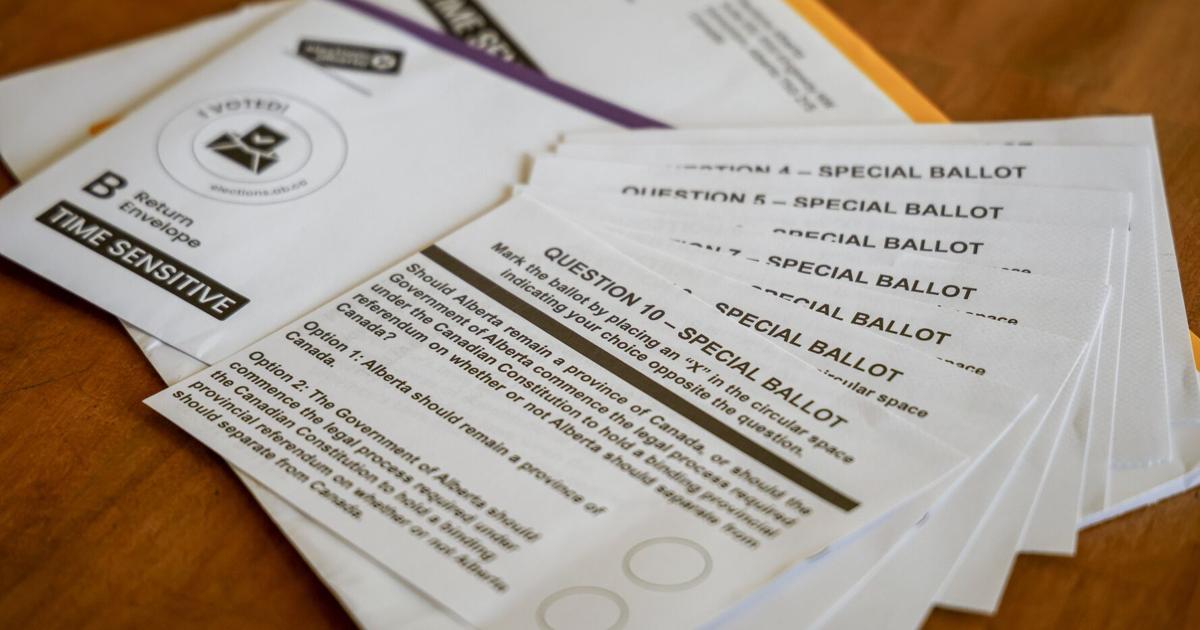
Albertans will vote in a referendum next month that asks, among other questions, if they want to start the legally required process to hold a formal vote on separation. asserted
they → vote → separation
A victory for the separatists on Oct. 19 would kick off campaigning in earnest for both the separatists and those who want the province to remain within Canada. asserted
province → kick → Canada
Ipsos found that a strong majority (70 per cent) of Albertans want to remain part of Canada, while 20 per cent want to hold a referendum on separation. asserted
cent → find → separation
But Ipsos found that the separatist vote may be softer than believed. uncertain
vote → find → ?
- Lions climb standings with win over Roughriders - asserted
Lions → climb → Roughriders
RCMP remind drivers to stop for school buses after two Kelowna students are struck by a vehicle - asserted
students → remind → vehicle
Planned driving safety training campus in Beaumont gets $38.5M from province - asserted
campus → plan → province
Death of pregnant woman and her baby prompts call for Saskatchewan rural health changes asserted
Death → prompt → changes
If the province moves to holding a binding referendum on separation, the number of respondents who would vote to stay rises to 84 per cent, while just 16 per cent would vote for separation. asserted
cent → move → separation
That suggests more people want to hold a referendum than want to actually leave the country. uncertain
people → suggest → country
“Rural Albertans, older Albertans and male Albertans are more likely to say that they want to go and younger Allbertans, more urban Albertans here in Calgary or in Edmonton are more likely to see that they’re going to want to stay,” Jack said. asserted
Jack → say → Edmonton
“We should see perhaps some more movement in the next couple of weeks as the referendum gets closer, but a lot people have a position on this. asserted
people → see → this
I think that they took it earlier in the campaign and they haven’t really changed their position whether they’re on the ‘yes’ side or the ‘no’ side.” asserted
they → think → side
Both Prime Minister Mark Carney’s Liberals and Pierre Poilievre’s Conservative Party are committed to campaigning for Alberta to remain a province in Canada — although Ipsos’ had some surprising numbers about which politician might be better suited to arguing that position with Albertans. uncertain
politician → commit → Albertans
In more bad news for Poilievre, Ipsos’ findings suggest Carney is more popular than he is in Alberta — traditionally the Conservatives’ heartland, and the province Poilievre now represents in the House of Commons. asserted
Poilievre → suggest → Commons
Just over half (51 per cent) of Albertans said they had a favourable view of Carney, compared to 35 per cent who viewed the prime minister unfavourably. asserted
who → say → minister
For Poilievre, support was more divided — with 44 per cent of Albertans viewing him favourably, compared to 40 per cent unfavourably. asserted
cent → divide → cent
“That’s something we don’t often see in Alberta,” Jack noted. asserted
Jack → ’ → Alberta
“(Carney) hasn’t played a key role so far in the referendum, but obviously these numbers suggest that he could in the future.” uncertain
he → play → future
The Ipsos poll was conducted for Global News between Sept. 18 and 22, and surveyed 1,500 voting-aged Canadians — 600 in Alberta, and 900 in the rest of Canada. asserted
poll → conduct → Canada
A similar poll of 1,500 Canadians would be considered accurate within 3.1 percentage points. asserted
poll → consider → points

💬Give feedback
🕘History 🎫Support