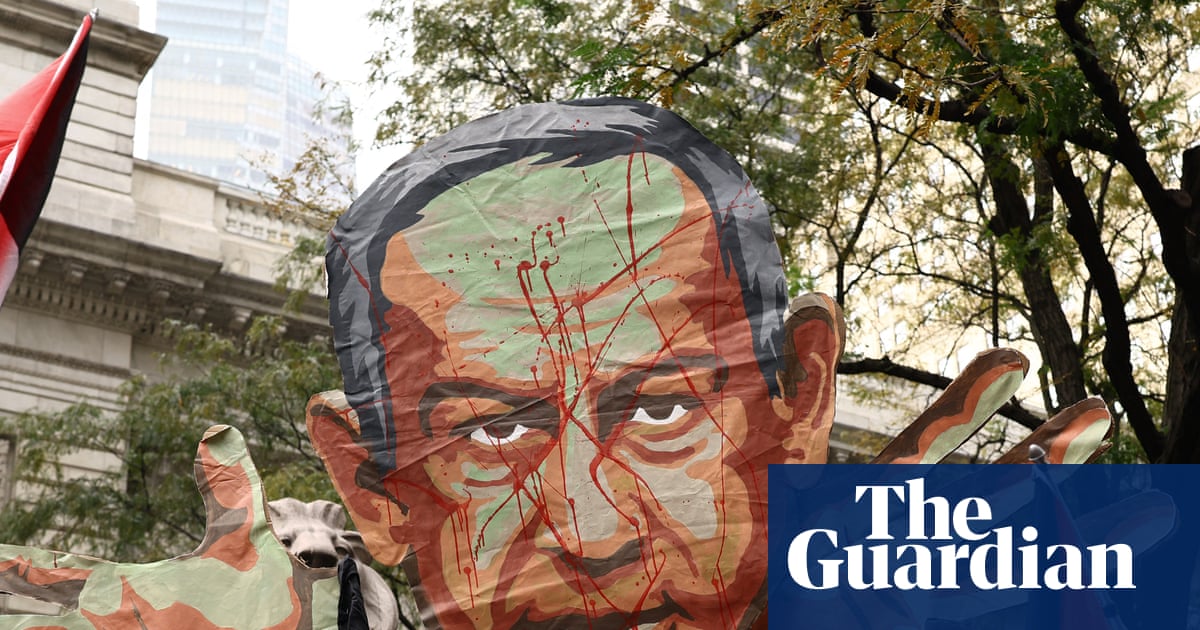
The Israeli documentary “NAZA” will make its North American premiere tomorrow at the New York Film Festival on the heels of Israeli Prime Minister Benjamin Netanyahu’s vitriolic speech at the United Nations, which was met by mass protests, arrests, and diplomats walking out.
asserted
which → make → protests
Other Israeli documentaries have screened at Lincoln Center, including one at the New York Jewish Film Festival in January on the movement for LGBTQ+ rights or another about an October 7 hostage.
asserted
documentaries → screen → hostage
But this film, co-directed by Yuval Abraham and Rachel Szor, has proven extraordinarily controversial in its home country, reviled by nearly every sector of media and politics.
asserted
film → co → media
The documentary, which is composed of anonymous interviews with those active in Israel’s military and intelligence service during the war against Gaza, depicts extensive, highly detailed confessions of their participation in the mass targeting and killing of Palestinian civilians.
asserted
which → compose → civilians
The film’s title comes from the Israeli military’s system for assessing collateral damage, an interface that one of the anonymous confessors says can map out every building in the Gaza Strip and predict what civilians may be killed in an airstrike.
uncertain
civilians → come → airstrike
One man who used the NAZA interface remarks in a clip from the film that the military once approved a single strike the system calculated would kill 500 Palestinians, and said the system makes no distinction between adults and children.
asserted
system → use → adults
The revelation of the film’s existence — its world premiere was at the Venice Film Festival earlier this month after being produced in secret for three years — sent shockwaves through Israeli society.
asserted
premiere → produce → society
Two contradictory claims have begun to dominate discussions of the documentary, at the highest levels of both the Israeli government and the military brass, both aiming to neutralize the film’s reach and the ability of its filmmakers to continue working.
uncertain
both → begin → filmmakers
The first is that the film released highly sensitive and classified information about the Israel Defense Forces’ operations in Gaza, contravening the law.
asserted
film → release → law
The second line of attack claims the film is a complete fabrication, a hoax, and in the words of IDF Chief of the General Staff Eyal Zamir, a “blood libel.”
uncertain
film → claim → Zamir
Key Israeli politicians argue Abraham and Szor are aiding the enemy in wartime, with National Security Minister Itamar Ben-Gvir calling them “friends” of Hamas who should be held accountable as such.
asserted
who → argue → Hamas
While some opponents of the current Israeli government, such as Yashar leader Gadi Eisenkot, have attempted to tack in a more liberal direction by saying “criticism is legitimate” — while also decrying the film for “present[ing] a distorted and one-sided picture” at a time when “the State of Israel [is] in a time of distress” — both the Israeli state and the army have begun proposing legal action be taken against the filmmakers, with their citizenship in particular coming under attack from not only Culture Minister Miki Zohar, but Prime Minister Benjamin Netanyahu himself.
asserted
citizenship → attempt → Zohar
In an unprecedented move, Netanyahu announced on September 16 in a video message posted on social media that his government would “revoke citizenship from anyone who defames IDF supporters abroad” in addition to raising the fine for defamation “twentyfold” to 1 million shekels (nearly $330,000 at the current exchange rate) to punish them further.
asserted
who → announce → them
Calling out the “NAZA” filmmakers specifically, Netanyahu went on to say “their place does not belong with us.”
asserted
place → call → us
The phenomenon of revoking Israeli citizenship is not novel.
asserted
phenomenon → revoke → citizenship
Earlier this year, two Palestinians from East Jerusalem were convicted of security offenses and stripped of their Israeli nationality, which paved the way for their deportation to either the occupied West Bank or even the Gaza Strip.
asserted
which → convict → Bank
But revoking the citizenship of Israeli Jews on any kind of similar grounds is without historical precedent.
asserted
revoking → revoke → precedent
Both Abraham and Szor — who also co-directed the documentary “No Other Land”
asserted
who → co → documentary
Proposals have been made in the past for the revocation of Israeli citizenship from certain Jews, most notably Yigal Amir, who killed Israeli Prime Minister Yitzhak Rabin.
asserted
who → make → Rabin
The far-right assassin, who is from an Orthodox Jewish family, was the subject of a public petition demanding his citizenship be revoked.
asserted
citizenship → demand → petition
But the Israeli Supreme Court rejected it on the grounds that “the dignity of the right” for every Jew to acquire and have Israeli citizenship overruled the “dignity of the murderer.”
asserted
Jew → reject → murderer
Now, for the first time, a sitting Israeli leader is advocating for the so-called “dignity of the right” to be overturned, not for murder, but for mere “slander,” in Netanyahu’s description, against the Israeli military.
asserted
dignity → sit → military
Although Israeli politicians and other officials have categorized the filmmakers as antisemites spreading lies about the Jewish people, Abraham and Szor are not explicitly anti-Zionist in the way that other prominent critics of Israel, like the historian Ilan Pappé and the architect Eyal Weizman, have defined themselves, or even how a Communist member of Israel’s Knesset, Ofer Cassif, has defined himself.
asserted
member → categorize → himself
Both co-directors have openly stated their belief in a future where both Israelis and Palestinians “are equally sovereign and free.”
asserted
Israelis → state → future
Abraham himself has said Israelis have a “right” to “sovereignty and security in this land,” just as Palestinians do.
asserted
Palestinians → say → land
Despite these threaded needles, the Jewish filmmakers of “NAZA” now find themselves in the position of being treated much the same way Palestinian citizens of Israel are: as though their citizenship was bestowed upon them in error, a mistake of history where convenience trumped logic, a catastrophe that needs to be rectified immediately.
asserted
that → thread → logic
The Law of Return — the idea that every Jewish person, even those who converted to the religion and have no ancestral ties to the land of Palestine, should be allowed to “return” to their homeland, to settle, to live, and to be treated as an equal alongside every other Jewish person, no matter their birthplace — was one of the fundamental building blocks of the Zionist project.
asserted
who → convert → project
But the Law of Return did not become law until 1950, and the Citizenship Law, which defined the terms of its larger eligibility, did not become law until 1952, four years after the State of Israel’s founding.
asserted
which → become → founding
For a short period in Israel’s history, citizenship had no clear definition, but it required quick clarification, not just because it is a key part of any fledgling state, but because they needed to be able to define which Arabs, who remained inside Israel’s new borders on temporary “red card” permits after the Nakba, could be allowed to stay, and who could be removed as an illegal infiltrator.
uncertain
who → have → infiltrator
Then-Agriculture Minister Dov Yosef remarked plainly during a cabinet debate in 1949: “When we publish the citizenship law and a person is found not to be a citizen, we can then deport him.”
asserted
we → remark → him
Citizenship was granted in limited quantities to the Palestinians who had been able to remain inside the newly established Israel and did not confer all the rights it supposedly guaranteed.
asserted
it → grant → rights
Palestinian citizens of Israel remained under control of a military governance system up until 1966, with their movements strictly controlled and their political activities restricted to rein in criticism of the Jewish state they now found themselves living under.
asserted
themselves → remain → state
The Law of Return, considered “inalienable” by many politicians, where any concrete restrictions must entail tearing of the law in its entirety, contained seemingly contradictory restrictions within its formally expansive framework.
asserted
restrictions → consider → framework
Israeli Communist Party leader Meir Vilner noted back in 1950, during discussion of the Law of Return in the Knesset, that even though Jewish citizenship was technically expansive, it still entailed restrictions to those who “endangered … the security of the state,” a vagueness that Vilner opposed on the grounds that it could be used by the government “against sections within the Jewish people.”
uncertain
it → note → people
The Polish-Israeli anti-Zionist intellectual Israel Shahak noted in 1975 that all the punishments normally doled out against Arabs, including losing their citizenship, remained theoretically possible against Jewish dissenters under Israeli law, but only “racism” against Arabs had prevented setting that precedent.
asserted
racism → note → precedent
As the United States became Israel’s primary benefactor in the 1960s and 1970s, previously dormant discussions about the grounds for revoking Israeli citizenship from Jews began to reemerge.
asserted
discussions → become → Jews
They coalesced around insufficient connection to Israel, with some aiming to establish a system of permanent residency, disallowing citizenship for Jews who did not spend enough time inside the Jewish state.
asserted
who → coalesce → state
After 9/11, these proposals took on a much more ideological, and much more far-right, character.
asserted
proposals → take → character
The Israeli right was soon overtaken with the possibility of revoking the citizenship of those it considered to be aiding the enemy, with Arab citizens of Israel being the primary target.
asserted
citizens → overtake → Israel
But anti-Zionist Jews were also in their crosshairs, including members of the ultra-Orthodox Jewish fringe sect Neturei Karta, or Jews who were insufficiently supportive of Israel, like Israeli journalist Gideon Levy.
asserted
who → include → Levy
…and 50 more, not listed.
 The Aporia