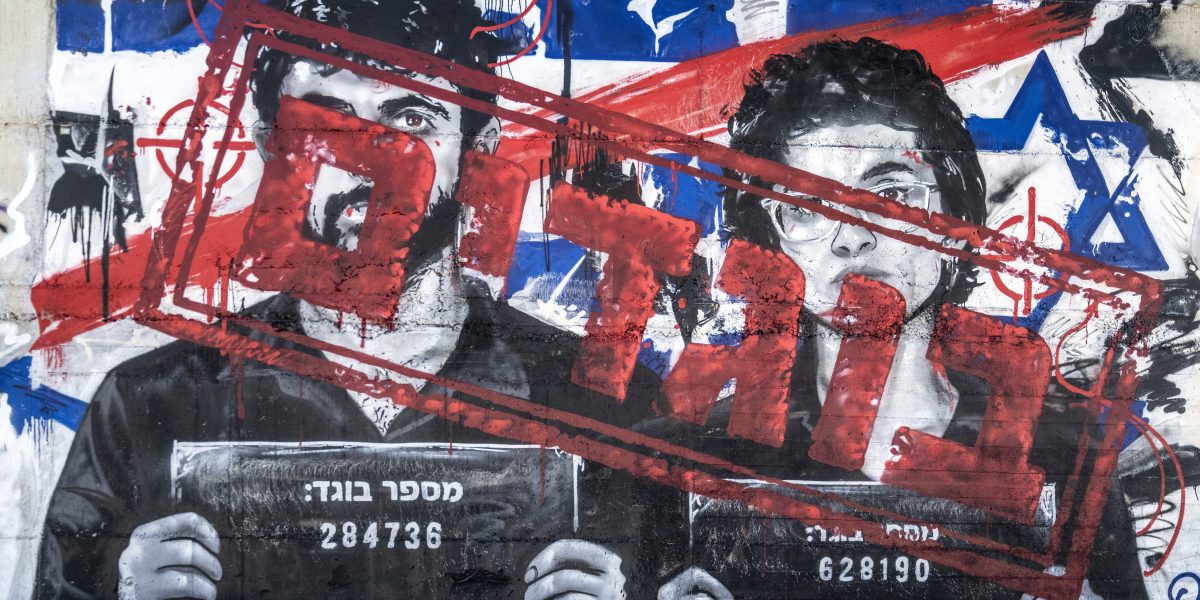
Earlier this month, Roman Gofman, the new director of the Mossad, Israel’s shadowy national intelligence agency, dismissed the heads of its intelligence directorate and Iran division, known only by their heavily anonymized names “K” and “Y,” respectively.
asserted
Gofman → dismiss → names
The Mossad prides itself on secrecy, and while terminations following the appointment of a new Mossad director aren’t unprecedented, such public oustings, which were reported by Israel’s mainstream news organizations, are almost unheard of.
asserted
which → pride → organizations
The last known dismissals for incompetence came in 1997, when a botched attempt to assassinate Khaled Mashal, then chair of Hamas’s political bureau, resulted in the detention of several Mossad agents inside Jordan and a public relations disaster.
asserted
attempt → know → Jordan
Prime Minister Benjamin Netanyahu’s government found itself forced to supply the antidote for the poison its Mossad agents had administered, bringing down both the agency’s director and the director of operations.
asserted
agents → find → operations
Israel is now dealing with the aftermath of the largest mistake in its history, one of its own doing: its failed war on Iran.
asserted
Israel → deal → Iran
Sold to the United States as an easy war that would quickly bring down the Islamic Republic and its alleged nuclear weapons program, almost nothing Israel desired came to pass.
asserted
Israel → sell → Republic
The promise of assassinating Ali Khamenei was that it would bring about governmental chaos and spur a spontaneous national uprising.
asserted
it → assassinate → uprising
Instead, it only led to the selection of his younger son as the new supreme leader, a leadership that may prove to be even more antagonistic to the United States and Israel than the previous one.
uncertain
that → lead → one
Israel also promised that any potential closure of the Strait of Hormuz would be militarily ineffective.
asserted
closure → promise → Hormuz
Now, Iran’s ability to hold the world economy hostage — despite relentless claims by the U.S. that the waterway is “open” — is its most valuable weapon.
uncertain
waterway → hold → U.S.
The Mossad’s particular role in this war involved weakening the Islamic Republic’s security structure in hopes of then funneling guns to Kurdish armed groups who would invade the country from Iraq, and then fuel mass demonstrations to topple the state.
asserted
who → involve → state
All of these lofty ambitions completely detonated on impact with reality, with Iran’s security structure remaining intact despite assassinations and airstrikes, Kurdish factions instead suffering constant Iranian military attacks, and no major protests occurring in any Iranian city, despite the massive anti-government protests in January that swept through the country.
asserted
that → detonate → country
For those who witnessed the Mossad’s public campaigns to encourage protests and defections — which it deployed in the open through Farsi-language social media accounts on X and Telegram bearing their name and seal — signs of the inevitable failure of this campaign were becoming evident.
asserted
signs → witness → campaign
While images from June 2025’s Twelve-Day War of Mossad agents operating inside Iran and sabotaging Iranian military operations shocked many inside the country — that sabotage hampering Iran’s initial military response — its ability to change fundamental facts on the ground, and to move an entire country’s population against the sitting government, sputtered.
asserted
ability → operate → government
The Mossad chose to shift its image as that war began, capitalizing on its perception as an all-powerful and omniscient force to offer its supposedly unlimited power to help the Iranian populace.
asserted
war → choose → populace
This shift manifested through cryptic social media posts, sarcastic quote-tweets of Iranian officials, and offering gifts to those who answered questions by direct message.
asserted
who → manifest → message
The Mossad offered remote medical services through WhatsApp, and former radio host Menashe Amir, who notably hosted an Israeli radio show in Farsi aimed at anti-Islamic Republic Iranians, made videos on the Mossad’s behalf encouraging Iranians to listen to what the intelligence agency had to say.
asserted
agency → offer → what
The effort produced little.
asserted
effort → produce → little
Iranian officials openly mocked the campaign online from the start, and it became increasingly desperate as mass protests failed to materialize.
asserted
protests → mock → start
AI-generated videos of Iranian prisons having their walls blown open, and of happy Iranians following their defections to Israel, did next to nothing.
asserted
walls → generate → nothing
The Mossad has continued to post AI-generated videos using Grok to encourage collaboration following the ceasefire.
asserted
Mossad → continue → ceasefire
While accusations were levied (and arrests made) of supposed Mossad agents inside the Iranian protests in January, their infiltration, alleged or otherwise, did not end up toppling or even shattering the Islamic Republic.
asserted
infiltration → levy → Republic
Instead, more than 7,000 protesters were killed that month, in addition to hundreds of police officers.
asserted
protesters → kill → officers
After the plan to arm Kurdish groups, in collaboration with the CIA, apparently fell apart — either by Trump’s veto or, as Trump claimed, because the Kurds simply kept the weapons themselves — the Mossad apparently came up with a quick Plan B. The new bright idea: Overthrow the government via an airstrike campaign against Iranian police stations and checkpoints manned by the Basij, the Islamic Revolutionary Guard Corps’ paramilitary militia component.
asserted
Mossad → arm → Basij
Despite extensive strikes in broad daylight, with some Iranians tipping off locations to opposition media outlets to help facilitate this campaign, the mass uprising, once again, did not arrive.
asserted
uprising → tip → campaign
The war did not continue long enough for a comprehensive Plan C to come to fruition on the ground, with the Israeli military beginning to strike railways and manufacturing infrastructure, and Trump taking the lead on calling for the destruction of Iran’s energy infrastructure and bridges.
asserted
Trump → continue → infrastructure
Both are unified in their hope to strangle the country economically in hopes of pushing Iranian society into oblivion, but this outcome is only truly possible through American military means.
asserted
outcome → unify → means
But even the U.S. has seen itself overextended, unable to resupply its missile interceptors for its own bases in the Middle East, and potentially unable to protect Israel as effectively as it had in the past should open conflict break out over its skies again.
asserted
conflict → see → skies
News of the dismissal of the Mossad officials was met with disbelief in the Israeli media and by veterans of the intelligence service, who accused Gofman of suppressing the agency’s ability to function.
asserted
who → meet → ability
By firing two deputies, security analysts accused him of foisting the agency’s failure onto underlings to shield the decisions made at the top levels of government from scrutiny.
asserted
analysts → fire → scrutiny
While overthrowing the Iranian government has remained a popular idea among Israeli officials and other elected politicians, Netanyahu chief among them, other politicians have acknowledged its difficulty.
asserted
politicians → overthrow → difficulty
Gadi Eisenkot, the former Israel Defense Forces chief of the general staff, has spoken of the unlikelihood of being able to overthrow the entire Iranian system, instead stating that operations should have continued “in the shadows.”
asserted
operations → speak → shadows
Reporting from Israel Hayom in May revealed that many in the Mossad were opposed to the idea of focusing resources on overthrowing the Iranian government, seeing it as a massive gamble.
uncertain
many → report → gamble
The Mossad’s former chief of influence operations, known as O., told the newspaper that he felt he had to sell the operation to many in the agency, despite the fact that “no one actually knows how to overthrow a regime or what the chances are that it will succeed.”
asserted
it → know → regime
In March, just days before he would be killed in an Israeli assassination strike, Ali Larijani, then-secretary of the Iranian Supreme National Security Council, told the Iranian news outlet ISNA that Netanyahu “seemed to believe that these attacks had set a movement in motion inside Iran and that, by portraying the system as being in disarray, he could incite the public.”
uncertain
he → kill → public
But Larijani pointed out that in less than a day, the regime had appointed “replacements for the commanders who had been killed, addressed the public, changed the atmosphere, and, by issuing specific orders, authorized the launch of missiles.”
asserted
who → point → missiles
Netanyahu, having pushed for the military overthrow of the Iranian government across multiple American administrations, finally got the war he wanted.
asserted
he → push → war
But neither raw force, nor covert operations executed on his orders, were enough to carry out his will.
asserted
force → execute → will
While Finance Minister Bezalel Smotrich has remarked upon how the current situation is very much working for Israel — one in which southern Iran is constantly bombarded with no end, and America is doing all of the fighting and dying — Netanyahu has continued his rhetoric about the need to create the conditions for the fall of the Islamic Republic.
asserted
Netanyahu → remark → Republic
But in a moment of rare humility, he admitted this may “not happen in a single day.
uncertain
this → admit → day
…and 35 more, not listed.
 The Aporia