Almost half of world’s farmers poisoned by pesticides every year, experts find

Read the original at The Guardian ↗
Cite

Pippa Neill Environment reporter. (2026, September 3). Almost half of world’s farmers poisoned by pesticides every year, experts find. The Guardian. https://www.theguardian.com/environment/2026/sep/02/50-per-cent-world-farmers-poisoned-pesticides-every-year-experts

Dated when The Aporia collected the article, usually within hours of publication. Check the original for its exact date and byline.

The Guardian · collected 2026-09-03 · by Pippa Neill Environment reporter

Quick Summary

A study commissioned by the Pesticide Action Network found that approximately 46% of the world's farmers, around 402-433 million people, are poisoned by pesticides every year. The highest estimated number of poisonings was in southern Asia, with Burkina Faso having the highest national incidence at nearly 84%. The study also estimates that 11,000 deaths occur annually due to pesticide poisoning, with 60% of these happening in India. Experts are calling for "immediate action" to phase out highly hazardous pesticides and provide farmers with safer alternatives.
Written locally by qwen2.5:14b on 2026-09-03, using this article's own text rather than the other coverage of the same event (that is the story summary below).

AI analysis runs on qwen2.5:14b, locally

Story summary

Almost half of the world's farmers, approximately 46%, are poisoned by pesticides every year, according to a recent study. This means that out of a global farming population of 934 million, around 402-433 million cases of unintentional acute pesticide poisoning occur annually among farmers and farm workers. The highest national incidence of poisoning was found in Burkina Faso, where nearly 84% of farmers and farm workers were reported to have experienced poisoning. Additionally, the study estimated that 11,000 deaths occur every year due to pesticide poisoning, with nearly 60% of these occurring in India. The researchers are calling for immediate action, including the implementation of a UN resolution to reduce pesticide use and promote safer alternatives.

Written for “Pesticide Poisoning in Agriculture” on 2026-10-21, grounded in this article and the 1 other(s) covering the same event.

Story

📰 Pesticide Poisoning in Agriculture
Environment · 2 article(s) covering the same event. See how they differ ↓

Compared with similar articles

This article reads unscored and hedges 0% of its claims. Each row says how that neighbour differs.
Mother Jones · 0.98 cosine similarity
⚖️ leaning not scored 🔴 0% hedged 0 of 20 📰 publisher trust 95
“Both articles report on the exact same study, results, and statistics, indicating they describe the same specific real-world event.”
How this article was measured signals, leaning charts, publisher record, byline, topics and claims

Signals How these are calculated →

Claims extracted
18
sentences that state something as happening or true
Uncertain
0%
0 of 18 hedged ("reportedly", "may", "according to")
Leaning
withheld
no quote in the article backed the model's score
Publisher signals
66/100
The Guardian's corrections and hedging, across everything collected from it. Not a measure of accuracy.
Outlets on this story
2
Environment
Same framing elsewhere
1
articles that frame the event the way this one does
Analyzed 2026-09-03 · how these are computed

How this is being covered How these are calculated →

Article leaning vs. publisher reliability
Source leaning vs. consistency

Publisher

The Guardian · 2190 article(s) · 6 correction(s) detected
Running correction rate · 6 correction(s)

Who wrote this

Pippa Neill Environment reporter
12 article(s) here · 1 carrying a prediction
🔮 “In summers like this year, we would normally ask for more resources, but those resources aren’t always available and we’re having to wait longer for additional resources or we’re having to find other ways to deal with the fire,” said Dave Swallow, the NFCC’s deputy lead on wildfires.
🔮 Mums for Lungs said the decision in 2023 by Burnham, the then mayor of Greater Manchester, to scrap plans for a clean air zone raised important questions about whether sufficient action was being taken to drive down pollution levels.
🔮 The government has set an ambition to increase the share of English land farmed organically to 10% by 2036, but concerns remain over how the transition will be funded.
🔮 “It was so emotional I shed a tear, it was one of those moments that will remain with me for life,” Magdalena said.
🔮 “In doing that, he will send out a message that he speaks the truth, however comfortable or uncomfortable,” said Berners-Lee.
🔮 “When you look at this astonishing and bizarre tree, there’s no doubt about what it has endured,” said May Chemais, ancient tree inventory lead for the Woodland Trust, the charity that runs the annual competition.
🔮 Drax’s planned datacentre could produce nearly double the emissions of all flights out of Gatwick airport each year by burning 4.9m tonnes of wood annually, an analysis has shown.
🔮 In the third national climate adaptation programme, published in July 2023, the Conservative government, then headed by Rishi Sunak, said it would run a wildfire risk programme in England from 2023 to 2027 so land management would be adapted for the risk.
🔮 The tongue may go blue and even protrude from the mouth.
2026-10-03 · assertive framing · Worst ever outbreak of bluetongue hits British farms
🔮 We had been speaking on and off for a while over her growing concern that her garden could be affected by pollution from a nearby chemical plant.
Also by Pippa Neill Environment reporter
Nothing else under this byline is closely related to this article, so these are simply their most recent.
All 12 articles by Pippa Neill Environment reporter →

Topics

Burkina Faso Frontiers in Public Health India Pesticide Action Network Pesticide Action Network India

Subjects

Burkina Faso GPE · 1× Frontiers in Public Health ORG · 1× Génon Jensen PERSON · 1× India GPE · 1× Jayakumar Chelaton PERSON · 1× Pesticide Action Network ORG · 1× Pesticide Action Network India ORG · 1× Pesticide Action Network UK ORG · 1× Sheila Willis PERSON · 1× the Health and Environment Alliance ORG · 1×

Narrative

Dr Sheila Willis, the head of international programmes at Pesticide Action Network UK, said: “Now that the scale of suffering has been revealed, farmers must be supported to access safer alternatives to protect their health and that of their families.” The study did not consider the impact of pesticide exposure on the estimated 84 million children working in agriculture and did not look at the long-term health impacts, with acute pesticide poisoning defined in the study as any illness or health effect experienced a short time after exposure.
framing: assertive · carried by 1 article(s) · first seen 2026-09-03
🔮 Dr Sheila Willis, the head of international programmes at Pesticide Action Network UK, said: “Now that the scale of suffering has been revealed, farmers must be supported to access safer alternatives to protect their health and that of their families.” The study did not consider the impact of pesticide exposure on the estimated 84 million children working in agriculture and did not look at the long-term health impacts, with acute pesticide poisoning defined in the study as any illness or health effect experienced a short time after exposure.

Claims (18 extracted, 0 hedged)

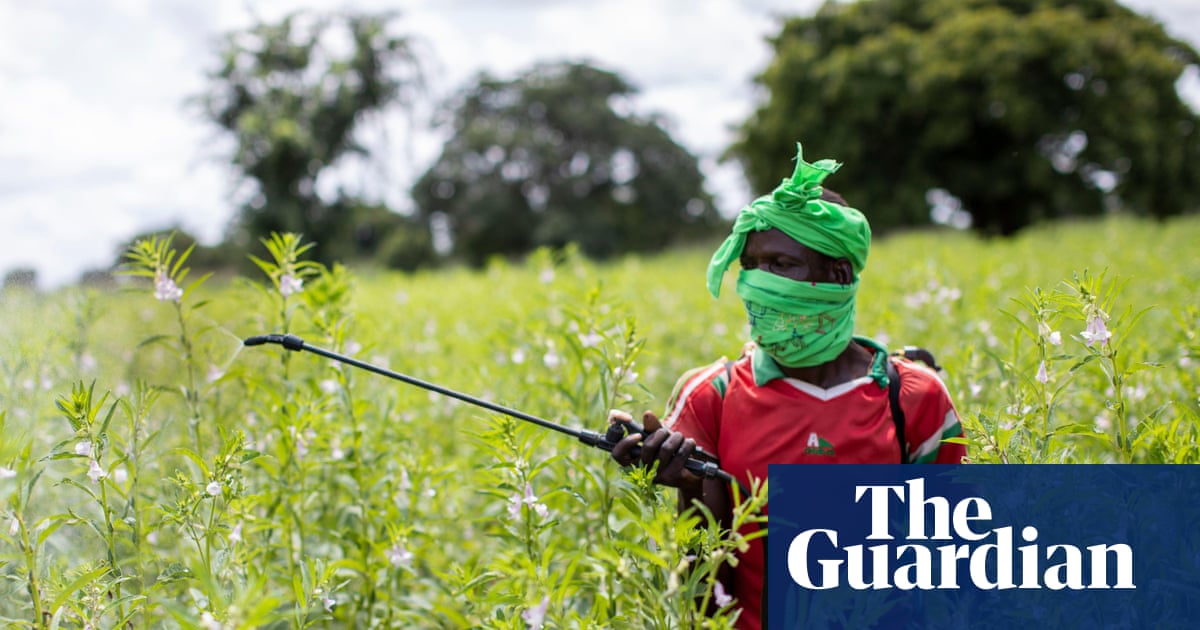
Almost half of the world’s farmers are poisoned by pesticides every single year, a study has found. asserted
study → poison → pesticides
Using publicly available data from 2006-2023, the study, which was commissioned by Pesticide Action Network, found there to be an estimated 402-433m cases of unintentional acute pesticide poisoning of farmers and farm workers every year. asserted
which → use → farmers
Based on a worldwide farming population of 934 million, this means approximately 46% of farmers are being poisoned every year. asserted
% → base → farmers
The greatest estimated number of poisonings was in southern Asia, followed by south-east Asia and east Africa. asserted
number → estimate → Asia
The overall highest national incidence of poisoning was in Burkina Faso in west Africa, where nearly 84% of farmers and farm workers were reported to have experienced poisoning. asserted
% → report → poisoning
The study, published in the journal Frontiers in Public Health on Wednesday, also found that an estimated 11,000 deaths occur every year due to pesticide poisoning, with nearly 60% of these in India. asserted
deaths → publish → India
Jayakumar Chelaton, the executive director of Pesticide Action Network India, said the research exposed a “crisis that can no longer be ignored”. asserted
that → say → crisis
The authors of the study are calling for “immediate action”, including the implementation of a UN recommendation to phase out highly hazardous pesticides. asserted
authors → call → pesticides
The study states that despite global efforts to highlight the dangers, pesticide use has continued to grow steadily, with 3.8m tonnes used in 2023, a doubling since 1990. asserted
tonnes → state → 1990
Dr Sheila Willis, the head of international programmes at Pesticide Action Network UK, said: “Now that the scale of suffering has been revealed, farmers must be supported to access safer alternatives to protect their health and that of their families.” The study did not consider the impact of pesticide exposure on the estimated 84 million children working in agriculture and did not look at the long-term health impacts, with acute pesticide poisoning defined in the study as any illness or health effect experienced a short time after exposure. asserted
poisoning → say → exposure
Génon Jensen, the executive director of the Health and Environment Alliance, said: “We are extremely concerned about the devastating health impacts from pesticide poisonings – both the acute impacts mentioned in this study but also chronic exposures that farm workers and communities suffer.” asserted
workers → say → that
Hélène Nicora, the director general of Parkinson’s Europe, said there was also “overwhelming evidence” to suggest that Parkinson’s was an environmentally driven disease, with growing evidence linking pesticide exposure to the development of Parkinson’s. asserted
Parkinson → say → Parkinson
Parkinson’s disease is a progressive disorder in which parts of the brain become damaged over time, affecting movement and balance. asserted
parts → damage → movement
The global burden of the disease is rising, with France, Germany and Italy all recognising it as an occupational disease for farmers. asserted
France → rise → farmers
Farmers and farm workers are mainly exposed to pesticides during preparation and application, as well as when touching treated crops and contaminated equipment or clothing. asserted
Farmers → expose → crops
Speaking at a webinar organised by Friends of the Earth Europe earlier this year, Rendert Algra said he believed his Parkinson’s disease was linked to the pesticides he had used when working at his family farm in the Netherlands. asserted
he → speak → Netherlands
“Being the eldest son, I did all the spraying of pesticides in our fields for several years in a row,” he said. asserted
he → do → row
Despite being the most robust study to date, the report highlights that available information on pesticide poisoning is inadequate, with the authors calling for standardised surveillance and reporting protocols so that pesticide-related poisonings become reliable and comparable. asserted
poisonings → highlight → surveillance

💬Give feedback
🕘History 🎫Support