Grain exports stall as Ukraine steps up attacks on Russia's Black Sea ports

Read the original at Deutsche Welle ↗
Cite

Loginov, O. (2026, August 26). Grain exports stall as Ukraine steps up attacks on Russia's Black Sea ports. Deutsche Welle. https://www.dw.com/en/grain-exports-stall-as-ukraine-steps-up-attacks-on-russia-s-black-sea-ports/a-78499629?maca=en-rss-en-world-4025-rdf

Dated when The Aporia collected the article, usually within hours of publication. Check the original for its exact date and byline.

Deutsche Welle · collected 2026-08-26 · by Oleg Loginov

Quick Summary

Russian President Vladimir Putin justified annexing Crimea by preventing NATO forces from entering the region and changing the balance of forces in the Black Sea area. Ukrainian attacks on Russia's largest commercial Black Sea port, Novorossiysk, have disrupted oil and grain shipments, making it difficult to export goods via the Black Sea. Experts warn that if the attacks continue at this intensity, they could have significant consequences for Russian exporters and the national budget. Approximately 1/3 of Russia's grain exports are handled through Novorossiysk, which is also one of Europe's largest ports in terms of cargo volume.
Written locally by qwen2.5:14b on 2026-08-26, using this article's own text rather than the other coverage of the same event (that is the story summary below).

AI analysis runs on qwen2.5:14b, locally

Story summary

Ukraine's attacks on Russia's Black Sea ports have disrupted grain exports, causing significant consequences for Russian exporters and the national budget. Up to a third of Russia's grain exports pass through Novorossiysk, its largest commercial port, which has been targeted by Ukrainian drone strikes. The disruption has led to a stall in grain exports, forcing surplus grain to be sold on the domestic market instead, which is already putting downward pressure on prices. This situation could become even more critical if the attacks continue at their current intensity. The consequences of this disruption are not limited to Russia, as wheat futures have hit a three-year high due to strained supplies and weakened global food systems. Ukraine and Russia together account for around a third of global wheat exports, making their conflict a significant factor in global food prices. Experts warn that if the situation continues, millions could be at risk of malnutrition due to higher fuel and fertilizer prices, as well as the El Niño warm weather system exacerbating food shortages.

Written for “Grain Export Disruptions” on 2026-10-16, grounded in this article and the 1 other(s) covering the same event.

Story

📰 Grain Export Disruptions
Economy/Business · 2 article(s) covering the same event. See how they differ ↓

Compared with similar articles

This article reads unscored and hedges 16% of its claims. Each row says how that neighbour differs.
Semafor
⚖️ Leans left 🔴 20% hedged 1 of 5 📰 publisher trust 60
“Both articles mention intensified Ukrainian attacks on Russia's Black Sea ports, specifically Novorossiysk and impacting grain shipments, indicating they are reporting on the same incident”
CBC News
⚖️ leaning not scored 🔴 8% hedged 1 of 13 📰 publisher trust 60
“Article A describes disruptions to grain shipments due to Ukrainian attacks on Novorossiysk, while Article B mentions a broader attack on multiple locations in Ukraine”
Daily Mail
⚖️ Leans strongly right 🔴 7% hedged 2 of 28 📰 publisher trust 64
“Article A describes a visit by Andy Burnham announcing the supply of secret missile technology to Ukraine, while Article B discusses disruptions in grain exports due to Ukrainian attacks on Russian Black Sea ports, with no mention of Burnham's visit or the technology supply”
The Straits Times
⚖️ Leans strongly right 🔴 11% hedged 1 of 9 📰 publisher trust 60
“Article A describes a visit by British Prime Minister Andy Burnham to Kyiv and British support for Ukraine's missile production, while Article B discusses Ukrainian attacks on Russia's Black Sea ports”
Daily Mail
⚖️ Leans strongly right 🔴 12% hedged 5 of 42 📰 publisher trust 64
“Article B mentions Ukrainian attacks on Russia's Black Sea ports, while Article A discusses a potential 'semi-military' response to UK support for Ukraine”
Washington Examiner
⚖️ Leans strongly right 🔴 0% hedged 0 of 67 📰 publisher trust 68
“Article A discusses a general strategy of 'Trumposterous' statecraft, while Article B describes a specific disruption to grain shipments caused by Ukrainian attacks on Russia's Black Sea ports”
The Independent
⚖️ Leans right 🔴 4% hedged 2 of 47 📰 publisher trust 59
“Article A discusses Ukrainian attacks on Russian ports disrupting grain shipments, while Article B mentions Ukraine not attacking major Russian cities during a CIA visit”
Euronews
⚖️ Leans left 🔴 22% hedged 6 of 27 📰 publisher trust 60
“Article A mentions 'intensified Ukrainian attacks on Novorossiysk, Russia's largest commercial Black Sea port', while Article B discusses a presidential decree allowing state seizure of businesses hit by drone strikes, without mentioning a specific attack or location”
The Straits Times
⚖️ Leans right 🔴 33% hedged 2 of 6 📰 publisher trust 60
“Article A discusses Ukraine's attacks on Russia's Black Sea ports, specifically Novorossiysk, while Article B refers to a potential response from Russia to Ukrainian strikes using British missiles, mentioning the UK and no specific port or incident”
The Straits Times
⚖️ leaning not scored 🔴 14% hedged 1 of 7 📰 publisher trust 60
“Article A describes disruptions to grain shipments due to Ukrainian attacks on Russia's Black Sea ports, while Article B reports on a separate incident of a cargo ship sinking off the coast of Romania”
How this article was measured signals, leaning charts, publisher record, byline, topics and claims

Signals How these are calculated →

Claims extracted
38
sentences that state something as happening or true
Uncertain
16%
6 of 38 hedged ("reportedly", "may", "according to")
Leaning
withheld
no quote in the article backed the model's score
Publisher signals
95/100
Deutsche Welle's corrections and hedging, across everything collected from it. Not a measure of accuracy.
Outlets on this story
2
Economy/Business
Same framing elsewhere
1
articles that frame the event the way this one does
Analyzed 2026-08-26 · how these are computed

How this is being covered How these are calculated →

Article leaning vs. publisher reliability
Source leaning vs. consistency

Publisher

Deutsche Welle · 438 article(s) · 0 correction(s) detected
No corrections detected for this publisher. That may mean careful reporting, or simply that nothing has been checked.

Who wrote this

Oleg Loginov
1 article(s) here · 1 carrying a prediction
🔮 When Russian President Vladimir Putin spoke in 2014 about Russia's motives for annexing the Ukrainian peninsula of Crimea, and thus violating international law, he justified it by saying: "We could not allow NATO forces to eventually come to the land of Crimea and Sevastopol, the land of Russian military glory, and cardinally change the balance of forces in the Black Sea area."
The only article under this byline in the corpus.

Topics

Crimea Novorossiysk Russia Russian Ukrainian

Subjects

Russia GPE · 13× Russian NORP · 8× Ukrainian NORP · 5× Novorossiysk GPE · 4× Crimea GPE · 2× Sisov PERSON · 2× SovEcon ORG · 2× Ukraine GPE · 2× NATO ORG · 1× Vladimir Putin PERSON · 1×

Narrative

Sisov of SovEcon estimated that "many Russian producers will not survive this season, especially after several years of deteriorating financial conditions." Because exports have come to a standstill, surplus grain will have to be sold on the domestic market, which is already putting downward pressure on prices.
framing: assertive · carried by 1 article(s) · first seen 2026-08-26
🔮 When Russian President Vladimir Putin spoke in 2014 about Russia's motives for annexing the Ukrainian peninsula of Crimea, and thus violating international law, he justified it by saying: "We could not allow NATO forces to eventually come to the land of Crimea and Sevastopol, the land of Russian military glory, and cardinally change the balance of forces in the Black Sea area."
2026-08-26 · Deutsche Welle
Grain exports stall as Ukraine steps up attacks on Russia's Black Sea ports · assertive framing

Claims (38 extracted, 6 hedged)

When Russian President Vladimir Putin spoke in 2014 about Russia's motives for annexing the Ukrainian peninsula of Crimea, and thus violating international law, he justified it by saying: "We could not allow NATO forces to eventually come to the land of Crimea and Sevastopol, the land of Russian military glory, and cardinally change the balance of forces in the Black Sea area." uncertain
forces → speak → area
Intensified Ukrainian attacks on Novorossiysk, Russia's largest commercial Black Sea port, have caused significant disruptions to oil and grain shipments in recent weeks. asserted
attacks → cause → weeks
The Russian navy no longer dominates the region. asserted
navy → dominate → region
And exporting goods via the Black Sea is becoming increasingly difficult for Russia because of Ukraine's drone strikes. asserted
exporting → export → strikes
It is only possible to reorganize logistics partially. asserted
It → reorganize → logistics
If the attacks continue at such intensity, the consequences for Russian exporters and the national budget could be significant, experts told DW. uncertain
experts → continue → DW
Novorossiysk has been a major hub for Russian exports since the 19th century and even today it remains Russia's largest port in terms of cargo volume, as well as one of the largest in Europe. asserted
it → remain → Europe
Up to a third of Russia's grain exports are handled through the hub, which is located close to the country's major agricultural regions. asserted
which → handle → regions
Crude oil, metals and containerized goods also pass through the port. asserted
oil → pass → port
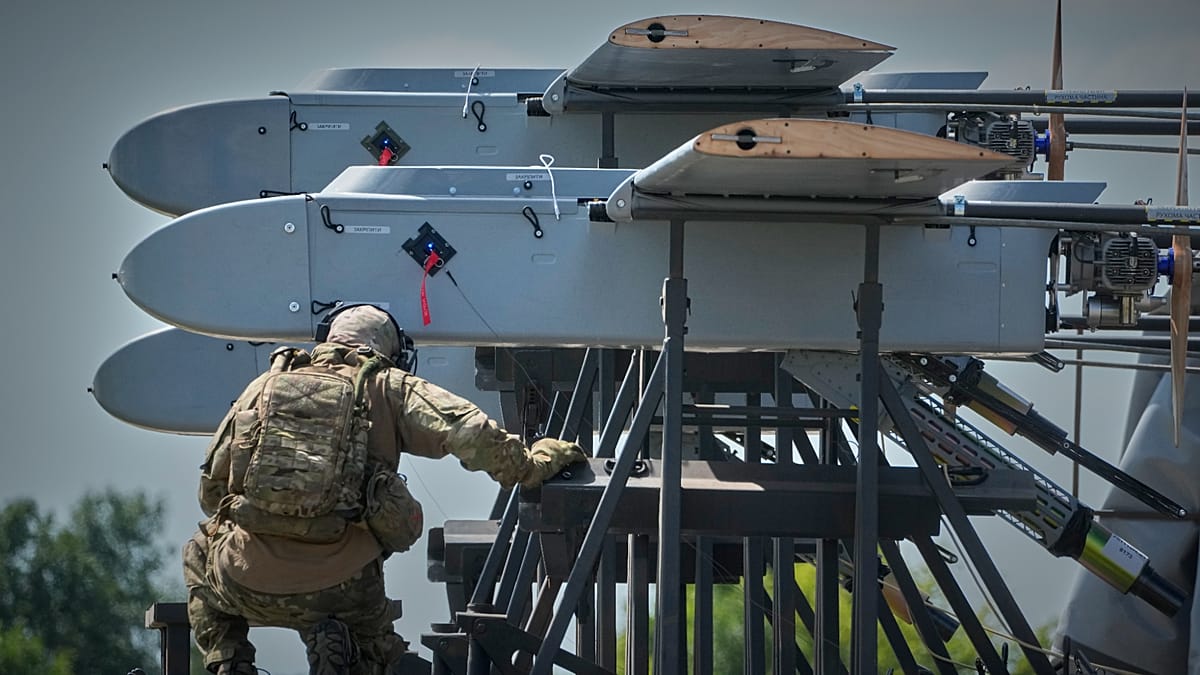
Recent Ukrainian maritime and aerial drone attacks have severely disrupted shipments, particularly of grain. asserted
attacks → disrupt → grain
Andrei Sisov, the head of SovEcon, a research and consulting firm specialized in agriculture, uses Telegram to follow the developments. asserted
Sisov → consult → developments
On August 12, he posted that the Novorossiysk Bread Products Plant (NKHP ) — one of Russia's largest grain export terminals — and the Novorossiysk grain terminal had ceased operations. asserted
Plant → post → operations
A day later, KSK, one of Russia's largest deep-water grain terminals, also halted its operations. asserted
KSK → halt → operations
Operations at a major grain terminal in Taman had already come to a standstill at the end of July. asserted
Operations → come → July
Prior to that, Ukraine paralyzed operations at the shallow-water ports of the Sea of Azov. asserted
Ukraine → paralyze → Azov
"This means that virtually all Russian grain exports via the Azov-Black Sea basin are blocked," Sisov said. asserted
Sisov → mean → basin
Oil exports also affected asserted
exports → affect → ?
The situation regarding oil exports is not quite as dramatic but while they have not come to a complete standstill, they are frequently disrupted. asserted
they → regard → standstill
According to the British news agency Reuters, the Sheskharis terminal — Russia's main oil export facility on the Black Sea, handling some 700,000 barrels of crude oil per day — halted loadings on August 14, which resumed only two days later. uncertain
which → accord → August
According to London-based Argus Media, a global energy and commodity price reporting agency, Russia could have 45 million metric tons of wheat — Russia's main agricultural export good — for export in 2026 to 2027. uncertain
Russia → accord → 2027
However, the situation in the Black Sea, through which about 90% of shipments are usually routed, will make it almost impossible to supply the global market. asserted
it → rout → market
Sisov of SovEcon estimated that "many Russian producers will not survive this season, especially after several years of deteriorating financial conditions." Because exports have come to a standstill, surplus grain will have to be sold on the domestic market, which is already putting downward pressure on prices. asserted
which → estimate → prices
Even if exports were to recover over time, there will still be problems. asserted
exports → recover → time
August is usually when shipments peak and it will be difficult to deliver anything no sent this month because terminals tend to operate at full capacity during the autumn anyway. asserted
terminals → peak → autumn
Ukrainian grain exports also decrease The escalation of hostilities in the Azov and Black Sea regions will also be felt on the global market since Russia is the world's largest wheat exporter. asserted
Russia → decrease → market
Ukrainian grain exports have also fallen sharply since there are attacks on both sides. asserted
exports → fall → sides
In the past month, Russia too has stepped up its attacks on Ukrainian ports and ships that are docked there. asserted
that → step → ports
"The disruptions have blocked out good wheat harvests in Ukraine and Russia from accessing global market," Xiaoyi Deng from Argus Media told DW. asserted
Deng → block → DW
"Both have struggled to work with alternative infrastructure, such as Baltic ports (via rail) or Danube River ports but the alternatives would not be up for full replacement. asserted
alternatives → struggle → replacement
According to the Center for Research on Energy and Clean Air (CREA), a Helsinki-based think tank, the port of Novorossiysk "loaded 30% less oil than during the same period last year" in the first two weeks of August. uncertain
port → accord → August
The decline was preceded by a Ukrainian strike on the Caspian Pipeline Consortium (CPC) marine terminal on July 19. asserted
decline → precede → July
Isaac Levi, an energy analyst at CREA, pointed out that damage to infrastructure was not the only reason for shipments to fall. asserted
shipments → point → infrastructure
He said that "strikes on vessels have discouraged ships from calling at ports considered major targets." asserted
strikes → say → ports
According to US business news channel Bloomberg, a Greek tanker believed to be carrying Russian oil came under attack on August 17. uncertain
tanker → accord → August
"If these constraints persist through August, Russia will find it increasingly difficult to simply defer shipments and make up the lost volumes later," Levi said. asserted
Levi → persist → volumes
"Russia can reroute barrels, but it cannot reroute infrastructure. asserted
it → reroute → infrastructure
The most plausible alternatives include the Baltic ports of Primorsk and Ust-Luga. asserted
alternatives → include → Primorsk
"But rerouting oil through the Baltic Sea ports would significantly increase transportation times and costs compared with Black Sea exports, while available capacity remains too small to replace significant volumes from Novorossiysk." This article was originally published in Russian. asserted
article → reroute → Russian

💬Give feedback
🕘History 🎫Support