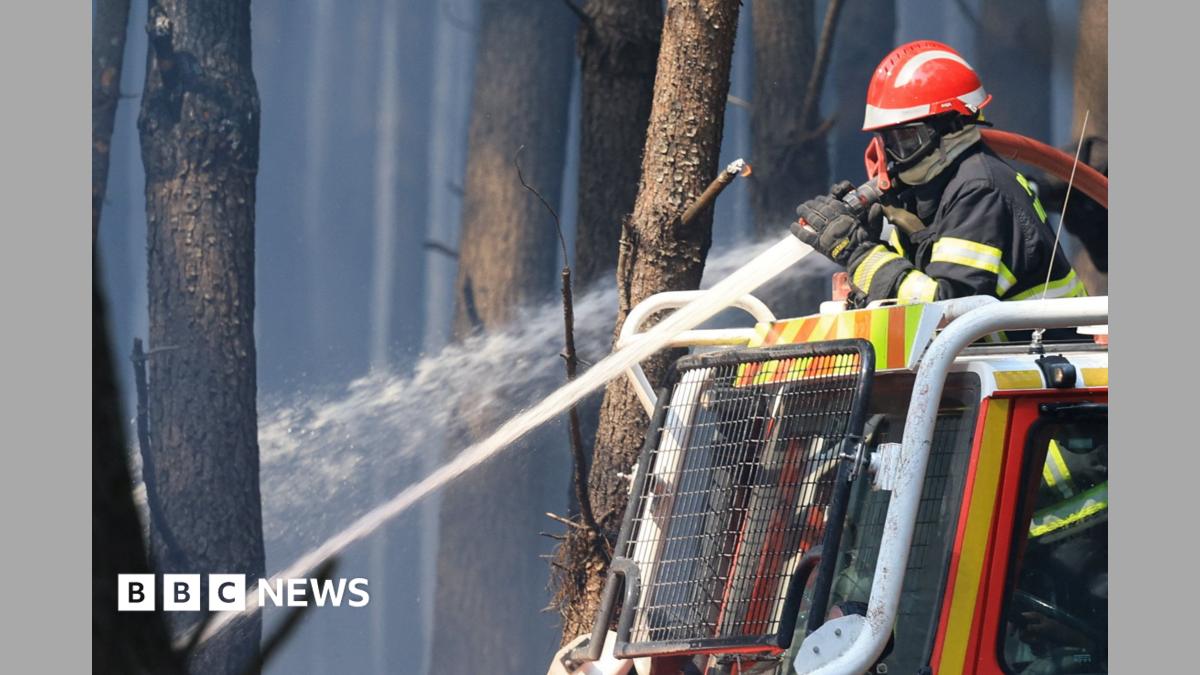
A human-made forest is at the centre of France's raging wildfires
Napoleon III created the large forest outside Bordeaux.
asserted
III → make → Bordeaux
Scientists say climate change is rewriting its future
For days after she and her partner were evacuated from their apartment in Lège-Cap-Ferret, Naomie Corsaint and her family tried to find out what happened to the house they'd lived in for a decade in nearby Le Porge, where a forest fire raged.
asserted
fire → say → Porge
Photos and videos trickled in, mostly from firefighters already hard at work.
asserted
Photos → trickle → work
The 20-year-old didn't get to see the scale of the devastation until she was granted permission to visit the community on Sunday.
asserted
she → get → Sunday
When she arrived, she saw only the cinder walls of her mother's house were left.
asserted
walls → arrive → house
"The town we used to know is gone," Corsaint told CBC on Tuesday.
asserted
Corsaint → use → Tuesday
"You can’t even get your bearings anymore; the houses we used to see when driving by — there’s nothing left.
asserted
we → get → bearings
It’s all ash.
asserted
It → ’ → ?
Corsaint and her family are among the more than 250,000 people evacuated from their homes in France as fires spread at an unprecedented rate near Bordeaux.
asserted
fires → evacuate → Bordeaux
In Spain, more than 116,000 people have had to leave their communities as fires continue to burn there, too.
asserted
fires → have → communities
Scientists say climate change is the primary driver behind the extraordinary fire conditions gripping western Europe, with a fourth heat wave of the season settling over the region this week.
asserted
wave → say → region
But they also say the scale of the fires cannot be understood without looking at how humans transformed the landscape itself.
asserted
humans → say → landscape
Pine forest dates back to Napoleon III
The pine forest stretching southwest of Bordeaux has long been one of France's great engineering success stories.
In the mid-1800s, under Napoleon III, vast wetlands considered unhealthy and unproductive were drained and replaced with a pine forest.
asserted
wetlands → date → forest
The new forest transformed the local economy, produced timber and resin and made the area habitable.
asserted
area → transform → timber
Nearly two centuries later, that same landscape is burning.
asserted
landscape → burn → ?
"This isn't a fire in a natural forest," said Raphaël Morera, an environmental historian at the French National Centre for Scientific Research, in an interview.
asserted
Morera → say → interview
"It’s a fire in a forest that was planted there to support an industrial activity.
asserted
that → ’ → activity
Morera says natural forests tend to contain a greater diversity of tree species and more interruptions that can slow a fire's advance.
asserted
that → say → advance
While France's firefighters are among the best equipped in Europe, the fires themselves are changing faster than emergency services can adapt, says Guillermo Rein, a professor of fire science at Imperial College London.
asserted
Rein → equip → London
What's more, European countries rely on each other for labour and equipment, but when fires rage in many countries at once, that becomes more difficult, especially with aging Canadair tanker fleets.
asserted
that → rely → fleets
Soil no longer retaining moisture
asserted
Soil → retain → moisture
Amid successive heat waves and months of unusually dry conditions, the landscape has lost much of the moisture that normally helps limit fire behaviour, according to Sylvain Delzon, a forest ecophysiologist at the University of Bordeaux and France's National Research Institute for Agriculture, Food and Environment.
uncertain
that → lose → Agriculture
"It's a sandy soil that doesn't retain water.
asserted
that → retain → water
So all the undergrowth was completely dried out and dead, becoming fuel for the fire.
asserted
undergrowth → dry → fire
"
In terms of scale and spread, the fires in France share some similarities with the 2016 Horse River Fire that prompted the evacuation of Fort McMurray in Alberta, said Stefan Doerr, a professor of wildfire science at Swansea University in Wales.
asserted
Doerr → share → Wales
"In both cases the fire behaviour is quite extreme," Doerr said in a video interview, noting the fires in France have created their own weather system — a phenomenon that also occurred around Fort McMurray, with the fire creating its own high winds and lightning.
asserted
fire → say → winds
'All we could see was smoke'
uncertain
we → see → ?
This week, images of a gigantic black cloud above France spread online.
asserted
images → spread → France
The cloud, a pyrocumulonimbus, is composed of the moisture evaporated from burnt trees and vegetation, in addition to soot particles.
asserted
cloud → compose → particles
It is formed by the energy and heat created by large forest fires pushing the air into the sky.
asserted
It → form → sky
To Corsaint, whose family home in Le Porge burned, and her boyfriend, Mattéo Martins, 21, the results were "almost apocalyptic."
asserted
results → burn → Porge
Before the couple had to leave their apartment in Lège-Cap-Ferret last week, they watched as the sky around them turned black.
asserted
sky → have → them
"All we could see was smoke.
uncertain
we → see → ?
Ash fell on the balcony," Corsaint said.
asserted
Corsaint → fall → balcony
You could hear planes, police sirens, everything except other people.
uncertain
You → hear → people
You can only see these fire clouds during huge wildfires
Trump says Canada should stop wildfire smoke.
asserted
Canada → see → smoke
Experts say it's not that simple
asserted
it → say → ?
Sophie Wilkinson, a wildfire and peatland researcher at Simon Fraser University in British Columbia who studied the Alberta wildfire — where there were also drained wetlands — said climate change is exposing the legacy of earlier land-use decisions.
asserted
change → study → decisions
"The era of denialism and pushing climate change into the future as a future issue is really gone."
asserted
era → push → issue
Wilkinson, speaking in a phone interview Tuesday, said extreme heat, drought and wildfire are symptoms of human-caused climate change, adding that protecting and restoring ecosystems such as peatlands must also be part of the response.
Susan Page, professor of physical geography at the University of Leicester in England who has spent decades studying peatlands, echoed Wilkinson's comments.
asserted
who → speak → comments
…and 7 more, not listed.
 The Aporia