- Published
"I take a nap and the world changes," says Chen Tianyu.
asserted
Tianyu → take → nap
His world certainly does.
asserted
world → do → ?
The 28-year-old keeps up with the latest technology by spending his spare time in factories that are switching to automation.
asserted
that → keep → automation
That way he knows what to prioritise when teaching his class about artificial intelligence (AI) and robotics.
asserted
he → know → intelligence
In front of him, around 30 college students are studying code.
asserted
students → study → code
One of them is typing furiously as his eyes dart from the screen to the robot: "The idea is it will grab that cylindrical piece and move it over there."
asserted
it → type → it
A line of industrial robots are waiting to be programmed, and in another part of the classroom, students are trying to develop robotic medical instruments.
asserted
students → wait → instruments
As he guides them, Chen declares: "If you are not needed by the world of AI and robotics, then you'll definitely be among those eliminated".
asserted
you → guide → those
For the people in this room, this is a step - or rather a leap - towards a future that China is meticulously building: Xi Jinping's $20bn (£14.7bn) plan to put his country at the forefront of innovation and in direct competition with the US.
asserted
China → build → US
They are in the Hangzhou Technician Institute, one of several huge, purpose-built vocational schools that want to churn out the next generation of tech-savvy engineers.
asserted
that → build → engineers
The campus sits on the outskirts of Hangzhou, a former imperial capital whose futuristic skyline is just the first hint of its role as a global tech hub.
asserted
skyline → sit → hub
Across the country, there are more than two million robots working in China's factories - which is more than anywhere else - and they are continuing to scale up at extraordinary speed.
asserted
they → be → speed
It is a commitment that will surely change the world, much like the last time the Chinese economy underwent a massive transformation.
asserted
economy → change → transformation
It is already shipping its robots across the globe: more than half of the world's industrial robots are now made in China.
asserted
half → ship → China
What is less clear is the impact of such sweeping automation in a country that sits at the heart of global manufacturing, trade and innovation.
asserted
that → sit → manufacturing
What does this mean for China's human workforce, for instance?
asserted
this → mean → instance
And how would we be able to truly measure the cost of this transformation in a regime that controls information so tightly?
asserted
that → measure → information
The future of China's workers is uncertain in the industrial revolution the world has been watching: gleaming solar grids, peak hours made noiseless by electric vehicles, machines that run faster than Usain Bolt.
asserted
that → watch → Bolt
Over the weekend, China hosted the second edition of the World Humanoid Games where robots boxed, sprinted and marched.
asserted
robots → host → Games
What is fuelling this spectacle is another, less visible revolution happening inside factories and classrooms.
asserted
fuelling → fuel → factories
The BBC has visited industrial sites where we have been shown robots that do not look human, or dance or leap on stage but weld, paint, lift, assemble and work around the clock without a break or benefits.
asserted
that → visit → break
Some are designed to build more robots.
asserted
Some → design → robots
We have also been inside academies where China is training the people who will work alongside its robotic workforce.
asserted
who → train → workforce
This is a front-row seat to what Xi calls China's "new productive forces" - and how they could reshape the country.
uncertain
they → call → country
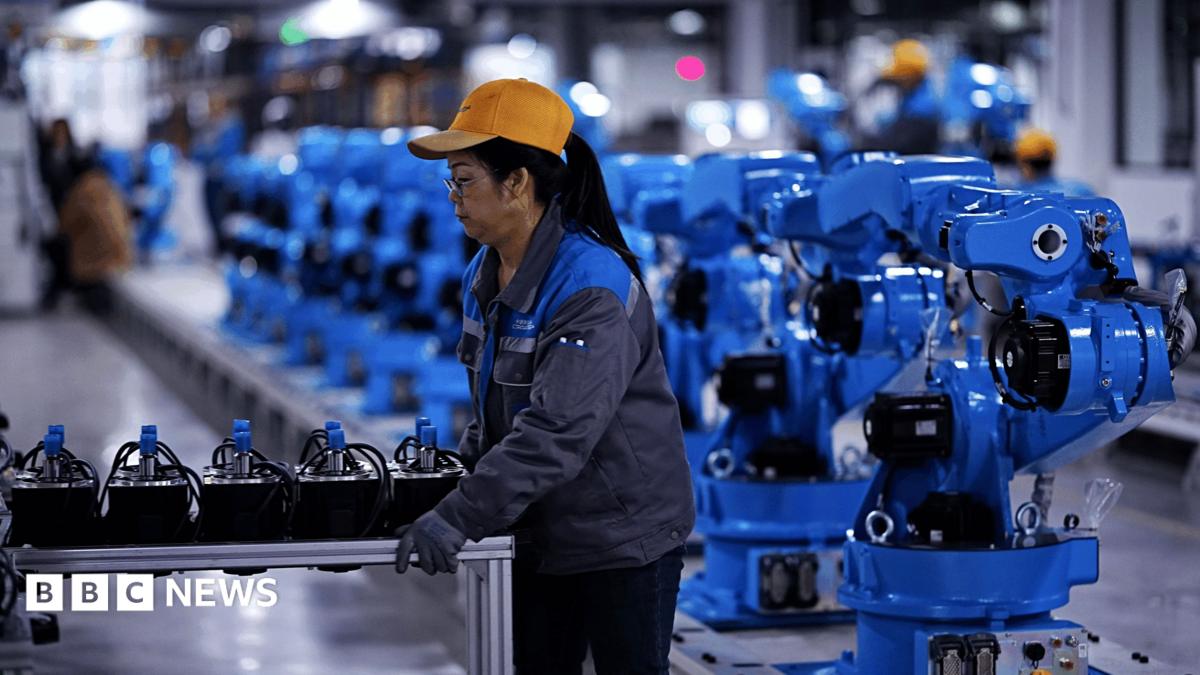
On a factory floor in the southern city of Chengdu, the old and and the new are working side by side.
asserted
old → work → side
An assembly line of around 30 middle-aged men and women is screwing, drilling and polishing CRP Technology's signature product: a robotic arm which performs various industrial tasks.
asserted
which → screw → tasks
Also in the room are four young engineers crowded around a console, trying to crack the code for a prototype, a new robot that they hope will help build other robots.
asserted
they → crowd → robots
One of them, 31-year-old Pang Kai, who is part of the research and development team, pushes the sleek skeleton across the room.
asserted
who → push → room
Because China's future workforce is not quite ready to strut out.
asserted
workforce → strut → ?
For now, it can only do simple repetitive movements, such as scan a QR code.
asserted
it → do → code
"Maybe in another half year, it can do another task," Pang says, smiling wistfully.
asserted
Pang → do → task
It's a long road and the team are celebrating every small win.
asserted
team → celebrate → win
CRP Technology, which employs around 300 people, has been building robot arms for nine years.
asserted
which → employ → years
Each arm can be tailored to a factory's needs to help build cars, electronics or wind turbines.
asserted
arm → tailor → cars
The firm says a single arm can be programmed to perform more than 90% of repetitive tasks.
asserted
arm → say → tasks
The engineers also wonder if, one day, they can replace the company's workforce.
asserted
they → wonder → workforce
"We want our new robot to be like human beings.
asserted
robot → want → beings
We hope it can think by itself," says Pang.
asserted
Pang → hope → itself
"We need these kinds of robots because maybe in 10 years, we won't have enough workers in China."
asserted
we → need → China
A shrinking population and an ageing workforce is another reason Beijing is in a hurry to revolutionise its factories.
asserted
Beijing → shrink → factories
…and 45 more, not listed.
 The Aporia