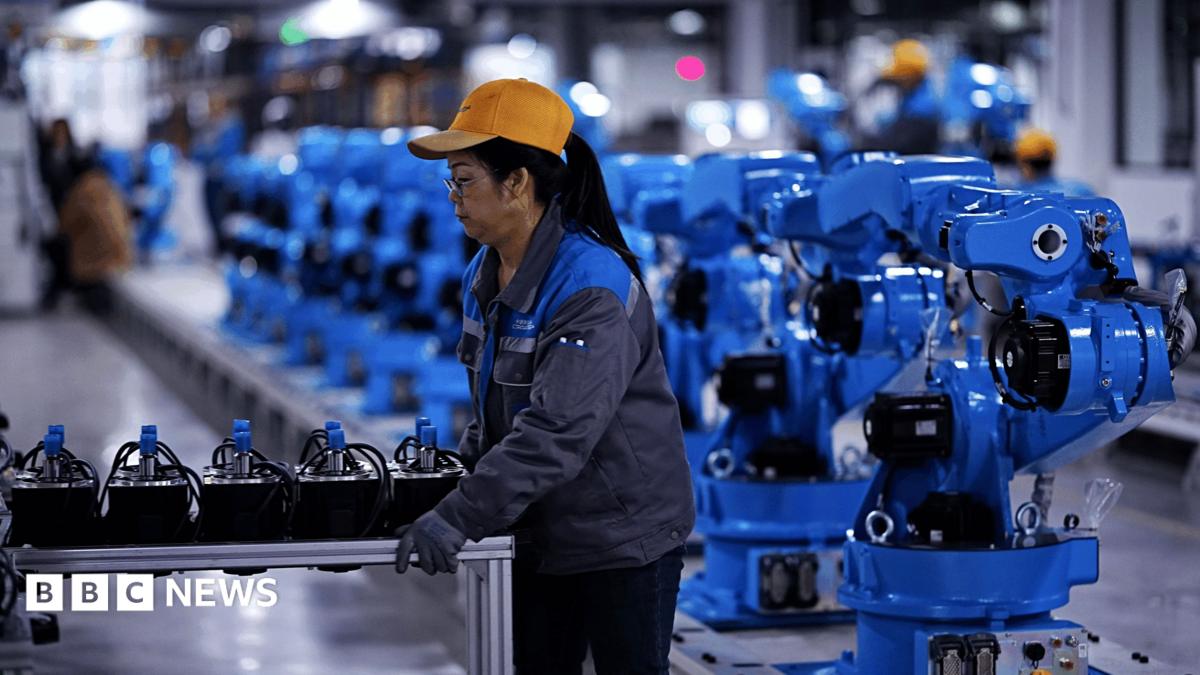
When Tiangong Ultra unofficially smashed Usain Bolt’s 100m world record in Beijing, China, unballetically flailing past the finish line in 8.86 seconds, he did not flash an Olympian grin down the camera lens.
asserted
he → smash → lens
In fact, he has no face.
asserted
he → have → face
Ultra, the work of the Beijing Humanoid Robot Innovation Center, was competing in the penultimate day of the unapologetically dystopian World Humanoid Robot Games, which has been hosting 666 teams at China’s National Speed Skating Oval.
asserted
which → compete → Oval
At this event, more than 2,000 robots are put to the test in track and field events (like long jump and an obstacle course); sports (like table tennis and soccer); and “scenarios” (like bricklaying and firefighting).
asserted
robots → put → bricklaying
The event produced several eye-catching moments, including when humanoids beat human records at the high jump and the 400m. Just a few days before Ultra’s race, Lightning, a robot developed by phone company Honor, ran the 100m in 9.39 seconds, again thundering home quicker than Bolt.
asserted
Lightning → produce → Bolt
But these tumbling records will likely be, in the pop cultural consciousness, eclipsed by something far more entertaining: tumbling robots.
asserted
records → tumble → something
One humanoid at the weightlifting event lost its balance with a weedy 15kg barbell, started jerking and slammed into the judges’ table, its helpless arms aloft, as if to say, “Why me?”
asserted
humanoid → lose → table
Most memorably, a robot ended his dash by careering into a safety mat, Tom and Jerry style, before cartoonishly arching backward and setting on fire.
asserted
robot → end → fire
It’s deeply reassuring to watch robots fizzle out into smithereens.
asserted
robots → ’ → smithereens
I myself have fond memories of watching the fire-hazard creations on Robot Wars in the U.K. (the successor to BattleBots in the U.S.) get shredded into shrapnel.
asserted
creations → have → shrapnel
This time, it’s a reassuring reminder that we can beat robot replicants at our own games.
asserted
we → ’ → games
This robot schadenfreude is fuelled by a fear of the future.
asserted
schadenfreude → fuel → future
Pointing out their flaws makes humanity’s finish line feel further away, even if that’s a highly unintelligent thing to think.
asserted
that → point → flaws
In many ways, this feeling can be filed next to our twisted delight in belittling generative AI.
asserted
feeling → file → AI
ChatGPT’s past inability to spell “strawberry” has made it an object of ridicule online.
asserted
it → spell → ridicule
Calling AI-generated content “slop” has become a knee-jerk reaction to artificial intelligence’s catastrophic metastasisation in the creative industries.
asserted
Calling → call → industries
And our collective giddiness about technical mishaps is not reserved just for AI.
asserted
giddiness → reserve → AI
For instance, we love to watch the armored glass windows of the Tesla Cybertruck break.
asserted
windows → love → Cybertruck
One possible reason: it shatters the illusion that the future is here and already decided.
asserted
future → shatter → illusion
Robots surely can’t replace us if we haven’t figured out car windows yet.
asserted
we → replace → windows
This feeling is magnified when they are humanoids—ersatz versions of ourselves.
asserted
they → magnify → ourselves
Seen through a sports lens, it mirrors how I felt with the Enhanced Games.
asserted
I → see → Games
The painfully brotastic event held in Las Vegas in May allowed athletes to take performance-enhancing drugs or wear banned gear.
uncertain
athletes → hold → gear
With social media instilling a chronic fatigue for actual human achievement, technophiles are moving the goalposts; if being pumped full of steroids or titanium plates makes you more likely to beat a world record, it’s worth it.
asserted
it → instill → record
Just a single best-ever-time, in the men’s 50m freestyle, was (unofficially) recorded by Kristian Gkolovmeev; he wore an outlawed polyurethane skinsuit.
asserted
he → record → skinsuit
Otherwise, the non-artificially-enhanced athletes dominated the competition.
asserted
athletes → enhance → competition
My concern: when it comes to humanoids, at least, our schadenfreude is set to be a short-lived pastime.
asserted
schadenfreude → come → humanoids
To put it into perspective, at last year’s World Humanoid Robot Games, Ultra won the 100 meters in 21.50 seconds, much closer to Bolt’s 200m record than his 100m time.
asserted
Ultra → put → time
They’re only getting stronger and faster.
asserted
They → get → ?
Dunking on “clankers,” a derogatory term for clumsy robots (like this one dancing to Billie Jean), may be the most classically human response: laughing off the impending doom.
uncertain
Dunking → dunk → doom
Many futurists predict that in the near future, our factories and farms and battlefields and back gardens will be filled with humanoid helpers.
asserted
factories → predict → helpers
In 2024, Elon Musk said that by 2040 there will probably be more humanoid robots than people.
asserted
Musk → say → people
And according to research by Morgan Stanley over 1 billion humanoids may be in use by 2050 and the market could be worth $5 trillion.
uncertain
market → accord → 2050
Spectators from afar like me, viewing the drama on our phones, will continue to watch with a sort of futuristic gallows humour.
asserted
Spectators → view → humour
Laughing at misfortune, however spiteful it may be, leads to social bonding—in this case, as an entire species, against robots—that humans desperately need right now.
uncertain
humans → laugh → that
Every time a clanker goes crash, bang, wallop, and kaput, it’s a visceral reminder that we still matter.
asserted
we → go → ?
And unlike them, when faced with their destruction, I’m able to smile.
asserted
I → face → destruction
 The Aporia