A tale of two tycoons

Semafor · collected 2026-08-25 · by Andy Browne
Read the original at Semafor ↗

Summary

The article profiles two Chinese tycoons: Wang Xingxing, founder of Unitree Robotics whose shares rose 460% on market debut, and Hui Ka Yan, the fallen real estate mogul sentenced to life in jail. Hui's company Evergrande had over $300 billion in liabilities before its collapse, leaving millions of vacant apartments behind. The article suggests that both men are products of China's system, which concentrates resources at the state's command, generating waste and debt. The real estate sector once accounted for 25% of China's economy and has left a trail of industrial overcapacity, with many industries facing similar issues such as excess capacity in solar, auto, and battery production.
Written by the local model on 2026-08-25, using this article's own text rather than the other coverage of the same event (that is the story summary below).

Signals How these are calculated →

Claims extracted
25
claim-shaped sentences
Uncertain
8%
2 of 25 hedged
Leaning
Leans left
of the writing, not the subject
Publisher trust
95.5
red-flag proxy, not a credibility rating
Outlets on this story
5
Crime & Law
Narrative spread
1
articles carrying this framing
Analyzed 2026-08-25 · how these are computed

AI analysis (generated at analysis time, not now)

Story summary

Hui Ka Yan, the founder of Evergrande, a Chinese property giant that collapsed with over $300 billion in liabilities, has been sentenced to life in prison by the Shenzhen Intermediate People's Court. Hui pleaded guilty in April to multiple charges, including embezzlement and corporate bribery. The court also fined his former companies a total of 15.82bn yuan (£1.73bn; $2.35bn) over crimes such as falsifying records and concealing debt. This marks a significant moment in the fallout from Evergrande's collapse, which shook China's property sector and hit investors and domestic banks hard. Hui's sentencing comes after the court convicted him of overseeing Evergrande's large-scale financial fraud, inflating the group's assets while concealing its liabilities. Several other senior executives were also sentenced to prison terms ranging from 22 months to 18 years.

Written for “Evergrande Founder Sentenced” on 2026-08-31, grounded in this article and the 4 other(s) covering the same event.
Why this leaning score
The article's own words the score was based on. Each is quoted verbatim and was checked against the article text before being stored, so you can find it in the original.
Score -0.35 Confidence medium
Leaning score -0.35 for article 2226 (medium confidence, 1 verified quote) · logged 2026-08-27

Story

📰 Evergrande Founder Sentenced
Crime & Law · 5 article(s) covering the same event. This is the one the site leads with.

How this is being covered How these are calculated →

Article leaning vs. publisher reliability
Source leaning vs. consistency

Compared with similar articles

This article reads leans left and hedges 8% of its claims. Each row says how that neighbour differs.
BBC News
⚖️ leaning not scored 🔴 6% hedged 1 of 17 📰 publisher trust 96
“Article B refers to a court sentencing of Hui Ka Yan on a separate day from Article A”
NPR Topics: News
⚖️ leaning not scored 🔴 0% hedged 0 of 14 📰 publisher trust 93
“Both articles describe the same Chinese court sentencing Hui Ka Yan, the founder of Evergrande, to life in prison on the same day (Thursday) and location (Shenzhen)”
Just In
⚖️ leaning not scored 🔴 0% hedged 0 of 4 📰 publisher trust 96
“Both articles report on the sentencing of Hui Ka Yan to life in prison by a Chinese court.”
BBC News
⚖️ Leans right further right than this 🔴 8% hedged 7 of 85 📰 publisher trust 96
“Article A describes a court sentencing a real estate tycoon, Hui Ka Yan, while Article B discusses college students learning about artificial intelligence and robotics in factories”
Semafor
⚖️ Leans right further right than this 🔴 0% hedged 0 of 4 📰 publisher trust 96
“Article A discusses two separate events: a stock market debut and a court sentencing, while Article B is unrelated to either of those incidents”
World news | The Guardian
⚖️ Leans left 🔴 13% hedged 2 of 15 📰 publisher trust 95
“Article B mentions two events happening on successive days, while Article A describes a single sentencing event with no mention of another occurrence”
Zeteo
⚖️ Leans strongly right further right than this 🔴 17% hedged 3 of 18
“Article A describes a court sentence of Hui Ka Yan and Wang Xingxing's market debut, while Article B discusses Peter Thiel's 2010 conference remarks unrelated to these events”

Publisher

Semafor · 35 article(s) · 0 correction(s) detected
SignalValueWeight
Correction rate 0.000 0.4
Uncertainty density 0.090 0.25
Assertive mismatch rate 0.000 0.35
No corrections detected for this publisher. That may mean careful reporting, or simply that nothing has been checked.

Who wrote this

Andy Browne
1 article(s) here · 1 carrying a prediction
🔮 Their backgrounds and personalities could hardly be more different: Wang is a self-described “tech supremacist”; Hui came up through gritty factory jobs.
2026-08-25 · assertive framing · A tale of two tycoons
The only article under this byline in the corpus.

Topics

China Chinese Evergrande Unitree Unitree Robotics

Subjects

China GPE · 9× Hui PERSON · 6× Chinese NORP · 3× Unitree ORG · 2× Wang PERSON · 2× Andy PERSON · 1× Evergrande ORG · 1× Hui Ka Yan PERSON · 1× Unitree Robotics ORG · 1× Wang Xingxing PERSON · 1×

Narrative

Jack Ma, the co-founder of Alibaba, got off lightly when Beijing decided to crack down on consumer tech: Alibaba was hit with a whopping fine, and Ma lost perhaps half his assets but kept his personal freedom — and his yacht. After Unitree’s spectacular listing, Wang is worth around $16 billion, at least on paper.
framing: assertive · carried by 1 article(s) · first seen 2026-08-25
🔮 Their backgrounds and personalities could hardly be more different: Wang is a self-described “tech supremacist”; Hui came up through gritty factory jobs.
2026-08-25 · Semafor
A tale of two tycoons · assertive framing

Claims (25 extracted, 2 hedged)

On successive days last week, exuberant investors hailed China’s latest corporate star — Wang Xingxing, the founder of humanoid robot maker Unitree Robotics, whose shares popped 460% in their market debut — while a court sentenced the fallen real estate tycoon Hui Ka Yan to life in jail. asserted
court → hail → jail
Their backgrounds and personalities could hardly be more different: Wang is a self-described “tech supremacist”; Hui came up through gritty factory jobs. uncertain
Hui → describe → jobs
Wang represents China’s hopes of rejuvenating the economy through robots, drones, and smart devices; Hui, the founder of property giant Evergrande, which collapsed under liabilities of more than $300 billion, has become the poster child for its excesses. asserted
which → represent → excesses
But both share one thing in common: They are products of a system that concentrates massive resources at the command of the state, in the process generating colossal waste and leaving a trail of debt and industrial overcapacity. asserted
that → share → debt
In sum, the pair represent how the business cycle in China plays out. asserted
cycle → represent → China
At its peak, the real estate sector accounted for 25% of the Chinese economy, filled the coffers of local governments through land sales, enriched state enterprises in steel and cement, and conjured vast service industries that employed millions as property agents, building managers, and mortgage lenders. asserted
that → account → agents
Its collapse left up to 90 million vacant apartments and ended Hui’s career. asserted
collapse → leave → career
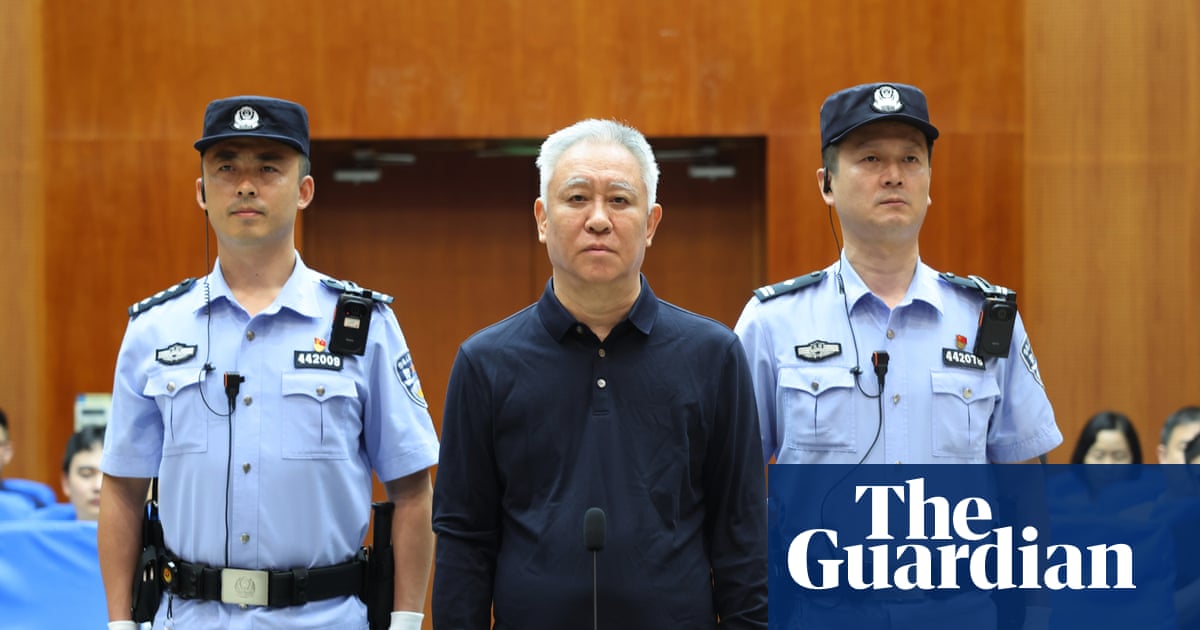
Once Asia’s richest man — he owned a soccer team, a superyacht, and a fleet of private jets — Hui looked forlorn in the dock, white-haired, expressionless, and dressed in a simple navy blue shirt. asserted
Hui → own → shirt
An investment binge in solar has given China more than 90% of the global market, but eviscerated profits for Chinese solar players. asserted
binge → give → players
Module prices plunged by half in 2023 and 25% again in 2024. asserted
prices → plunge → 2024
The global battery industry, also dominated by China, had built up enough capacity to meet actual demand almost three times over. asserted
industry → dominate → demand
The auto industry is similarly afflicted. asserted
industry → afflict → ?
Brad Setser, a former US Treasury official now with the Council on Foreign Relations, calculates that China has the capacity to produce 55 million cars, close to two-thirds of global demand — and that number is rapidly increasing. asserted
number → calculate → demand
Today, Unitree’s pre-IPO investors are sitting on a windfall gain, although nobody really knows if there’s a commercial application for the gangly humanoid contraptions. asserted
nobody → sit → contraptions
The Chinese public is mesmerized by their athletic stunts — Unitree’s “Superman” robot can out-accelerate Usain Bolt and leap six-feet-six-inches into the air. asserted
robot → mesmerize → air
But even state planners warn that with more than 150 companies all making similar products (50 have either listed or plan to), a bubble may be forming. uncertain
bubble → warn → products
One Beijing-based venture capital executive told the Financial Times that “humanoid robotics is approaching the peak of the hype cycle.” asserted
robotics → base → cycle
No doubt his crimes are real, but he was also only playing his part in what was essentially a Ponzi scheme that everybody — from village committees to the Politburo — relied upon to drive growth and generate employment. asserted
everybody → play → employment
Developers like Hui came to see the market as a one-way bet — why would the government spoil its own party? — and in a sense, loading up on risky debt was a rational strategy. asserted
loading → come → debt
Desmond Shum, the author of Red Roulette, posted on X that “the system created the incentives, rewarded the behavior, and profited from the boom.” asserted
system → post → boom
China’s roller-coaster business cycle has a long history of producing dizzying highs and painful lows for the country’s leading entrepreneurs. asserted
cycle → have → entrepreneurs
In the 2000s, a bricks-and-mortar retail boom ended with the jailing of Huang Guangyu, the billionaire founder of GOME Electronics, convicted of bribery and insider trading. asserted
boom → end → bribery
A later outbound investment wave came to an abrupt halt with the jailing of several globe-trotting moguls, including Wu Xiaohui, the owner of New York’s Waldorf Astoria Hotel. asserted
wave → come → Hotel
Jack Ma, the co-founder of Alibaba, got off lightly when Beijing decided to crack down on consumer tech: Alibaba was hit with a whopping fine, and Ma lost perhaps half his assets but kept his personal freedom — and his yacht. After Unitree’s spectacular listing, Wang is worth around $16 billion, at least on paper. asserted
Wang → get → paper
But like many private fortunes in China, it’s a precarious one. asserted
it → ’ → China

💬 Give feedback
🕘 History 🎫 Support