It’s not often that 3.6 billion people—or 44.4% of the world’s population—look at the same thing at the same time.
asserted
people → ’ → time
And it’s not often that something comes along that’s worth the attention of all those billions.
asserted
that → ’ → billions
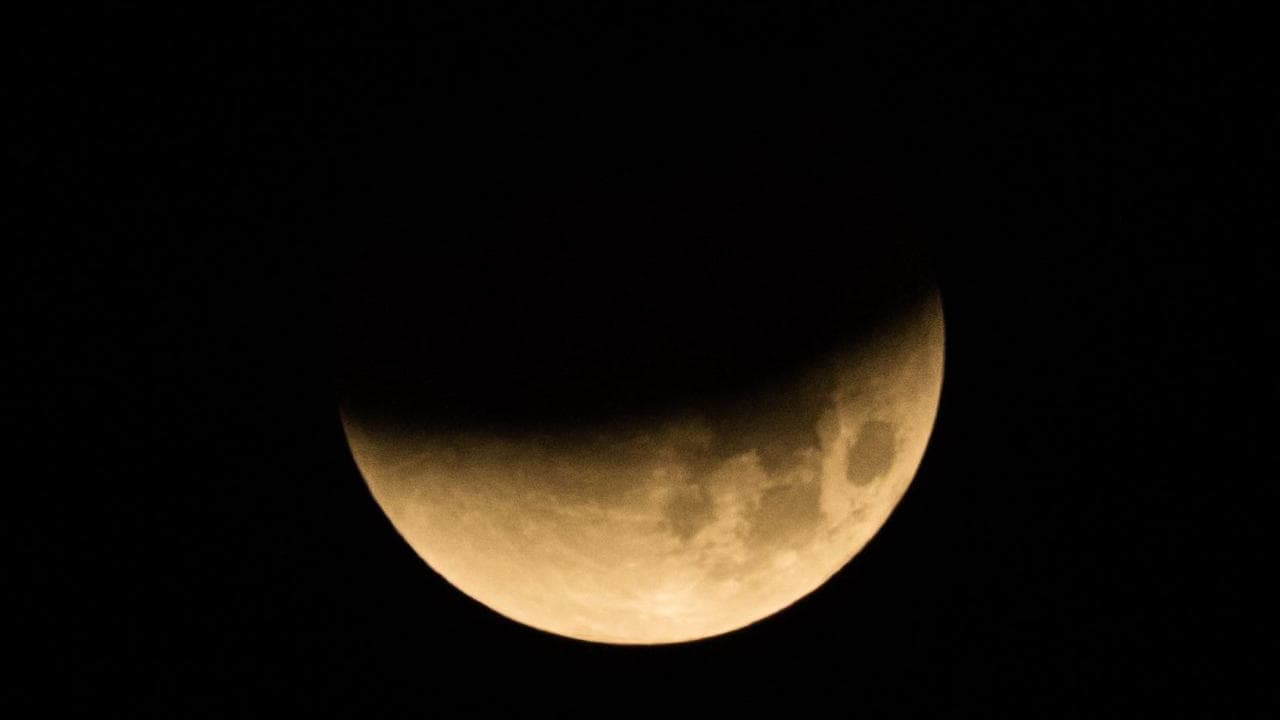
But that will happen on the evening of Aug. 27 when much of the world will be able to witness a blood moon lunar eclipse, during which 96% of the face of the full moon will fall into Earth’s shadow, glowing a deep orange-red in the process.
asserted
% → happen → process
Lunar eclipses occur during a full moon, when the Earth is positioned between the sun and the moon, blocking all or most of the solar light that otherwise bathes the lunar surface.
asserted
that → occur → surface
On average, lunar eclipses occur two to three times per year, though total lunar eclipses, when the moon is entirely shadowed, make up only 29% of those events.
asserted
moon → occur → events
The autumnal color the moon takes on is due to a trick of the Earth’s atmosphere.
asserted
moon → take → atmosphere
Not all of the sunlight that would otherwise be striking the moon during an eclipse is blocked by the Earth; some of it leaks around the periphery of the planet and manages to reach the moon.
asserted
some → strike → moon
That light streams through the Earth’s atmosphere during its passage to the moon, and some of the wavelengths of visible light—particularly the blue—are absorbed and scattered.
asserted
some → stream → light
What’s left is principally the red spectrum which partially lights the moon.
asserted
which → leave → moon
All total lunar eclipses result in blood moons.
asserted
eclipses → result → moons
In theory, a lunar eclipse ought to occur once a month.
asserted
eclipse → occur → theory
On every orbit around the Earth on its 27.3-day journey, after all, the moon will always pass through a point at which the planet sits between it and the sun.
asserted
planet → pass → it
But the plane of the moon’s orbit around the Earth is tilted about five degrees compared to the Earth’s orbit around the sun.
asserted
plane → tilt → sun
That means that on some passages behind the Earth the moon avoids the shadow, soaring above or ducking below the planet.
asserted
moon → mean → planet
How long will the lunar eclipse last?
asserted
eclipse → last → ?
An eclipse of the moon plays out slowly.
asserted
eclipse → play → moon
The one that will begin on the evening of Aug. 27 and continue into the early hours of Aug. 28 will last a total of five hours and 38 minutes.
asserted
that → begin → hours
Even the most dedicated eclipse chaser, however, may not be able to take it all in.
uncertain
chaser → take → it
Depending on where in the world an observer is—and this eclipse will be visible in Europe, Africa, North and South America, and western Asia—the moon may set before the eclipse is done or rise after it’s already begun.
uncertain
it → depend → Europe
That will be the case in the Americas, where observers will see an eclipsed moon come up in the skies.
asserted
moon → see → skies
Finding a flat area with few buildings and a clean sight line may be necessary to witness the eclipse, since in many places the moon will be low in the sky, close to the horizon.
uncertain
moon → find → horizon
In the U.S., the eclipse will begin at 9:23 p.m. ET on Aug. 27, and end at 3:01 ET the next day.
asserted
eclipse → begin → ET
The penumbral phase occurs first, when the moon moves into the faint, outer reaches of the Earth’s umbra, or shadow.
asserted
moon → occur → umbra
The partial phase comes next, when the true, darker shadow of the Earth begins to cover the lunar disk.
asserted
shadow → come → disk
The total or maximum phase is when only a small portion—or none at all—of the moon remains unshadowed.
asserted
portion → remain → moon
For the upcoming eclipse, the penumbral phase will take one hour and ten minutes, the partial phase one hour and 39 minutes, and the maximum phase, when the moon will be 96% obscured, will also take one hour and 39 minutes.
asserted
moon → take → hour
That maximum shadow will occur at 12:12 a.m. ET.
asserted
shadow → occur → ET
The eclipse will then return to the partial and penumbral phases before the moon soars on and leaves the Earth’s shadow behind.
asserted
moon → return → shadow
This eclipse occurs in a busy time for the skies.
asserted
eclipse → occur → skies
On Aug. 12, just over two weeks before the lunar eclipse is set to occur, there was a total eclipse of the sun, visible in Spain, Portugal, Iceland, Greenland, and Siberia.
asserted
eclipse → set → Spain
There is actually such a thing as an eclipse season, a month-long stretch occurring twice a year—in the summer and winter—when the moon passes the point in its five-degree orbit that the Earth, moon, and sun align in a way to make both types of eclipses possible.
asserted
types → be → eclipses
If you fancy eclipses, you’re well advised to take this one in while you can.
asserted
you → fancy → one
New Years Eve fireworks will be going off that night, but they will be nothing compared to the sky show the Earth, the sun, and the moon will serve up.
asserted
Earth → go → show
 The Aporia