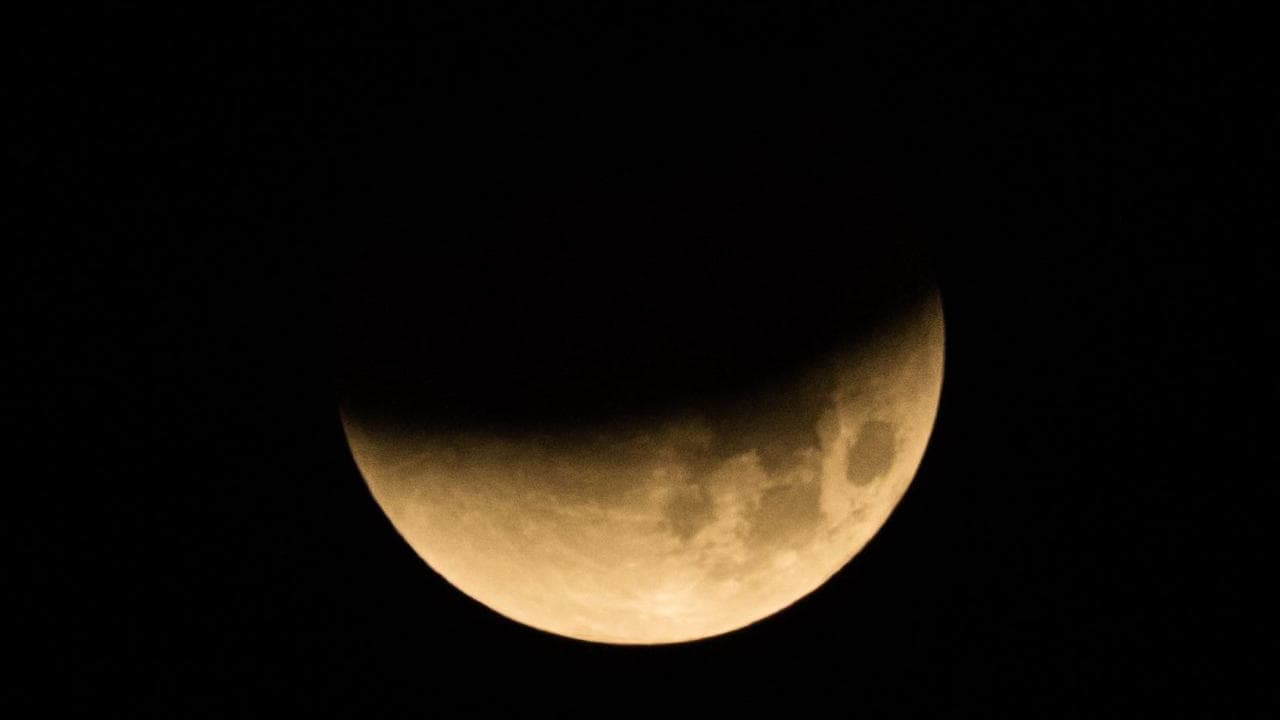
Partial lunar eclipse to grace Canadian skies this week

CBC | Top Stories News · collected 2026-08-24 · by Nicole Mortillaro
Read the original at CBC | Top Stories News ↗

Summary

A partial lunar eclipse will occur in the skies over Canada on August 27-28, roughly two weeks after a total solar eclipse was seen in parts of Europe. The eclipse will reach its maximum coverage at 93% by midnight ET and will be visible across most of the country. According to Elaina Hyde, director of the Allan I. Carswell Observatory, the moon's appearance during this event may appear red, but not completely so. The eclipse can be viewed with just one's eyes, and binoculars or a camera may also be used for better views.
Written by the local model on 2026-08-24, using this article's own text rather than the other coverage of the same event (that is the story summary below).

Signals How these are calculated →

Claims extracted
19
claim-shaped sentences
Uncertain
0%
0 of 19 hedged
Leaning
not political
takes no side on a contested political question
Publisher trust
95.4
red-flag proxy, not a credibility rating
Outlets on this story
4
Science
Narrative spread
1
articles carrying this framing
Analyzed 2026-08-24 · how these are computed

AI analysis (generated at analysis time, not now)

Story summary

A partial lunar eclipse will be visible across Canada on August 27-28. It comes two weeks after a total solar eclipse was seen in parts of Europe, including Iceland, Spain, and a small portion of Portugal. This lunar eclipse is notable because it's relatively deep, with 93% coverage at its maximum. The entire duration of the eclipse will be visible from most of Canada, while Western Canada will see the partial eclipse as the moon rises. Unlike solar eclipses, there's no need for protective eyewear to watch this event, and it will last several hours rather than minutes. This lunar eclipse is part of an "eclipse season" that occurs twice a year, when the moon passes through Earth's shadow due to the alignment of the sun, earth, and moon. The eclipse can be seen across North and South America, as well as parts of Europe and Africa.

Written for “Lunar Eclipse News” on 2026-08-31, grounded in this article and the 3 other(s) covering the same event.
Why this leaning score
This article does not take a side on a contested political question, so it has no leaning score. That is an answer rather than a gap: a match report or a rescue can be warmly or critically written without being left or right, and scoring it anyway is how approval of a subject gets recorded as a political position.
No political leaning scored for article 2124 · logged 2026-08-27

Story

📰 Lunar Eclipse News
Science · 4 article(s) covering the same event.

How this is being covered How these are calculated →

Article leaning vs. publisher reliability
Source leaning vs. consistency

Compared with similar articles

This article reads unscored and hedges 0% of its claims. Each row says how that neighbour differs.
The Globe and Mail · 0.89 cosine similarity
⚖️ leaning not scored 🔴 6% hedged 1 of 18 📰 publisher trust 21
“Both articles describe the same lunar eclipse visible in Canada on August 27-28”
TIME
⚖️ leaning not scored 🔴 9% hedged 3 of 33 📰 publisher trust 95
“Both articles describe the same lunar eclipse occurring on August 27-28, 2026”
NBC News Top Stories
⚖️ leaning not scored 🔴 5% hedged 1 of 21 📰 publisher trust 96
“Different locations (Canada vs US) and slightly different timing”

Publisher

CBC | Top Stories News · 194 article(s) · 0 correction(s) detected
SignalValueWeight
Correction rate 0.000 0.4
Uncertainty density 0.092 0.25
Assertive mismatch rate 0.000 0.35
No corrections detected for this publisher. That may mean careful reporting, or simply that nothing has been checked.

Who wrote this

Nicole Mortillaro
5 article(s) here · 1 carrying a prediction
🔮 Lunar eclipse comes 2 weeks after total solar eclipse seen in parts of Europe On the night of Aug. 27-28, a partial lunar eclipse will be visible across the country.
2026-08-24 · assertive framing · Partial lunar eclipse to grace Canadian skies this week
🔮 This year, on the day of the shower's peak, we will also get a partial solar eclipse.
🔮 Instead, it's expected to occur once every six to 15 years in Ontario and once every two to six years in the Northwest Territories.
🔮 A SpaceX rocket will slam into the moon on Wednesday, and astronomers will be watching closely
🔮 Company's proposal of 50,000 mirrors would be 'catastrophic for astronomy,' says one professional astronomer
More on this subject from Nicole Mortillaro
Get ready for 'meteor Christmas' with an added bonus: a partial solar eclipse
2026-08-11 · CBC | Top Stories News · 50% similar
All 5 articles by Nicole Mortillaro →

Topics

Canada Canadian Iceland Portugal Spain

Subjects

Canada GPE · 2× Hyde PERSON · 2× Canadian NORP · 1× Elaina Hyde PERSON · 1× Iceland GPE · 1× Portugal GPE · 1× Spain GPE · 1× Toronto GPE · 1×

Narrative

"It's kind of a fun one because … August had so many great things going on for it and still does," said Elaina Hyde, director of the Allan I. Carswell Observatory York University’s department of physics and astronomy in Toronto.
framing: assertive · carried by 1 article(s) · first seen 2026-08-24
🔮 Lunar eclipse comes 2 weeks after total solar eclipse seen in parts of Europe On the night of Aug. 27-28, a partial lunar eclipse will be visible across the country.
2026-08-24 · CBC | Top Stories News
Partial lunar eclipse to grace Canadian skies this week · assertive framing

Claims (19 extracted, 0 hedged)

Partial lunar eclipse to grace Canadian skies this week asserted
eclipse → grace → skies
Lunar eclipse comes 2 weeks after total solar eclipse seen in parts of Europe On the night of Aug. 27-28, a partial lunar eclipse will be visible across the country. asserted
eclipse → come → country
The eclipse comes roughly two weeks after the total solar eclipse that was seen across Iceland, Spain and a small portion of Portugal. asserted
that → come → Portugal
Lunar eclipses occur when the moon moves through Earth’s shadow, called its umbra. asserted
moon → occur → shadow
Before it enters the umbra, however, it passes through Earth’s outer, dimmer shadow, called the penumbra. asserted
it → enter → shadow
However, because it is much dimmer, it’s difficult to see with the naked eye when this occurs. asserted
this → ’ → eye
Most of Canada will see the entire duration of the eclipse, while Western Canada will see the partial eclipse already taking place as the moon rises. asserted
moon → see → place
The great news is that, unlike with a solar eclipse, you don’t need any protective eyewear to watch the event. asserted
you → need → event
Also unlike a solar eclipse, a lunar eclipse takes place over hours, not minutes. asserted
eclipse → take → hours
When to see it The eclipse will begin as the moon enters Earth’s penumbra at roughly 10 p.m. ET, but that’s not when you want to go out to start observing. asserted
you → see → ET
Instead, the visible part of the eclipse begins at 10:33 p.m. ET on Aug. 27 and ends at 1:52 a.m. on Aug. 28. asserted
part → begin → Aug.
The deepest part of the eclipse will occur at 12:13 a.m. with almost all of the moon appearing darkened. asserted
all → occur → moon
This is just one of many astronomical events taking place this month. asserted
This → take → place
"It's kind of a fun one because … August had so many great things going on for it and still does," said Elaina Hyde, director of the Allan I. Carswell Observatory York University’s department of physics and astronomy in Toronto. asserted
Hyde → have → Toronto
"We had, of course, the very, very partial solar eclipse back on August 12th. asserted
We → have → 12th
We had the Perseids, which were either fabulous or slightly less fabulous, depending on how cloudy your skies were. asserted
skies → have → Perseids
"It's a partial eclipse, so it's not going to turn 100 per cent red, but depending on where you are in Canada, it will still be pretty red," Hyde said. asserted
Hyde → go → Canada
The great thing about lunar eclipses is that there's no need for any equipment — just your eyes. asserted
thing → be → equipment
"This is a naked eye object, but if you have binoculars or a small telescope or just a [cellphone] camera with a really good night mode, you should be able to get pretty good pictures," Hyde said. asserted
Hyde → have → pictures

💬 Give feedback
🕘 History 🎫 Support