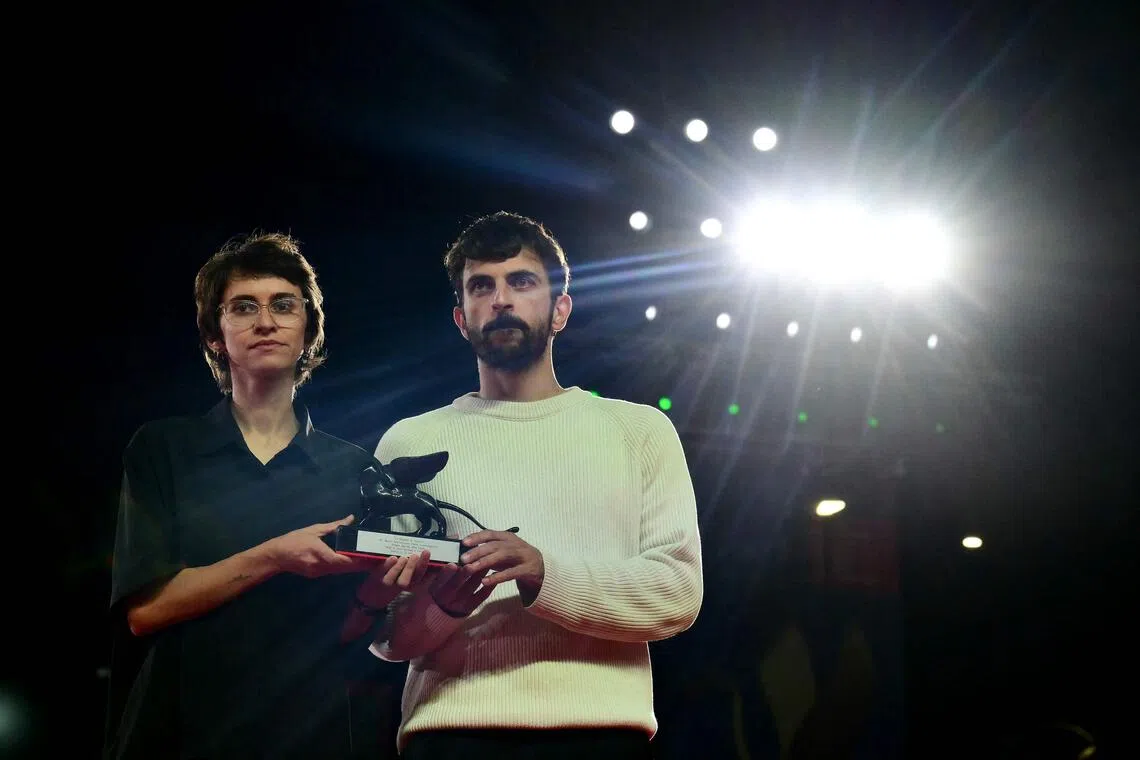
Photo via The Guardian

From ovations in Venice to death threats in Israel: the extreme responses to NAZA documentary

Read the original at The Guardian ↗
Cite

Beaumont, P. (2026, September 19). From ovations in Venice to death threats in Israel: the extreme responses to NAZA documentary. The Guardian. https://www.theguardian.com/film/2026/sep/19/ovations-venice-death-threats-israel-extreme-responses-to-naza-documentary

Dated when The Aporia collected the article, usually within hours of publication. Check the original for its exact date and byline.

The Guardian · collected 2026-09-19 · by Peter Beaumont

Quick Summary

The Guardian-produced documentary NAZA premiered at the Venice Film Festival, where it received a 25-minute standing ovation. The film, which uses Hebrew interviews with anonymous Israeli military insiders, details systems used in Israel that select targets for strikes, often resulting in civilian casualties. In Gaza, over 73,000 Palestinians have been killed. While the documentary has gained international attention and praise, it has sparked intense backlash in Israel, including death threats against the filmmakers from far-right groups and calls for new laws to punish critics by Israeli Prime Minister Benjamin Netanyahu.
Written by AI on 2026-09-19, from this article's own text only (the story summary below draws on all the coverage).
See how they differ ↓

AI analysis

Story summary

At the 2026 Venice Film Festival, "NAZA", a documentary by Israeli directors Yuval Abraham and Rachel Szor, won a special jury prize. The film, named after an Israeli military acronym for collateral damage, accuses Israel's army of intentionally targeting civilians in Gaza using AI-powered systems. It includes interviews with 24 anonymous Israeli military whistleblowers who describe systemic mass civilian killings during the war that began on October 7, 2023.

The documentary received a standing ovation and sparked intense backlash from Israeli officials. Culture Minister Miki Zohar threatened to strip Abraham and Szor of their citizenship for alleged treason, while Prime Minister Benjamin Netanyahu called it "shocking incitement." The military chief Eyal Zamir ordered a legal review to investigate the sources involved in the documentary.

The film's controversial nature highlights deep divisions within Israel over the war's conduct and raises questions about freedom of expression versus national security concerns.

Written for “Gaza Documentary Controversy Israel” on 2026-11-18, grounded in this article and the 17 other(s) covering the same event.

How they differ

12 outlets covered “Gaza Documentary Controversy Israel”.

What each outlet says

One AI summary per outlet of its latest article on this story, written from that article alone and checked against it. Open the article for the outlet's own words.

The GuardianThis outlet19 Sep

The Guardian-produced documentary NAZA premiered at the Venice Film Festival, where it received a 25-minute standing ovation. The film, which uses Hebrew interviews with anonymous Israeli military insiders, details systems used in Israel that select targets for strikes, often resulting in civilian casualties. In Gaza, over 73,000 Palestinians have been killed. While the documentary has gained international attention…

From ovations in Venice to death threats in Israel: the extreme responses to NAZA documentary (this article)2 articles from The Guardian on this story
Al Jazeera19 Sep

A new documentary called NAZA has caused significant controversy in Israel ahead of its October elections. Filmmakers Yuval Abraham and Rachel Szor have faced severe backlash for allegations already reported earlier, such as the Israeli military using AI to target buildings, leading to civilian deaths. Culture Minister Miki Zohar and Prime Minister Benjamin Netanyahu have called for legal action against the…

NAZA: Why are old Gaza allegations causing new fury in Israel? →4 articles from Al Jazeera on this story
The Straits Times16 Sep

Prime Minister Benjamin Netanyahu threatened to pass legislation revoking the citizenship and imposing heavy financial penalties on individuals who defame Israeli soldiers, specifically targeting directors Yuval Abraham and Rachel Szor of the Gaza documentary "NAZA." The film has drawn backlash in Israel for alleging that mass civilian deaths were planned into Israeli military decisions during operations in Gaza…

Netanyahu steps up threats against directors of Gaza documentary 'NAZA' →3 articles from The Straits Times on this story
Dawn13 Sep

At the Venice Film Festival, Israeli directors Yuval Abraham and Rachel Szor won a special jury prize for their documentary NAZA, which critiques Israel’s use of AI in targeting civilians in Gaza. The film, based on interviews with 24 whistleblowers from Israeli military and intelligence, received significant acclaim but missed out on the top Golden Lion award, which went to Danish director May el Toukhy's post-war…

Gaza documentary by Israeli directors wins special prize at Venice →
Deutsche Welle14 Sep

Israeli Culture Minister Miki Zohar has threatened to revoke the citizenship of filmmakers Yuval Abraham and Rachel Szor for their Venice Film Festival-winning documentary "NAZA," which details Israeli airstrikes in Gaza that killed Palestinian civilians. The minister accused the filmmakers of treason, saying they harmed their homeland to gain international approval. The film features interviews with 24 unnamed…

Israeli minister accuses 'NAZA' filmmakers of 'treason' →
CBS News14 Sep

Israel's culture minister, Miki Zohar, has called for revoking the citizenship of documentary filmmakers Yuval Abraham and Rachel Szor after their film "NAZA" won an award at the Venice International Film Festival. The documentary features interviews with Israeli military and intelligence whistleblowers who claim that AI-powered systems were used to target Palestinian civilians in Gaza. In social media posts, Zohar…

Israeli official calls for revocation of "NAZA" filmmakers' citizenship →
Show 5 more outlets
South China Morning Post14 Sep

Israeli army chief Eyal Zamir has ordered a legal review of the documentary film NAZA, which won a special prize at the Venice Film Festival. The film investigates alleged mechanisms behind Israeli warfare in Gaza through interviews with 24 former military and intelligence personnel whose identities are concealed. In response to concerns about false claims affecting soldiers' safety and state security, Zamir…

Israeli army chief orders legal review of Gaza war documentary NAZA →
BBC14 Sep

Israel's culture minister, Miki Zohar, has threatened to revoke the citizenship of Oscar-winning filmmakers Yuval Abraham and Rachel Szor over their documentary "Naza," which accuses the Israeli army of mass civilian killings in Gaza. The film, released at the Venice Film Festival last week, features interviews with 24 unidentified former Israeli military personnel who discuss advanced targeting systems used during…

Israeli minister threatens to revoke filmmakers' citizenship over Gaza documentary →
The Free Press16 Sep

Yuval Abraham and Rachel Szor's documentary NAZA premiered at the Venice International Film Festival on September 10, winning a Special Jury Prize and receiving a record-breaking 25-minute standing ovation. The film, titled after an Israeli military acronym meaning "collateral damage," alleges that Israel's targeting and authorization systems in Gaza led to unlawfully high civilian casualties, suggesting these…

Hold Your Applause for the New Gaza Documentary →
CBC16 Sep

A documentary film called NAZA, which premiered at the Venice International Film Festival and received critical acclaim, alleges that Israel’s military tactics in Gaza involve targeting civilians with AI systems designed to kill individuals in residential areas. The film features anonymous testimonies from 24 former Israeli military and intelligence personnel who claim attacks are approved regardless of civilian…

Documentary alleges Israel bombs Gaza regardless of risk to civilians →
ABC News (AU)19 Sep

Israeli filmmakers Yuval Abraham and Rachel Szor directed a documentary titled NAZA, which alleges that the Israeli army systematically killed civilians during military operations in Gaza. The film won a Special Jury Prize at the Venice International Film Festival but sparked intense criticism back home, with Prime Minister Benjamin Netanyahu threatening to revoke citizenship from those who defame IDF soldiers…

Gaza documentary sparks 'treason' uproar in Israel →

Where they agree and split

Agreed

AI · cited, from two or more outlets

  • The documentary NAZA won a special jury prize at the Venice Film Festival.14
  • Israeli officials have threatened to revoke the citizenship of the filmmakers behind 'NAZA'.25
Quoted from the coverage (3)

According to figures by Gaza officials, which are considered to be broadly reliable by the UN, more than 73,000 Palestinian people, including 20,000 children, have been killed in Israeli attacks since the operation began.

5 outlets

The revocation of nationality is legally possible in Israel, although it is rarely applied.

4 outlets

Chief of the General Staff Eyal Zamir instructed the military prosecutor to “examine and advance possible legal measures concerning the film and those involved in it”, the military posted on social media.

4 outlets

Disputed

Picked by our model, which is sometimes wrong

  • The filmmakers claim that Israeli intelligence officers described AI-powered targeting systems used to kill Palestinian civilians, while Israel's military denies deliberately targeting civilians.12
  • Culture Minister Miki Zohar accuses the filmmakers of harming their homeland for international applause, but the filmmakers argue that their work exposes systemic mass killing and dehumanization of Palestinians.21

Framing

How the first headlines put it

  • The Guardian presents a broader context of international acclaim and domestic controversy, whereas Al Jazeera emphasizes the long-standing nature of the allegations made by 'NAZA'.67
Words to watch (1)

Netanyahu says Gaza documentary 'NAZA' is 'shocking incitement' The Straits Times

The full story: what happened, how it changed, and all 18 articles →

Compared with similar articles

This article reads leans left and hedges 0% of its claims. Each row says how that neighbour differs.
ABC News (AU)
Hedges 2 of 29 claims Outlet record 67/100
The Dispatch
Hedges 0 of 4 claims Outlet record 61/100
“Article A describes the audience reaction to the NAZA documentary at the Venice film festival, while Article B discusses a study on media coverage of Israel over the last decade.”
The Free Press
Leans strongly left further left than this Hedges 5 of 12 claims Outlet record 96/100
NBC News
Outlet record 78/100
New York Post
Leans strongly right further right than this Hedges 2 of 26 claims Outlet record 66/100
“The articles describe different events, with Article A focusing on the reaction to a documentary at the Venice film festival and Article B discussing an interview with a journalist.”
CBC News
Leans left Hedges 2 of 23 claims Outlet record 60/100
“While both articles discuss reactions to the documentary NAZA, they describe different aspects and locations of the response — Article A focuses on opinions in Jerusalem about legal action against the filmmakers, while Article B describes the standing ovation at the Venice film festival.”
Al Jazeera
Leans strongly left further left than this Hedges 6 of 72 claims Outlet record 60/100
“The articles describe different aspects of a broader topic related to media coverage and public reaction to events in Gaza but do not refer to the same specific incident.”
The Straits Times
Hedges 4 of 17 claims Outlet record 64/100
“Article A discusses the Israeli minister's call for an investigation into sources of a film, while Article B describes the audience reaction to the film at the Venice Film Festival.”
CBS News
Hedges 1 of 11 claims Outlet record 67/100
“Article A reports on an Israeli official's call to revoke filmmakers' citizenship after their documentary won a prize at Venice Film Festival, while Article B describes the audience reaction and ovations for the same documentary at the film festival.”
Al Jazeera
Leans strongly right further right than this Hedges 1 of 14 claims Outlet record 60/100
“Article A discusses Israeli officials' reaction to the documentary Naza and potential legal action, while Article B describes the positive reception of the film at the Venice Film Festival.”

Story

Gaza Documentary Controversy Israel
Politics · 18 article(s) covering the same event. Compare every outlet's account →
How this article was measured signals, leaning charts, publisher record, byline, topics and claims

Signals How these are calculated →

Claims extracted
39
sentences that state something as happening or true
Uncertain
0%
0 of 39 hedged ("reportedly", "may", "according to")
Leaning
Leans left
of the writing, not the subject · beta estimate
Publisher signals
64/100
The Guardian's corrections and hedging, across everything collected from it. Not a measure of accuracy.
Outlets on this story
18
Politics
Same framing elsewhere
1
articles that frame the event the way this one does
Analyzed 2026-09-19 · how these are computed

How this is being covered How these are calculated →

Article leaning vs. publisher reliability
Source leaning vs. consistency

Publisher

The Guardian · 3642 article(s) · 8 correction(s) detected
Running correction rate · 8 correction(s)

Who wrote this

Peter Beaumont
6 article(s) here · 1 carrying a prediction
“This escalation validates our fears that the arrest and continued detention of the six Matsadaash journalists would signal a crackdown of unprecedented magnitude,” said Bahgat.
Exit polls published on Tuesday evening suggested that the opposition bloc of parties led by the former chief of staff of the Israel Defense Forces, Gadi Eisenkot, would win most seats in the Knesset by a slight margin, edging out Benjamin Netanyahu’s right and far-right coalition despite the prime minister’s Likud emerging as the largest party.
The IDF statement follows previous efforts by Israeli politicians to dismiss NAZA – a military acronym euphemistically used by Israeli intelligence to indicate the number of civilians that it expects will be killed in an airstrike – which have accompanied death threats against the film’s directors, Yuval Abraham and Rachel Szor, and calls by the country’s prime minister, Benjamin Netanyahu, for them to be stripped of their Israeli citizenship. It also echoed previous complaints by some Israeli critics – including journalists – that the film’s military sources were anonymised, despite the fact that source protection in media investigations is commonplace and regarded by much of the media as an ethical requirement.
Until May, food supplies were still getting through to residents of a city that had once been home to 24,000.
The film’s title comes from an Israeli military acronym used euphemistically to refer to the civilians expected to be killed in a military attack.
A report by the International Institute for Strategic Studies in May reached a similar conclusion: “The recent deterioration of maritime security followed a prolonged period of relative calm in the waters off the Somali coast, which resulted in the redeployment of international anti-piracy fleets and the relaxation of commercial risk-management practices.
Also by Peter Beaumont
Nothing else under this byline is closely related to this article, so these are simply their most recent.
All 6 articles by Peter Beaumont →

Topics

Gaza Guardian Israel Israeli Tel Aviv

Subjects

Israeli NORP · 9× Israel GPE · 7× Gaza GPE · 2× Netanyahu PERSON · 2× Szor PERSON · 2× Guardian ORG · 1× Palestinians NORP · 1× Rachel Szor PERSON · 1× Tel Aviv GPE · 1× Yuval Abraham PERSON · 1×

Narrative

By Wednesday, Netanyahu had decided to weigh in, announcing he would promote two bills to legislate against the “defamation” of Israeli soldiers and the state of Israel. “We will revoke citizenship for anyone who defames IDF soldiers around the world – he will be deeply hurt in his pocket.” At points, the threats of violence have been realised.
framing: assertive · carried by 1 article(s) · first seen 2026-09-19
The film’s title comes from an Israeli military acronym used euphemistically to refer to the civilians expected to be killed in a military attack.

Claims (39 extracted, 0 hedged)

Then, in the Sala Grande, the main screening hall of the Venice film festival within the Palazzo del Cinema, the audience stood almost as one and turned to applaud the film-makers for 25 minutes. asserted
audience → stand → minutes
The film the audience had watched for 80 harrowing minutes was the Gaza documentary NAZA, which has been produced by the Guardian. asserted
which → watch → Guardian
The film’s title comes from an Israeli military acronym used euphemistically to refer to the civilians expected to be killed in a military attack. asserted
title → come → attack
Unfolding against the background of Tel Aviv at night, the participants – intelligence officers and other soldiers – describe a series of systems, some powered by AI, that select the thousands who should die in strikes, often at night and surrounded by their families. asserted
who → unfold → families
Perhaps most challenging for Israel’s political elite is that it is a story told exclusively in Hebrew by 24 anonymised Israeli military insiders, many of them from elite units. asserted
is → tell → units
The documentary depicts a wide variety of viewpoints that all lead to the same conclusion: participation in a programme of mass killing where there were few boundaries between combatant and civilian, in a war where more than 73,000 Palestinians have been killed. asserted
Palestinians → depict → war
Some describe being shamed by their experience. asserted
Some → describe → experience
Others describe excitement, and a sense of “fun” as they justify their actions. asserted
they → describe → actions
It will open in US cinemas from 30 September, with international distribution plans to be announced shortly. asserted
plans → open → September
The ripples of ovation gathered in volume among the few who have seen the film before its New York premiere, but in Israel the film provoked a very different response. asserted
film → gather → response
Rightwing political figures have rushed to accuse its directors – the Oscar-winning Israeli film-makers Yuval Abraham and Rachel Szor – of “treason”. asserted
figures → rush → treason
The Israeli prime minister, Benjamin Netanyahu, who has long harboured an antipathy to critical media, declared on Wednesday he would seek new laws to strip citizenship from people who he said “smear” Israeli soldiers. asserted
he → harbour → soldiers
Demonstrators and members of far-right groups went further still, calling for violence against the pair and the demolition of their homes. asserted
Demonstrators → go → homes
Outside Szor’s parents’ house in central Israel, protesters called for the “death penalty for traitors”. asserted
protesters → call → traitors
An editorial in the left-leaning newspaper Haaretz warned that their lives were credibly endangered. asserted
lives → lean → newspaper
Dozens of human rights and peace organisations in Israel rallied to defend the film-makers, as did international press freedom organisations. asserted
organisations → rally → makers
The whiplash ferocity of the response, even in the midst of a febrile election campaign where Israeli attitudes to the war in Gaza are a central issue, has surprised even those in the Israeli leftwing and human rights community who have long been on the receiving end of such denunciations. asserted
who → surprise → denunciations
The pushback to the documentary is both a testament to its power and evidence of how the Israeli right is exploiting a film, as yet unseen by most, to craft its own version of what it says it represents. asserted
it → exploit → what
Critics in Israel seized on the longstanding idea that Israelis should not criticise their country in front of foreign audiences. asserted
Israelis → seize → audiences
Ofer Winter, a controversial former rightwing army officer turned politician, told an election rally for his People of Israel in Rishon LeZion: “An Israeli citizen, a Jew, receives thunderous applause for going out and smearing and defaming his own people. asserted
citizen → turn → people
“I understand that you are afraid to return to Israel,” he taunted the directors. asserted
he → understand → directors
You have nothing to return to. asserted
You → have → nothing
It is a disgrace and a shame to return after you spat in the faces of your own people.” asserted
you → return → people
The rightwing journalist Yehuda Schlesinger of Channel 14, a station regarded as being a mouthpiece for Netanyahu, went further still, saying Abraham and Szor should be “pursued” and “hunted”, prevented from returning to Israel, and describing the ovation in Venice as “25 minutes of antisemitic applause”. asserted
Abraham → regard → applause
By Wednesday, Netanyahu had decided to weigh in, announcing he would promote two bills to legislate against the “defamation” of Israeli soldiers and the state of Israel. “We will revoke citizenship for anyone who defames IDF soldiers around the world – he will be deeply hurt in his pocket.” At points, the threats of violence have been realised. asserted
threats → decide → violence
On Wednesday, the journalist Haggai Matar, a director of the left-leaning independent +972 Magazine and Sicha Mekomit (Local Call), where Abraham’s first reporting on the allegations appeared in collaboration with the Guardian, said their offices had been broken into by rightwing activists who had filmed the intrusion. asserted
who → lean → intrusion
“The discussion about NAZA has been a million times more prominent than the UK sanctions announcement,” said Dahlia Scheindlin, an Israeli political and polling expert who writes a column for Haaretz, adding that the right was exploiting the current inability of Israelis to see the film and make their own judgment. asserted
right → say → judgment
“While it is unseen, it can be turned into something electorally potent that at present Israelis aren’t able to demystify. asserted
Israelis → turn → present
The film has also arrived in the midst of a markedly worsening atmosphere towards dissenting views, acute since Hamas’s deadly attack on southern Israel on 7 October 2023, with the film challenging a long-held expectation that Israel’s media self-censor in times of conflict. asserted
media → arrive → conflict
As Israel has become increasingly isolated internationally over both Gaza, where an independent UN inquiry found Israel continues to commit genocide, and growing settler violence in the occupied West Bank, the film also appears to have touched a more complex nerve in Israel’s collective psyche. asserted
film → isolate → psyche
Israel’s forthcoming elections in October have acted as an accelerant for the country’s rightwing parties, whose language has become more hardline and extreme under Netanyahu’s far-right coalition. asserted
language → act → coalition
Human rights activists, critical journalists, the left more broadly and even the notion of an independent judiciary have long been presented as an enemy within by the far right, who appear to be seeking to weaponise the film against a wider community of critics of Israel and its military. asserted
who → present → Israel
The extreme response from Netanyahu and his allies has itself been condemned. asserted
itself → condemn → Netanyahu
The Yedioth Ahronoth columnist Nahum Barnea described the calls to strip the film-makers of their citizenship as “delusional”. asserted
columnist → describe → citizenship
The former editor-in-chief of the Jerusalem Post, Yaakov Katz, wrote: “Not only does such a move not make Israel look stronger, but it creates the impression that we have something to hide and are afraid of criticism. asserted
we → write → criticism
It makes it seem like we fear to stand up for our truth and what we believe in.” asserted
we → make → what
And for Haaretz’s Etan Nechin, who saw the film at a press screening in New York earlier this week, the reaction to NAZA is a symptom of a serious malaise. asserted
reaction → see → malaise
“In a healthy democracy, NAZA would be shown on the evening news, its allegations would cause a public outrage and the state would promise a thorough investigation,” he wrote. asserted
he → show → investigation
“Instead, following the film’s Venice premiere, Abraham and Szor have effectively been pushed into exile.” asserted
Abraham → follow → exile
Give feedback · no sign-in needed

No sign-in needed for now. Your note is sent without a name, so it cannot be answered.

History Support