Trump Needs to Channel His Inner George Costanza to End His Disastrous Iran War

Zeteo · collected 2026-08-24 · by Daniel DePetris commentary
Read the original at Zeteo ↗

Summary

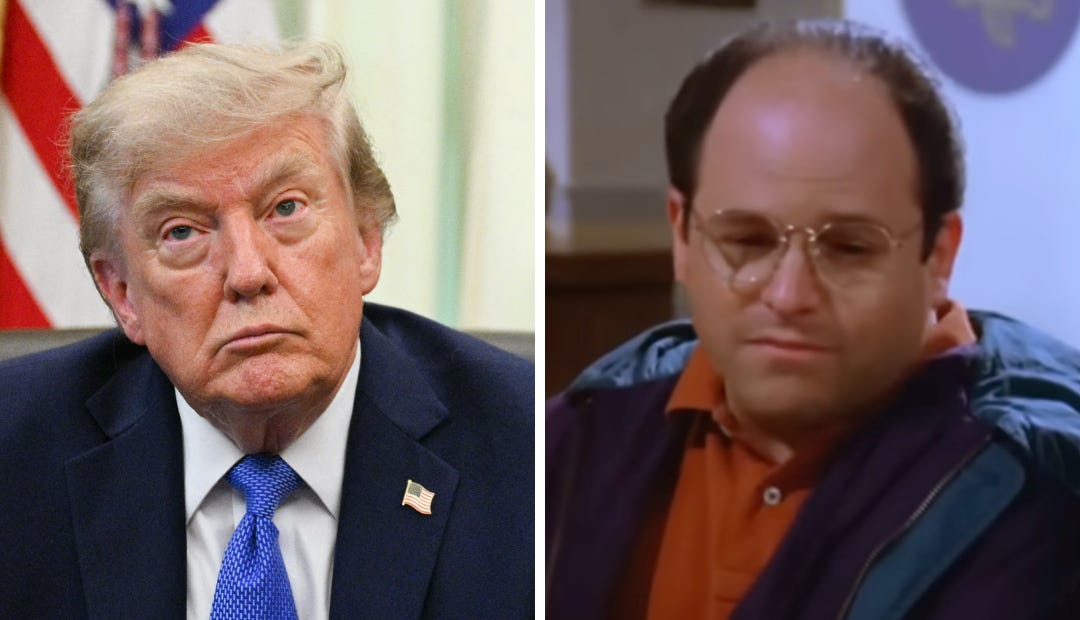
The article argues that President Donald Trump is making poor decisions regarding the US war against Iran, likening his situation to a fictional character's quote from TV show Seinfeld. It suggests that every decision Trump has made about Iran has led to unintended consequences, echoing George Costanza's admission of always being wrong. The author does not provide any specific numbers or details about the war's impact, instead focusing on a rhetorical comparison. The article is an opinion piece analyzing Trump's policy decisions and their outcomes.
Written by the local model on 2026-08-25, using this article's own text rather than the other coverage of the same event (that is the story summary below).

Signals How these are calculated →

Claims extracted
6
claim-shaped sentences
Uncertain
33%
2 of 6 hedged
Leaning
Leans strongly left
expected in commentary, which argues a position
Publisher trust
not scored
Commentary is not rated for newsroom trust
Outlets on this story
193
Politics
Narrative spread
1
articles carrying this framing
Analyzed 2026-08-25 · source text last changed 2026-08-25 · how these are computed

AI analysis (generated at analysis time, not now)

Story summary

Here are the articles grouped by topic:

Iran War

Trade Tariffs

Other

Note that some of the article summaries are quite similar, and it may be worth combining or rephrasing them to reduce duplication.

Written for “US-Iran Trade Dispute Escalation” on 2026-08-31, grounded in this article and the 192 other(s) covering the same event.
Why this leaning score
The article's own words the score was based on. Each is quoted verbatim and was checked against the article text before being stored, so you can find it in the original.
Score -0.65 Confidence high
Leaning score -0.65 for article 1939 (high confidence, 2 verified quotes) · logged 2026-08-28

Story

📰 US-Iran Trade Dispute Escalation
Politics · 193 article(s) covering the same event.

How this is being covered How these are calculated →

Article leaning vs. publisher reliability
Source leaning vs. consistency

Compared with similar articles

This article reads leans strongly left and hedges 33% of its claims. Each row says how that neighbour differs.
Washington Examiner
⚖️ Leans left further right than this 🔴 7% hedged 3 of 42 📰 publisher trust 96
“Both articles mention the US war against Iran and are dated at the exact same time.”
Mother Jones
⚖️ Leans strongly right further right than this 🔴 14% hedged 1 of 7 📰 publisher trust 95
“Article A discusses the overall US war against Iran in general terms, without mentioning any specific details or timeline, while Article B refers to a specific military operation ('Operation Epic Fury') and quotes Trump's statements on March 9, indicating they are describing related but distinct events”
The Straits Times World News
⚖️ leaning not scored 🔴 10% hedged 3 of 29 📰 publisher trust 95
“Article B does not mention any specific incident or date that matches Article A's description of a war between the US and Iran starting in February, prompting Tehran to keep the Strait of Hormuz shut”
BBC News
⚖️ leaning not scored 🔴 8% hedged 2 of 25 📰 publisher trust 96
“Article A reports on a threat made by Trump on August 20th, while Article B criticizes Trump's actions in the war against Iran that started six months prior, without mentioning a specific new event or incident”

Publisher

Zeteo · 25 article(s) · 0 correction(s) detected

Commentary. The three signals behind a trust score all measure a newsroom's record with its own reporting, so they are not computed for this source. How trust is scored.

No corrections detected for this publisher. That may mean careful reporting, or simply that nothing has been checked.

Who wrote this

Daniel DePetris
1 article(s) here · 1 carrying a prediction
🔮 While this might seem overly hyperbolic, it doesn’t take a genius to recognize that every decision Trump makes with respect to Iran has led to results he didn’t expect.
The only article under this byline in the corpus.

Topics

Iran U.S.

Subjects

Iran GPE · 2× Trump PERSON · 2× Costanza PERSON · 1× Donald Trump PERSON · 1× George Costanza’s PERSON · 1× U.S. GPE · 1×

Narrative

Nearly six months into the U.S. war against Iran, one can’t help but come to the conclusion that President Donald Trump doesn’t know what he’s doing, is completely out of his depth, or is basing his policy on incredibly flawed assumptions.
framing: mixed · carried by 1 article(s) · first seen 2026-08-24
🔮 While this might seem overly hyperbolic, it doesn’t take a genius to recognize that every decision Trump makes with respect to Iran has led to results he didn’t expect.

Claims (6 extracted, 2 hedged)

Nearly six months into the U.S. war against Iran, one can’t help but come to the conclusion that President Donald Trump doesn’t know what he’s doing, is completely out of his depth, or is basing his policy on incredibly flawed assumptions. asserted
he → help → assumptions
It brings to mind one of George Costanza’s famous quotes in ‘Seinfeld’: “Every decision I’ve ever made in my entire life has been wrong. asserted
I → bring → life
My life is the complete opposite of everything I want it to be. asserted
it → want → everything
Every instinct I have in every aspect of life, be it something to wear, something to eat, it’s all been wrong. asserted
it → have → life
While this might seem overly hyperbolic, it doesn’t take a genius to recognize that every decision Trump makes with respect to Iran has led to results he didn’t expect. uncertain
he → seem → results
Much like the depressed Costanza sitting in the coffee shop, an angry Trump may now be sitting in the Oval Office wondering where it all went wrong. uncertain
it → sit → Office
💬 Give feedback
🕘 History 🎫 Support